PARASITE · Apicomplexan protozoan
Plasmodium falciparum
Plasmodium falciparum — Thin blood smear (ring forms)
Stain: Giemsa-stained thin blood smearMorphology: Multiple delicate ring trophozoites (signet rings) within red blood cells, often with multiple infections per RBC; banana/crescent-shaped gametocytes pathognomonicYield: HIGHDifficulty: MEDIUM
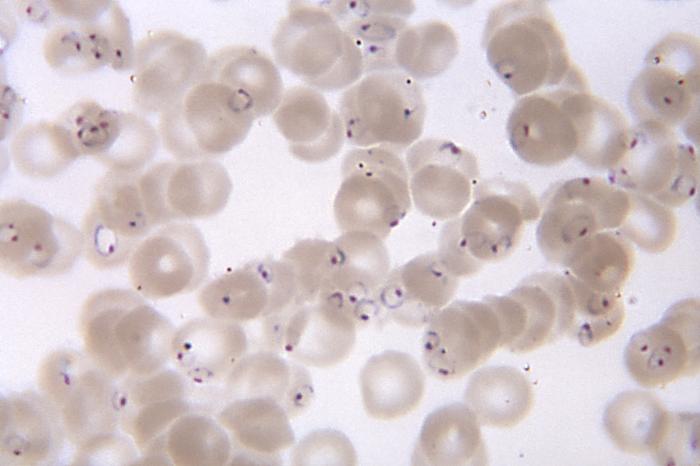
Image: Wikimedia Commons · CDC/PHIL (Public Domain)
Key facts
**Pathogenesis**: Anopheles mosquito → sporozoites → liver (NO hypnozoites unlike vivax/ovale) → merozoites → RBCs. PfEMP-1 mediates cytoadherence of infected RBCs to endothelium → microvascular sequestration → cerebral malaria. **Diagnostic clue**: Thin/thick Giemsa smear shows rings + banana-shaped gametocytes; high parasitemia (>5%) possible because P. falciparum infects RBCs of all ages. Rapid antigen detection (HRP2) available. **Virulence**: Cytoadherence (PfEMP-1), rosetting, antigenic variation.
Boards buzzwords
- banana gametocytes
- signet-ring trophozoites
- irregular fevers (malignant tertian)
- cerebral malaria
- blackwater fever
- PfEMP-1
Associated diseases
- Severe / cerebral malaria (seizures, coma)
- Blackwater fever (massive intravascular hemolysis, hemoglobinuria)
- Algid malaria (shock)
- Acute kidney injury, ARDS, hypoglycemia
Treatment
Severe → IV artesunate (drug of choice); uncomplicated → artemisinin-based combination therapy (ACT) such as artemether-lumefantrine or atovaquone-proguanil; chloroquine resistance is widespread