Thyroid Disorders: Hypo- & Hyperthyroidism
A boards-focused walk through hypo- and hyperthyroidism, built around HPT-axis feedback: screen with TSH, confirm with free T4, then localize with antibodies/RAIU and pick the next best step (including Graves, thyroiditis, thyroid storm, and myxedema coma).
The HPT axis — and why TSH reads it best
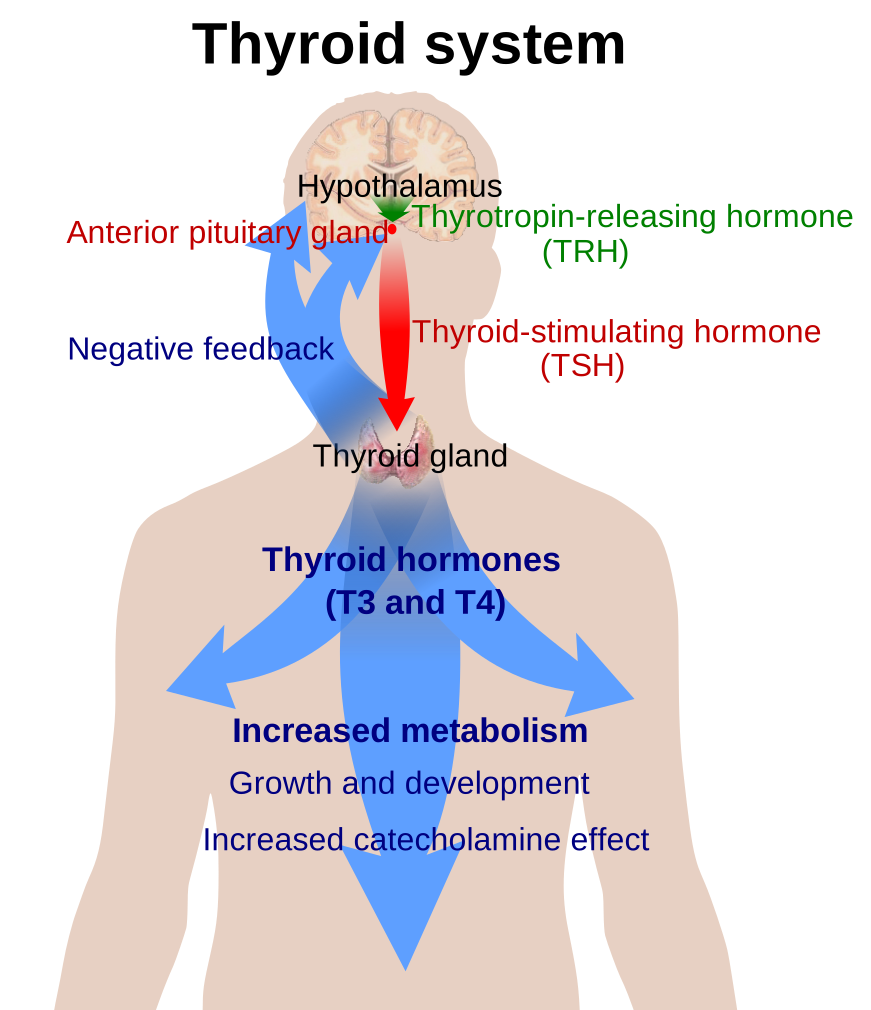
Thyroid function is governed by the hypothalamic–pituitary–thyroid (HPT) axis: hypothalamic TRH drives pituitary TSH, which stimulates the thyroid to make T4 (prohormone) and T3 (active). Peripheral deiodinases convert T4→T3, and >99% of circulating hormone is protein-bound (chiefly TBG), so free T4 reflects true status. Thyroid hormone sets basal metabolic rate — hypothyroidism slows everything down; thyrotoxicosis speeds everything up.
Feedback is the key to reading labs. In primary disease the gland itself fails or overworks, so TSH moves opposite to free T4 (↑TSH in hypo, ↓TSH in hyper). In central (secondary) disease the pituitary fails, so TSH and free T4 move together (both low). Because the pituitary is exquisitely sensitive, TSH is the single best screening test; add free T4 to confirm and to catch central disease. Boards then ask you to localize the cause — antibodies (anti-TPO, TRAb), radioactive iodine uptake (RAIU), ultrasound — and to choose the next best step.
- Primary hypothyroidism (↑TSH, ↓free T4) = ~95% of cases. #1 cause in iodine-sufficient areas is Hashimoto (anti-TPO/anti-thyroglobulin; lymphocytic infiltrate with germinal centers and Hürthle cells). Worldwide #1 cause = iodine deficiency.
- Vignette buzzwords: fatigue, cold intolerance, weight gain, constipation, dry/coarse skin, brittle hair, bradycardia, delayed ('hung-up') ankle reflexes, menorrhagia, carpal tunnel, hyperlipidemia, ↑CK, hyponatremia, macrocytic anemia.
- Myxedema = non-pitting, doughy skin from dermal GAG deposition (also periorbital puffiness, macroglossia, hoarse voice).
- Subclinical hypothyroidism: ↑TSH + normal free T4. Treat if TSH >10, symptomatic, anti-TPO positive, or pregnant/planning pregnancy.
- Treatment: oral levothyroxine (T4); recheck TSH in ~6 weeks. Start low in elderly/CAD (angina, arrhythmia risk).
- Hashimoto raises risk of thyroid (MALT) lymphoma. Untreated congenital hypothyroidism → cretinism (newborn-screened).

- Labs: ↓TSH with ↑free T4 and/or ↑T3 (T3 toxicosis). Subclinical = ↓TSH + normal free hormones.
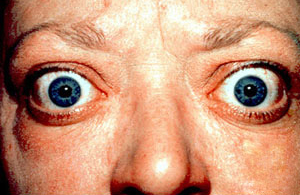
- Graves = #1 cause. TSI/TRAb stimulate the TSH receptor → diffuse goiter with bruit and diffusely ↑RAIU. Unique extrathyroidal signs (antibody-, not hormone-driven): ophthalmopathy/proptosis, pretibial myxedema, thyroid acropachy.
- Toxic multinodular goiter (older adults; iodine-induced Jod–Basedow) and toxic adenoma → focal 'hot' nodule(s), patchy/focal RAIU.
- Thyroiditis (subacute de Quervain, silent/postpartum) → hormone leak → LOW RAIU, self-limited.
- Buzzwords: weight loss with ↑appetite, heat intolerance, palpitations/AFib, fine tremor, anxiety, diarrhea, warm moist skin, lid lag/stare, hyperreflexia. Elderly → apathetic hyperthyroidism.
- Treatment: β-blocker (propranolol also blocks T4→T3) for symptoms; methimazole first-line (PTU in 1st-trimester pregnancy and thyroid storm); definitive radioiodine or surgery.
- Methimazole: teratogen (aplasia cutis), agranulocytosis (fever/sore throat → stop, check CBC). PTU: hepatotoxicity, ANCA vasculitis.
Reading the axis: lab patterns
| Condition | TSH | Free T4 | Key clue |
|---|---|---|---|
| Primary hypothyroid | ↑ | ↓ | anti-TPO (Hashimoto) |
| Subclinical hypothyroid | ↑ | normal | treat if >10 / pregnant |
| Central (2°) hypothyroid | ↓ or inappropriately normal | ↓ | other pituitary deficits |
| Primary hyperthyroid | ↓ | ↑ (or isolated ↑T3) | RAIU localizes cause |
| Subclinical hyperthyroid | ↓ | normal | AFib / osteoporosis risk |
| Sick euthyroid | normal → ↓ | normal → ↓ | ↓T3 first; acutely ill — don't test |
Stem: A 32-year-old woman has 4 months of palpitations, 5-kg weight loss despite a good appetite, heat intolerance, and tremor. Exam: diffuse, non-tender goiter with a bruit, exophthalmos, lid lag, resting tachycardia.
- Labs: ↓TSH, ↑free T4/T3.
- Diagnosis: Graves disease (TRAb/TSI positive).
- Next best step: start a β-blocker for symptoms, then methimazole. RAIU shows diffusely increased uptake — but you may skip the scan when TRAb is positive with a classic exam.
- Definitive therapy: radioactive iodine or thyroidectomy. Caution: radioiodine can worsen ophthalmopathy — pretreat/cover with glucocorticoids, especially in smokers.
Twist — thyroid storm: after infection or surgery the patient develops fever 40 °C, AFib with RVR, delirium, vomiting. Next step: ICU + propranolol → PTU → (1 h later) iodine (SSKI/Lugol) → hydrocortisone. Give the thionamide before iodine so the iodine load doesn't fuel new synthesis.
Stem: A 40-year-old woman has a painful, tender anterior neck with jaw/ear pain and palpitations, 3 weeks after an upper-respiratory illness. ESR/CRP markedly elevated; ↓TSH, ↑free T4.
- Diagnosis: subacute (de Quervain) granulomatous thyroiditis — post-viral, giant cells; classically triphasic (thyrotoxic → hypothyroid → euthyroid).
- Distinguishing test: RAIU is LOW (stored hormone leaking, not new synthesis) — the opposite of Graves.
- Management: NSAIDs (glucocorticoids if severe) + β-blocker. Do NOT give thionamides or radioiodine — there is no overactive synthesis to block.
Contrast: painless low-RAIU thyrotoxicosis = silent/postpartum thyroiditis. Factitious thyrotoxicosis (surreptitious levothyroxine) also has low RAIU but a LOW thyroglobulin, whereas thyroiditis leaks stored colloid and shows HIGH thyroglobulin — the board-favorite discriminator.
Thyrotoxicosis by RAIU (localize the cause)
| ↑ RAIU — true overproduction | ↓ RAIU — leak / exogenous / ectopic |
|---|---|
| Graves — diffuse uptake | Subacute (de Quervain) — painful, ↑ESR |
| Toxic multinodular goiter — patchy | Silent/postpartum thyroiditis — painless |
| Toxic adenoma — single hot nodule | Amiodarone / iodine excess — low uptake from iodine load |
| hCG-mediated (molar preg / choriocarcinoma) | Factitious levothyroxine — low thyroglobulin |
| Struma ovarii — pelvic uptake, low neck uptake |
- 5 B's of thyroid storm: Block synthesis (thionamide/PTU), Block release (iodine — after the thionamide), Block T4→T3 conversion (PTU, propranolol, steroids, iodinated contrast), Beta-blockade (propranolol), Block enterohepatic recycling (cholestyramine) — plus cooling and hydrocortisone.
- PTU = 'P' → Pregnancy (1st trimester) and Peripheral-conversion block (storm); methimazole everywhere else.
- Hypo = cold, dry, slow; Hyper = warm, moist, fast — sort every buzzword by 'metabolic rate up or down.'
- 'Hung-up' reflexes (delayed relaxation) = hypo; hyperreflexia = hyper.
- Jod–Basedow (iodine → hyper in nodular goiter) vs Wolff–Chaikoff (iodine load → transient hypo — the rationale for giving iodine in storm).
Special situations & next-best-step traps
Myxedema coma (decompensated hypothyroidism): hypothermia, hypoventilation with CO₂ retention, hyponatremia, hypoglycemia, and altered mental status, often precipitated by cold or infection. Next step: ICU with IV levothyroxine (± T3) plus IV hydrocortisone — cover coexisting adrenal insufficiency before/with hormone.
Pregnancy: hCG weakly stimulates the TSH receptor, so a low-normal 1st-trimester TSH is expected (gestational thyrotoxicosis is usually self-limited). Overt Graves: PTU in the 1st trimester, switch to methimazole afterward. Known hypothyroid patients need their levothyroxine dose raised ~30% early in pregnancy.
Amiodarone can cause either hypothyroidism (Wolff–Chaikoff) or hyperthyroidism (type I iodine-induced vs type II destructive). Central hypothyroidism: monitor free T4, not TSH, and give glucocorticoids before levothyroxine if adrenal insufficiency is possible (avoid precipitating adrenal crisis). Sick euthyroid: don't screen thyroid function in acutely ill inpatients — the abnormalities usually resolve.
Practice Endocrine now
Board-style questions, spaced-repetition flashcards, and a Socratic AI tutor — free to start.