TCA Cycle & Oxidative Phosphorylation
A board-focused walkthrough of the TCA cycle and oxidative phosphorylation, anchored on rate-limiting enzymes, shared cofactors, and the exact site plus clinical picture of each ETC poison and uncoupler (cyanide, CO, oligomycin, DNP, salicylates).
Big picture
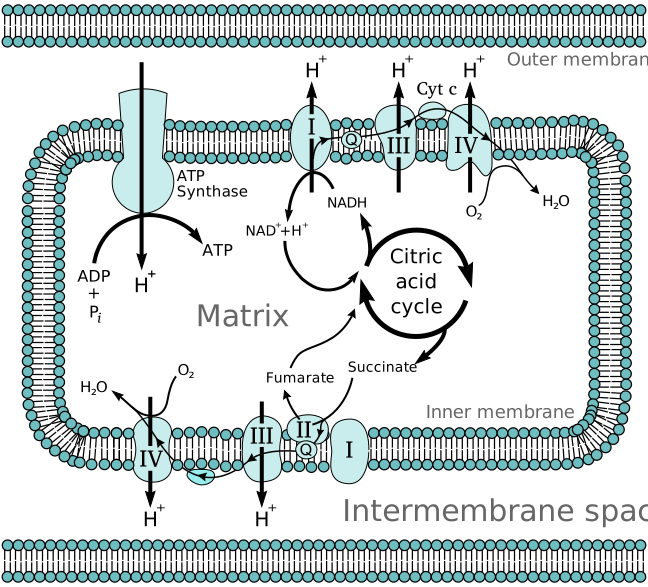
The TCA (Krebs) cycle runs in the mitochondrial matrix, oxidizing acetyl-CoA to CO2 and harvesting high-energy electrons as NADH and FADH2. These reduced carriers feed the electron transport chain (ETC) on the inner mitochondrial membrane, where electrons flow through complexes I–IV and pump protons into the intermembrane space. The resulting electrochemical (proton-motive) gradient drives ATP synthase (complex V) — this coupling of electron transport to ATP synthesis is oxidative phosphorylation (oxphos).
Boards test this pathway less on memorizing every intermediate and more on poisons and uncouplers: cyanide, CO, oligomycin, and 2,4-dinitrophenol each hit one defined step and produce a predictable clinical picture. Lock down the rate-limiting enzymes, the shared cofactors, and the site + effect of each toxin, and most questions on this topic fall out from a single logical framework.
- Location: mitochondrial matrix; aerobic (needs the ETC to regenerate NAD+/FAD)
- Rate-limiting enzyme: isocitrate dehydrogenase (inhibited by ATP/NADH, activated by ADP/Ca2+)
- Per acetyl-CoA: 3 NADH, 1 FADH2, 1 GTP, 2 CO2 released
- PDH & α-ketoglutarate dehydrogenase share 5 cofactors: thiamine (B1), lipoic acid, CoA (B5), FAD (B2), NAD (B3)
- Arsenic inhibits lipoic acid → blocks PDH & α-KGDH (garlic breath, rice-water stools, vomiting, QT prolongation; treat with dimercaprol/succimer)
- PDH deficiency: lactic acidosis + neurologic deficits from birth; feed a ketogenic diet (high fat; ↑ lysine/leucine — the only purely ketogenic amino acids)
- Succinate dehydrogenase = TCA enzyme that is also complex II of the ETC; the only membrane-bound step; uses FAD
- Feeds biosynthesis: oxaloacetate → gluconeogenesis/aspartate, α-KG → glutamate, succinyl-CoA → heme
- NADH enters at complex I; FADH2 enters at complex II (succinate dehydrogenase) — FADH2 skips complex I, so it yields less ATP
- Electron flow pumps H+ into the intermembrane space → proton-motive force → ATP synthase (complex V)
- ATP yield: ~2.5 ATP/NADH, ~1.5 ATP/FADH2 (older texts say 3 and 2)
- Electron transport inhibitors (block e- flow → proton pumping stops → ↓ATP, ↓O2 use): rotenone (I), antimycin A (III), cyanide / CO / azide / H2S (IV)
- ATP synthase inhibitor: oligomycin → protons can't flow back, gradient backs up, so electron transport AND O2 consumption fall
- Uncouplers (2,4-DNP, salicylates, thermogenin/UCP1 in brown fat): shuttle H+ across the membrane, dissipating the gradient as heat → O2 consumption ↑ but ATP ↓ → hyperthermia

Where each agent hits — and the clue
| Agent | Target | O2 use | Classic clue |
|---|---|---|---|
| Rotenone | Complex I | ↓ | Insecticide/piscicide |
| Antimycin A | Complex III | ↓ | — |
| Cyanide / CO | Complex IV | ↓ | Fire/smoke, cherry-red skin, high venous O2, lactic acidosis |
| Oligomycin | ATP synthase (V) | ↓ | Gradient backs up |
| 2,4-DNP / salicylates / UCP1 | Uncoupler (H+ leak) | ↑ | Hyperthermia, sweating, ↓ATP |
A firefighter pulled from a house fire is confused and tachypneic. Labs show a high anion-gap lactic acidosis and a paradoxically high mixed venous O2 saturation (narrowed arteriovenous O2 difference) because tissues cannot use oxygen. Skin may look cherry-red; breath can smell of bitter almonds.
Dx: cyanide poisoning — inhibits complex IV (cytochrome c oxidase), halting the ETC. Next best step: give hydroxocobalamin (binds CN- → cyanocobalamin, renally cleared) ± sodium thiosulfate. Nitrites (induce methemoglobin, which scavenges CN-) are an alternative but are risky in smoke inhalation, because concurrent CO poisoning already limits O2 delivery.
High-yield trap: prolonged sodium nitroprusside infusion is an iatrogenic cyanide source — watch for it in a hypertensive-emergency stem.
A young adult using an online "fat-burner" supplement for weight loss presents with profuse sweating, hyperthermia (>40°C), tachycardia, and agitation. Workup finds no infection and no thyroid abnormality.
Dx: 2,4-dinitrophenol (DNP) toxicity — an uncoupler that ferries protons across the inner mitochondrial membrane, so the gradient's energy is released as heat instead of making ATP. Electron transport and O2 consumption actually rise, while ATP synthesis falls. Management: supportive — aggressive cooling, IV fluids, benzodiazepines; there is no antidote.
Contrast: aspirin (salicylate) overdose also uncouples oxidative phosphorylation → fever plus the classic primary respiratory alkalosis + anion-gap metabolic acidosis mix. Physiologic uncoupling by thermogenin (UCP1) in brown fat is how neonates generate non-shivering heat.
TCA intermediates — Citrate Is Krebs' Starting Substrate For Making Oxaloacetate: Citrate → Isocitrate → α-Ketoglutarate → Succinyl-CoA → Succinate → Fumarate → Malate → Oxaloacetate
PDH / α-KGDH cofactors — Tender Loving Care For Nancy: Thiamine (B1/TPP) · Lipoic acid · CoA (B5) · FAD (B2) · NAD (B3)
Complex IV recall hook: Cyanide and Carbon monoxide (plus azide, H2S) all block Complex IV — the cyanide/CO pair classically gives cherry-red skin with high venous O2.
One framework to answer them all
Complete aerobic oxidation of one glucose yields ~30–32 ATP: glycolysis nets 2 ATP + 2 NADH, and pyruvate dehydrogenase plus the TCA cycle generate the bulk of the NADH/FADH2 that oxidative phosphorylation converts to ATP.
On exam day, reason from the lesion:
- Block the ETC (cyanide, CO, rotenone, antimycin) → electron flow and O2 use stop, gradient can't be maintained, ATP falls → lactic acidosis.
- Block ATP synthase (oligomycin) → protons back up, so electron flow and O2 consumption also fall.
- Uncouple (DNP, salicylates, brown-fat thermogenin) → gradient leaks as heat, so O2 use rises while ATP falls → hyperthermia.
That single O2-vs-ATP logic distinguishes nearly every toxin question on this topic.
Practice Biochemistry now
Board-style questions, spaced-repetition flashcards, and a Socratic AI tutor — free to start.