Environmental & Nutritional Pathology
A high-yield tour of board-favorite environmental toxins (CO, cyanide, lead, arsenic, methanol, ethylene glycol) and nutritional deficiencies (fat-soluble and B vitamins, vitamin C), emphasizing classic vignette buzzwords, mechanisms, and next-best-step antidotes and supplements.
How the Boards Test This
Environmental and nutritional pathology is tested by pattern recognition: a specific exposure or dietary clue plus a pathognomonic finding equals one diagnosis. Environmental toxins injure through defined mechanisms — carbon monoxide and cyanide cripple oxygen delivery or use, while lead blocks heme-synthesis enzymes. Nutritional deficiencies produce reproducible syndromes: night blindness (vitamin A), the Wernicke triad (B1), pellagra (B3), and scurvy (C). For each, the exam rewards three things — recognizing the buzzword, knowing the mechanism, and choosing the next best step (the antidote, the confirmatory level, or the specific supplement). This lesson pairs the classic vignette cues with the decisions examiners expect you to make.
- Carbon monoxide (fire, faulty heater): headache, cherry-red skin; PaO2 normal and pulse oximetry falsely normal, but true O2 saturation (co-oximetry) is low; delayed bilateral globus pallidus lesions. Tx: 100% O2 → hyperbaric
- Cyanide (house fires, nitroprusside): almond breath, lactic acidosis, elevated venous O2 (narrowed A-V difference from blocked cytochrome c oxidase). Tx: hydroxocobalamin ± sodium thiosulfate
- Lead: microcytic anemia + basophilic stippling, Burton lines on gingiva, wrist/foot drop, kids with pica/pre-1978 paint. Tx: succimer (mild); dimercaprol then EDTA (encephalopathy)
- Arsenic: garlic breath, profuse watery (rice-water) diarrhea, Mees lines (transverse white nail bands). Tx: dimercaprol
- Methanol: visual "snowstorm"/blindness, anion-gap acidosis. Tx: fomepizole (+ folinic acid)
- Ethylene glycol: calcium oxalate crystals, renal failure. Tx: fomepizole
Deficient in fat malabsorption — cystic fibrosis, cholestasis, celiac, short bowel:
- A (retinol): night blindness, xerophthalmia, Bitot spots, follicular hyperkeratosis. Excess → pseudotumor cerebri, teratogenic (isotretinoin)
- D: rickets in children (bowed legs, rachitic rosary), osteomalacia in adults; hypocalcemia → tetany
- E (tocopherol): hemolytic anemia + neurologic deficits (ataxia, ↓proprioception) that mimic B12 but without megaloblastic anemia or ↑methylmalonic acid
- K: neonatal/acquired bleeding, ↑PT/INR first, then ↑PTT; cofactor for factors II, VII, IX, X and proteins C & S (warfarin blocks epoxide reductase)
Vignette: A 2-year-old living in an apartment built in 1955 has irritability, developmental regression, abdominal pain, and constipation. Smear shows basophilic stippling; labs reveal microcytic anemia with normal/high ferritin (distinguishing it from iron deficiency).
Dx: Lead poisoning — inhibits ALA dehydratase and ferrochelatase, raising ALA and protoporphyrin (and impairing rRNA breakdown → stippling).
Next step: Confirm with a venous blood lead level; abdominal X-ray may show radiopaque flecks. Treat by level — remove the exposure source, succimer (oral) for moderate elevation, and dimercaprol then EDTA for encephalopathy or very high levels (start dimercaprol first so EDTA doesn't redistribute lead into the CNS).

Vignette: A malnourished man with alcohol use disorder presents with confusion, ophthalmoplegia/nystagmus, and gait ataxia — the Wernicke triad.
Dx: Thiamine (B1) deficiency; impaired glucose/energy metabolism damages the mammillary bodies.
Next step: Give IV thiamine BEFORE any glucose — a glucose load first consumes remaining thiamine and can precipitate or worsen Wernicke encephalopathy. Untreated, it progresses to often-irreversible Korsakoff syndrome (anterograde amnesia + confabulation). Also appears in hyperemesis gravidarum and post-bariatric patients — not only alcoholics.
Vignette: An elderly man living alone on a 'tea and toast' diet (or a child on a highly restricted diet) has corkscrew hairs with perifollicular hemorrhages, swollen bleeding gums, easy bruising, and poor wound healing.
Dx: Vitamin C deficiency (scurvy) — ascorbate is a cofactor for prolyl and lysyl hydroxylase; without hydroxylation of proline/lysine, collagen cannot form a stable triple helix or cross-link, so vessels and connective tissue are fragile.
Next step: Vitamin C repletion. Key discriminator: bleeding with normal PT/PTT and platelet count — this is vascular fragility, not a coagulopathy. Contrast vitamin K deficiency, where PT/INR is prolonged.
Pellagra — the 3 D's (a 4th D = Death):
- Dermatitis — photosensitive; Casal necklace around the neck
- Diarrhea
- Dementia
Cause = niacin (B3) deficiency. Remember the three roads to it: Hartnup disease (defective neutral amino-acid/tryptophan transport), carcinoid syndrome (tryptophan diverted to serotonin), and isoniazid (depletes B6, a cofactor for making niacin from tryptophan). Bonus: niacin also treats dyslipidemia — excess causes flushing (blunted by aspirin).
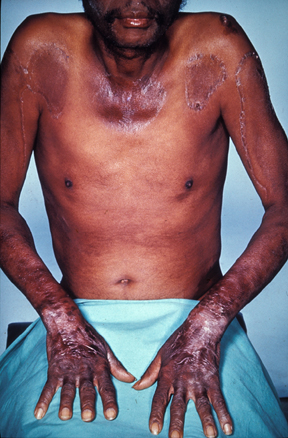
Water-Soluble B Vitamin Deficiencies
| Vitamin | Deficiency syndrome | Classic clue |
|---|---|---|
| B1 thiamine | Wernicke-Korsakoff; wet/dry beriberi | Alcoholic; give before glucose |
| B2 riboflavin | Cheilosis, corneal vascularization | Angular stomatitis, magenta tongue |
| B3 niacin | Pellagra (3 D's) | Casal necklace; Hartnup, carcinoid |
| B6 pyridoxine | Sideroblastic anemia, seizures, neuropathy | Isoniazid given without B6 |
| B9 folate | Megaloblastic anemia; neural tube defects | ↑homocysteine, normal MMA; no neuro signs |
| B12 cobalamin | Megaloblastic anemia + subacute combined degeneration | ↑homocysteine and ↑MMA; pernicious anemia |
Practice Pathology now
Board-style questions, spaced-repetition flashcards, and a Socratic AI tutor — free to start.