DNA Replication & Repair
A board-focused walk through the DNA replication fork (its enzymes and the drugs that block them) and the five DNA repair pathways, each paired with its classic inherited cancer-prone syndrome and next-best-step management.
Why the boards love this topic
DNA replication is semiconservative (each daughter duplex keeps one parental strand) and bidirectional, beginning at AT-rich origins of replication (AT-rich = fewer H-bonds, easier to melt) and moving outward along two forks. Fidelity is guaranteed by DNA polymerase 3'→5' proofreading; residual errors and environmental damage are cleaned up by dedicated repair pathways.
Step 1 tests this in two predictable ways: (1) the enzymes of the replication fork — and the drugs that block them — and (2) the repair pathway → inherited disease pairings, where one broken repair system yields a classic cancer-prone syndrome. The unifying mechanism: an unrepaired lesion becomes a fixed mutation at the next round of replication, the direct link between failed repair and malignancy.
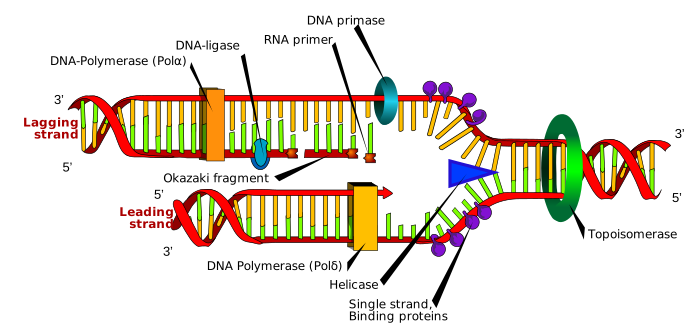
- Helicase unwinds dsDNA at the fork; single-strand binding (SSB) proteins (eukaryotic = RPA) keep strands separated
- Topoisomerase II (prokaryotic = DNA gyrase) relieves supercoils ahead of the fork by cutting and resealing DNA
- Fluoroquinolones inhibit prokaryotic topo II (gyrase) + topo IV; etoposide/teniposide block eukaryotic topo II; irinotecan/topotecan block eukaryotic topo I
- Primase lays the RNA primer; all synthesis runs 5'→3'
- DNA pol III (prokaryotes) elongates and 3'→5' exonuclease proofreads
- DNA pol I removes the RNA primer with its unique 5'→3' exonuclease, then fills the gap
- DNA ligase seals nicks between Okazaki fragments on the discontinuous lagging strand; the leading strand is continuous
- Telomerase = reverse transcriptase adding TTAGGG repeats to 3' ends; reactivated in most cancers
The five repair pathways → disease
| Pathway | Lesion repaired | Defect → disease |
|---|---|---|
| NER (nucleotide excision) | Bulky, helix-distorting — UV pyrimidine (thymidine) dimers; acts in G1 | Xeroderma pigmentosum |
| BER (base excision) | Single altered base (deamination C→U, oxidation); glycosylase → AP endonuclease | Spontaneous base damage |
| MMR (mismatch) | Replication mismatches / strand slippage; MSH2, MLH1 | Lynch syndrome / HNPCC (MSI) |
| HR (homologous recomb.) | Double-strand breaks in S/G2; BRCA1/2 | Breast/ovarian ca; Fanconi anemia (crosslinks) |
| NHEJ (end joining) | Double-strand breaks, no template; ATM = DSB sensor kinase | Ataxia-telangiectasia |
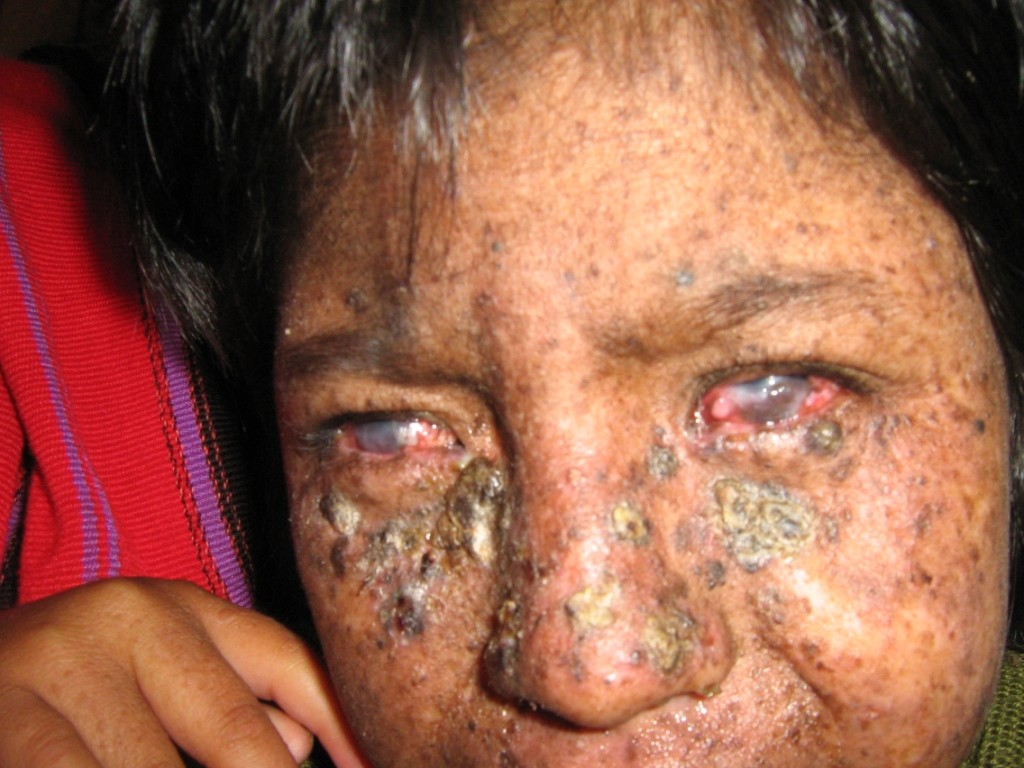
- Xeroderma pigmentosum (AR): NER defect → cannot excise UV thymidine dimers → severe photosensitivity, dry skin, early skin cancers (BCC, SCC, melanoma), photophobia and corneal damage
- Lynch syndrome / HNPCC (AD): MMR defect (MSH2, MLH1) → microsatellite instability; right-sided (proximal) colon cancer plus endometrial/ovarian; few but fast-progressing adenomas
- Ataxia-telangiectasia (AR): ATM gene → cerebellar ataxia, oculocutaneous telangiectasias, IgA deficiency (sinopulmonary infections), ↑AFP, ionizing-radiation sensitivity, lymphoma/leukemia
- Fanconi anemia (AR): interstrand-crosslink repair defect → bone marrow failure / aplastic anemia, ↑AML risk, café-au-lait spots, short stature, thumb/radial anomalies
- BRCA1/2 (AD): HR defect → breast/ovarian cancer; PARP inhibitors exploit synthetic lethality
Vignette: A 5-year-old from a consanguineous family has had dry, scaly skin and numerous freckle-like macules on sun-exposed areas since infancy, plus photophobia and corneal clouding. Exam shows actinic keratoses and a nodular basal-cell-type lesion — extraordinary at this age.
Diagnosis: Xeroderma pigmentosum — an autosomal-recessive defect in nucleotide excision repair, so UV-induced pyrimidine (thymidine) dimers cannot be removed.
Next best step: Strict lifelong UV/sun avoidance (protective clothing, broad-spectrum sunscreen, UV-blocking eyewear) with regular dermatologic and ophthalmologic surveillance for early skin cancers.
Vignette: A 46-year-old man is diagnosed with right-sided (proximal) colon adenocarcinoma. Family history reveals colorectal and endometrial cancers across three generations, several before age 50 (meets Amsterdam criteria). Tumor IHC shows loss of MLH1 with high microsatellite instability (MSI-H).
Diagnosis: Lynch syndrome (HNPCC) — an autosomal-dominant defect in DNA mismatch repair.
Next best step: Because the tumor shows isolated MLH1 loss, reflex BRAF V600E and MLH1-promoter methylation testing first, to exclude sporadic MSI-H cancer; a negative reflex with this pedigree then prompts germline MMR testing (MLH1/MSH2/MSH6/PMS2) and surveillance colonoscopy every 1–2 years plus endometrial screening. Contrast with FAP: APC mutation, hundreds of polyps, prophylactic colectomy.
Repair defect → disease:
- MMR → MSI: MisMatch Repair failure = MicroSatellite Instability = Lynch
- AT = ATM: Ataxia-Telangiectasia is the ATM gene; ATM senses double-strand breaks and is exquisitely radiation-sensitive
- XP can't eXcise: Xeroderma Pigmentosum = broken nucleotide eXcision repair of UV dimers
Replication:
- Only DNA pol I carries a 5'→3' exonuclease — so it Initially strips out the RNA primer
- "-floxacin" fluoroquinolones handcuff the prokaryotic gyrase (topoisomerase II)
Practice Biochemistry now
Board-style questions, spaced-repetition flashcards, and a Socratic AI tutor — free to start.