Valvular Heart Disease
A board-focused tour of the five tested valvular lesions — aortic stenosis/regurgitation, mitral stenosis/regurgitation, and mitral valve prolapse — linking each murmur and buzzword to its pathophysiology, echo findings, and next-best-step intervention. Includes maneuver tables, the acute-regurgitation surgical emergencies, and the crucial acute-vs-chronic AR distinction.
Framework: timing first, then localize
Valvular disease is a plumbing problem. Every lesion is either pressure overload (obstruction → concentric hypertrophy) or volume overload (regurgitation → eccentric dilation). On the boards, nail the timing before you localize:
- Systolic murmurs: aortic/pulmonic stenosis (ejection, crescendo-decrescendo) and mitral/tricuspid regurgitation (holosystolic).
- Diastolic murmurs: aortic/pulmonic regurgitation (early decrescendo) and mitral/tricuspid stenosis (mid-diastolic rumble). Diastolic and continuous murmurs are never innocent.
Two bedside rules unlock most vignettes: left-sided murmurs are loudest in expiration, and right-sided murmurs get louder with inspiration (Carvallo sign). When two lesions sound alike (AS vs HCM vs MVP), maneuvers that shift preload/afterload break the tie.
- Aortic stenosis (AS): harsh crescendo-decrescendo systolic murmur, RUSB → carotids; pulsus parvus et tardus, soft/absent S2, S4. Symptom triad = SAD (Syncope, Angina, Dyspnea).
- Bicuspid aortic valve → AS presenting in the 50s-60s; calcific/senile → 70s+. Heyde syndrome = AS + GI angiodysplasia bleeding + acquired von Willebrand (type 2A) deficiency.
- Aortic regurgitation (AR): early diastolic decrescendo at LSB, leaning forward; wide pulse pressure, water-hammer pulse, head-bobbing — these hyperdynamic signs mark chronic AR. Austin Flint rumble at apex.
- Mitral stenosis (MS): rheumatic until proven otherwise; opening snap + apical diastolic rumble, loud S1; presents with AFib, hemoptysis, dysphagia/hoarseness from LA enlargement.
- Mitral regurgitation (MR): holosystolic at apex → axilla; S3. Louder with handgrip.
- MVP: mid-systolic click + late systolic murmur; young women, myxomatous degeneration (Marfan/Ehlers-Danlos).
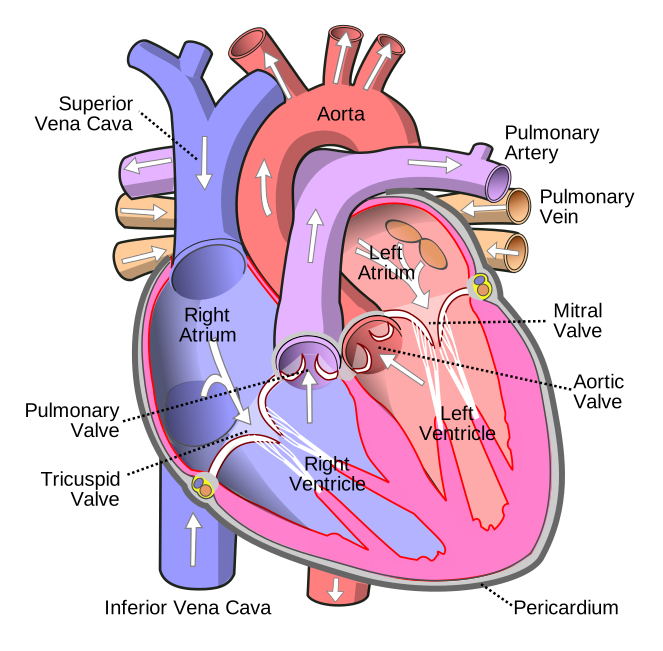
The five lesions at a glance
| Lesion | Murmur & exam | Classic cause | Management |
|---|---|---|---|
| Aortic stenosis | Crescendo-decrescendo systolic → carotids; parvus et tardus, S4 | Calcific (>70), bicuspid (younger), rheumatic | AVR / TAVR when symptomatic or LVEF <50% |
| Aortic regurgitation | Early diastolic decrescendo, LSB; wide pulse pressure (chronic) | Root dilation (Marfan), bicuspid; acute: dissection, endocarditis | Surgery (AVR) for symptoms or LV dysfunction; vasodilators only if hypertensive; acute = emergency |
| Mitral stenosis | Opening snap + diastolic rumble, loud S1 | Rheumatic heart disease | Balloon valvuloplasty; warfarin (not DOAC) for AFib |
| Mitral regurgitation | Holosystolic → axilla; S3 | MVP, ischemic (papillary rupture), endocarditis | Repair > replace; operate for symptoms/LV dysfunction |
| MVP | Mid-systolic click + late murmur | Myxomatous degeneration | Reassure; surgery only if severe MR |
Stem: A 74-year-old man reports two episodes of exertional syncope and chest tightness. Exam: a harsh crescendo-decrescendo systolic murmur at the right upper sternal border radiating to the carotids, a weak, delayed carotid upstroke (parvus et tardus), and a single soft S2.
- Diagnosis: severe aortic stenosis.
- Confirm: transthoracic echocardiography — severe = valve area <1.0 cm², mean gradient ≥40 mmHg, jet velocity ≥4 m/s.
- Next best step / definitive therapy: aortic valve replacement (SAVR or TAVR). Symptomatic severe AS mandates AVR regardless of ejection fraction.
- Trap: avoid nitrates, other vasodilators, and aggressive diuresis — a fixed obstruction makes cardiac output preload-dependent, so dropping preload precipitates hypotension and syncope.

Stem: Three to five days after an inferior STEMI, a patient develops abrupt flash pulmonary edema, hypotension, and a new holosystolic murmur. Echo shows a flail mitral leaflet.
- Diagnosis: acute mitral regurgitation from papillary muscle rupture — classically the posteromedial papillary muscle, which has a single blood supply (from the PDA/RCA territory).
- Pearl: the murmur may be soft or absent because LA and LV pressures equalize rapidly, so there is little gradient — do not be reassured by a quiet exam.
- Next best step: stabilize with afterload reduction (IV nitroprusside) ± intra-aortic balloon pump, then emergent surgical repair/replacement.
- Contrast — acute AR (aortic dissection or endocarditis): a short, soft early-diastolic murmur with tachycardia, a soft S1 (premature mitral-valve closure), and pulmonary edema/cardiogenic shock. Crucially, the wide pulse pressure and bounding peripheral signs of _chronic_ AR are ABSENT — the stiff, non-dilated LV equalizes with aortic diastolic pressure too fast. Still a surgical emergency.
- AS symptoms = SAD: Syncope, Angina, Dyspnea. Once symptomatic, survival drops sharply and valve replacement is indicated — but the letters are not a prognostic ranking: classic post-symptom survival runs angina (~5 yr) > syncope (~3 yr) > heart failure/dyspnea (~2 yr), so dyspnea/CHF carries the worst prognosis.
- Maneuver rule: almost every murmur softens when you stand / Valsalva (↓ preload) — the two exceptions, HCM and MVP, get louder (MVP click moves earlier). Squatting and handgrip reverse this.
- Handgrip (↑ afterload) increases the backward-flow murmurs — MR, AR, VSD — and decreases AS and HCM.
- Right-sided rises with Respiration (inspiration) = Carvallo sign for tricuspid regurgitation.
- Austin Flint = the AR jet striking the anterior mitral leaflet, mimicking an MS rumble at the apex.
Bedside maneuvers decoded
| Maneuver | Hemodynamic effect | Louder ↑ | Softer ↓ |
|---|---|---|---|
| Stand / Valsalva strain | ↓ preload | HCM, MVP | AS, MR, AR, most others |
| Squat / passive leg raise | ↑ preload (+afterload) | AS, MR, most | HCM, MVP |
| Handgrip | ↑ afterload | MR, AR, VSD | AS, HCM |
| Inspiration | ↑ venous return (right heart) | TR, PS, PR (right-sided) | Left-sided |
| Amyl nitrite | ↓ afterload | AS, HCM | MR, AR, VSD |
Next-best-step: when to intervene
Boards test the trigger for intervention, not the pills — most valvular disease has no mortality-improving drug, so the definitive fix is mechanical.
- Severe AS: replace (SAVR or TAVR) once symptomatic, or if asymptomatic with LVEF <50%, or when undergoing other cardiac surgery. Otherwise, serial surveillance.
- Chronic severe AR / MR: operate for symptoms or early LV dysfunction (falling EF or progressive LV dilation) — don't wait for an end-stage ventricle. For primary MR, repair beats replacement.
- Severe MS: percutaneous balloon valvuloplasty if anatomy is favorable and there is no left-atrial thrombus or significant MR.
- Rheumatic MS + AFib: anticoagulate with a VKA (warfarin) — DOACs are contraindicated here.
- New murmur + fever or emboli: get blood cultures + echocardiography for endocarditis before labeling it chronic.
- Acute severe regurgitation (dissection, papillary rupture, endocarditis) = surgical emergency.
Practice Cardiology now
Board-style questions, spaced-repetition flashcards, and a Socratic AI tutor — free to start.