Tick-Borne Illnesses (Lyme, RMSF, Ehrlichia, Babesia)
A boards-focused tour of the classic tick-borne infections — mapping vector, geography, and buzzword presentation to the next-best diagnostic and treatment step, anchored by the rule that doxycycline covers everything except Babesia.
Overview: Match the Vector to the Disease
Tick-borne illnesses cluster by season (late spring–summer), geography, and tick vector, so the exposure history is the single highest-yield clue on Step and on the wards.
The Ixodes (black-legged/deer) tick transmits a trio that can co-infect one patient: Lyme (Borrelia burgdorferi), anaplasmosis (Anaplasma phagocytophilum), and babesiosis (Babesia microti) — all concentrated in the Northeast and upper Midwest. Dermacentor (dog/wood tick) transmits Rocky Mountain spotted fever (Rickettsia rickettsii), seen paradoxically most in the Southeast/South-central US (North Carolina, Tennessee, Oklahoma, Arkansas, Missouri), not the Rockies. The Lone Star tick (Amblyomma americanum) carries Ehrlichia chaffeensis (monocytic ehrlichiosis).
Unifying board pearl: doxycycline treats nearly all of them — Lyme, RMSF, Ehrlichia, Anaplasma. The exception is Babesia, a malaria-like protozoan needing antiparasitics. When RMSF or ehrlichiosis is suspected, start doxycycline empirically — do not wait for serology.
- Organism/vector: Borrelia burgdorferi (spirochete) via Ixodes scapularis; reservoir is the white-footed mouse (deer sustain the adult tick but are not the bacterial reservoir). Tick must be attached ~36–48 h to transmit.
- Early localized: erythema migrans — expanding target/bull's-eye rash with central clearing, ~3–30 days post-bite; ± flu-like illness. Treat clinically — do NOT order serology (often negative early).
- Early disseminated: multiple EM lesions; bilateral facial (CN VII) palsy, lymphocytic meningitis; cardiac AV block/myocarditis (can be complete heart block).
- Late: mono-/oligoarticular arthritis of large joints (esp. knee).
- Diagnosis (non-EM): two-tier serology — ELISA → Western blot (or the modified two-EIA algorithm).
- Treatment: oral doxycycline (amoxicillin/cefuroxime if pregnant); IV ceftriaxone for meningitis or high-grade carditis; isolated facial palsy → oral doxycycline.
- Prophylaxis: single-dose doxycycline 200 mg if an Ixodes tick was attached ≥36 h in an endemic area, given within 72 h of removal.
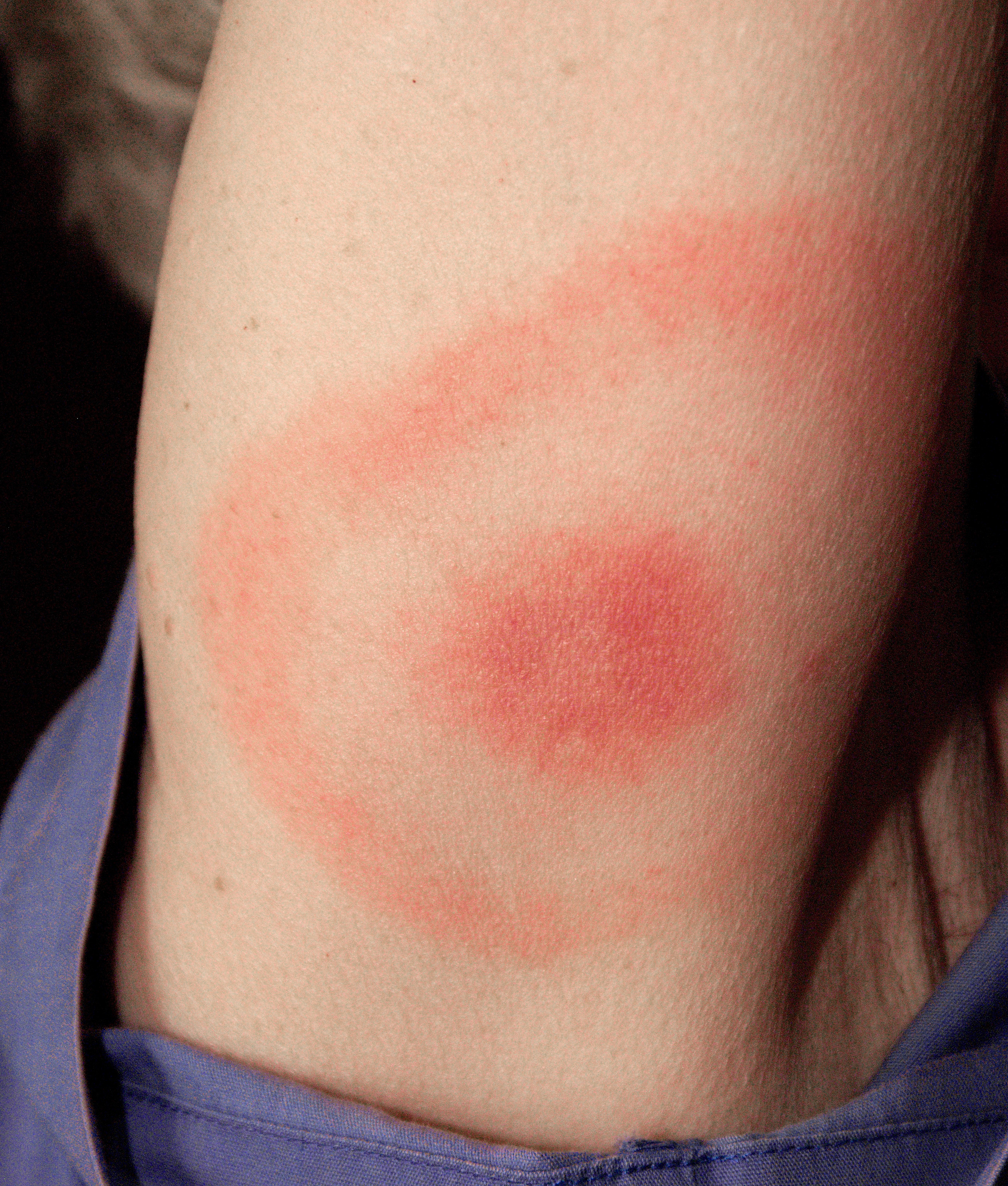
Vignette: A 24-year-old hiker in Connecticut recalls a fading "bull's-eye" rash 3 weeks ago and now has lightheadedness and near-syncope. HR 38, ECG shows third-degree (complete) AV block.
- Diagnosis: Lyme carditis (early disseminated Lyme).
- Next best step: admit with continuous cardiac monitoring and start IV ceftriaxone. High-grade AV block is usually reversible — use temporary pacing if needed rather than a permanent pacemaker.
- Contrast: isolated erythema migrans or an isolated facial palsy is managed outpatient with oral doxycycline. New bilateral facial (CN VII) palsy in an endemic area is Lyme until proven otherwise.
- Organism/vector: Rickettsia rickettsii (obligate intracellular) via Dermacentor dog/wood ticks; most US cases in the Southeast/South-central states, not the Rockies.
- Presentation: abrupt fever, severe headache, myalgia, then rash around days 3–5.
- Classic rash: macular → petechial, beginning on wrists and ankles, spreading to palms, soles, and trunk (centripetal). Rash can be absent early ("Rocky Mountain spotless fever").
- Labs (vasculitis): thrombocytopenia, hyponatremia, elevated transaminases; may progress to shock/encephalitis.
- Diagnosis: CLINICAL — treat empirically. Confirm later with indirect immunofluorescence (IFA) serology (retrospective) or skin-biopsy immunohistochemistry.
- Treatment: doxycycline for ALL ages, including young children (a short course does not stain teeth) — delay raises mortality (untreated case-fatality historically ~20–25%). Chloramphenicol is the weaker alternative and the drug traditionally considered in pregnancy.
Vignette: A 7-year-old from North Carolina has 4 days of fever and headache; today a maculopapular rash appeared on the wrists and ankles and is now reaching the palms and soles. Platelets 90k, Na 129.
- Diagnosis: Rocky Mountain spotted fever.
- Next best step: start doxycycline immediately — do not wait for confirmatory serology, and do not withhold doxycycline because of the child's age.
- Trap: delaying treatment for lab confirmation increases mortality; RMSF is the classic "treat-on-suspicion" tick illness. A palms-and-soles rash also raises secondary syphilis and coxsackie (hand-foot-mouth), but the exposure, hyponatremia, and thrombocytopenia point to RMSF.
Ehrlichiosis & anaplasmosis — the "spotless," morulae illnesses:
- *Ehrlichia chaffeensis* → monocytic ehrlichiosis; Lone Star tick; morulae in monocytes.
- *Anaplasma phagocytophilum* → granulocytic anaplasmosis; *Ixodes* (co-infects with Lyme/Babesia); morulae in neutrophils.
- Both: fever/headache/myalgia, usually no rash, with leukopenia, thrombocytopenia, ↑ transaminases. Treat: doxycycline.
Babesiosis — malaria-like protozoan:
- *Babesia microti* via *Ixodes*; also transfusion-transmitted. Asplenic, elderly, or immunocompromised patients get severe disease.
- Fever + hemolytic anemia; smear shows intraerythrocytic ring forms and the pathognomonic "Maltese cross" tetrad; no hemozoin pigment (vs malaria).
- Treat: atovaquone + azithromycin (mild–moderate); clindamycin + quinine ± RBC exchange transfusion (severe disease, e.g. parasitemia >10% or organ dysfunction).
Vignette: A 68-year-old splenectomized man who summers on Nantucket has 1 week of fevers, drenching sweats, and fatigue. Labs: hemolytic anemia (↑ LDH, ↓ haptoglobin) and thrombocytopenia; blood smear shows ring forms and a "Maltese cross" within red cells.
- Diagnosis: babesiosis — high-risk because of asplenia.
- Next best step: atovaquone + azithromycin for mild–moderate disease; for severe disease (high parasitemia, marked hemolysis, asplenia with organ dysfunction) use clindamycin + quinine and consider RBC exchange transfusion.
- Co-infection pearl: because Ixodes also carries Lyme and Anaplasma, evaluate for concurrent infection if symptoms persist despite therapy.
- RMSF rash = "wrists & ankles first, then palms, soles, and in": it spreads centripetally from the extremities toward the trunk.
- "Maltese cross" in a red cell = Babesia (ring forms like malaria, but no pigment).
- Ixodes carries "LAB": Lyme + Anaplasma + Babesia — one tick, so watch for co-infection.
- "Doxy for the ticks": doxycycline covers Lyme, RMSF, Ehrlichia, Anaplasma — Babesia is the exception (atovaquone + azithromycin).
- Morulae: Monocytes → Ehrlichia; granulocytes/neutrophils → Anaplasma.
Comparison Table (Organism · Exposure · Treatment)
| Disease | Organism | Tick / exposure | Buzzword clue | Treatment |
|---|---|---|---|---|
| Lyme | Borrelia burgdorferi | Ixodes; NE/Midwest; mouse reservoir | Erythema migrans, bilateral facial palsy, AV block, knee arthritis | Doxycycline (IV ceftriaxone for carditis/meningitis) |
| RMSF | Rickettsia rickettsii | Dermacentor; SE/South-central US | Rash wrists/ankles → palms/soles; ↓Na, ↓plt | Doxycycline (all ages) |
| Ehrlichiosis | Ehrlichia chaffeensis | Lone Star tick; SE US | Morulae in monocytes; "spotless"; leukopenia | Doxycycline |
| Anaplasmosis | Anaplasma phagocytophilum | Ixodes; NE/Midwest | Morulae in neutrophils; "spotless" | Doxycycline |
| Babesiosis | Babesia microti | Ixodes; transfusion; asplenia | Maltese cross, hemolytic anemia | Atovaquone + azithromycin (clinda + quinine if severe) |
Practice Infectious Disease now
Board-style questions, spaced-repetition flashcards, and a Socratic AI tutor — free to start.