Sexually Transmitted Infections & PID
A high-yield board review of the major STIs — chlamydia, gonorrhea, syphilis, HSV, chancroid, LGV, granuloma inguinale, and trichomoniasis — plus pelvic inflammatory disease, emphasizing buzzword-to-organism matching, comparison tables, and next-best-step management per current (2021) CDC guidelines. Covers STEP 1 pathophysiology and STEP 2 CK diagnosis and treatment decisions.
Overview: STIs → PID
Sexually transmitted infections (STIs) are dominated on boards by two organisms — Chlamydia trachomatis (serovars D–K) and Neisseria gonorrhoeae — which together cause most cases of pelvic inflammatory disease (PID). PID is an ascending, polymicrobial infection of the upper female genital tract: cervicitis progresses to endometritis, salpingitis, oophoritis, and pelvic peritonitis. The damage is immune-mediated tubal scarring, so the feared long-term sequelae are infertility, ectopic pregnancy, and chronic pelvic pain. Acute complications include tubo-ovarian abscess (TOA) and Fitz-Hugh-Curtis perihepatitis. Exam questions reward two skills: matching a buzzword (discharge, ulcer, rash) to the right organism, and knowing the next best step — which for PID is almost always to treat empirically before cultures return.
- Chlamydia trachomatis (D–K): most common reportable bacterial STI; often asymptomatic; obligate intracellular; NAAT is the diagnostic test of choice
- N. gonorrhoeae: gram-negative diplococci, purulent discharge; can seed joints/skin (DGI)
- Painful genital ulcer → HSV (grouped vesicles, multinucleated giant cells) or chancroid (H. ducreyi, "school of fish")
- Painless genital ulcer → syphilitic chancre (T. pallidum), LGV, or granuloma inguinale (Donovan bodies)
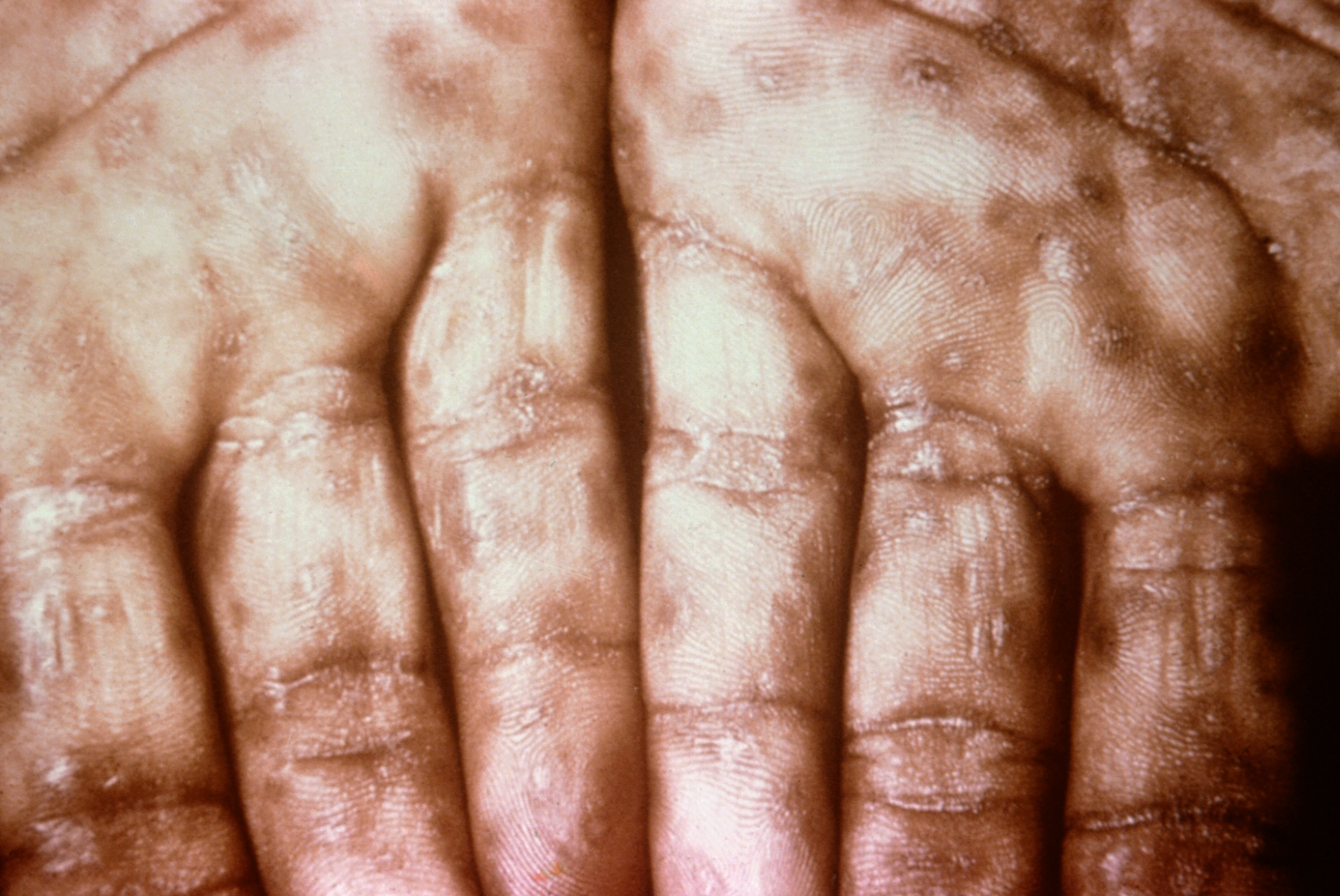
- Secondary syphilis: maculopapular rash including palms and soles + moist condylomata lata
- Trichomoniasis: motile flagellate, frothy yellow-green discharge, strawberry cervix, pH >4.5
- Reactive arthritis (post-chlamydial): "can't see, can't pee, can't climb a tree"
- Fitz-Hugh-Curtis: perihepatitis with "violin-string" adhesions (RUQ pain + PID)

Genital Ulcer Disease
| Disease | Organism | Ulcer | Lymphadenopathy | Dx clue |
|---|---|---|---|---|
| Primary syphilis | Treponema pallidum | Single, painless, indurated, clean base (chancre) | Painless, rubbery | Dark-field; RPR/VDRL → FTA-ABS |
| Chancroid | Haemophilus ducreyi | Painful, ragged, soft, purulent | Painful, suppurative buboes | "School of fish" Gram stain |
| Genital herpes | HSV-2 | Painful grouped vesicles → shallow ulcers | Tender | Multinucleated giant cells (Tzanck); PCR |
| LGV | C. trachomatis L1–L3 | Small, painless, transient | Painful buboes, groove sign | NAAT |
| Granuloma inguinale | Klebsiella granulomatis | Painless, beefy-red, bleeding | Pseudobuboes (no true nodes) | Donovan bodies |
Vignette: A 24-year-old woman with two new partners has 3 days of lower abdominal pain, deep dyspareunia, and mucopurulent discharge. Exam: cervical motion tenderness and bilateral adnexal tenderness, temp 38.1°C.
Diagnosis: Pelvic inflammatory disease (PID). Dx is clinical — CDC minimum criteria = cervical motion or uterine or adnexal tenderness in an at-risk woman with pelvic pain and no other explanation. Obtain NAAT for GC/CT, urine β-hCG, and HIV + syphilis testing; ultrasound if TOA is suspected.
Next best step: Start empiric antibiotics now — do not wait for cultures. Outpatient CDC regimen: ceftriaxone 500 mg IM ×1 + doxycycline 100 mg PO BID ×14 d + metronidazole 500 mg PO BID ×14 d. Admit for IV therapy if pregnant, TOA present, severe illness, a surgical emergency (e.g., appendicitis) can't be excluded, or failure/intolerance of oral therapy. New RUQ pain → suspect Fitz-Hugh-Curtis.
Vaginitis Comparison
| Feature | Bacterial vaginosis | Trichomoniasis | Vulvovaginal candidiasis |
|---|---|---|---|
| Organism | Gardnerella (↓ lactobacilli) | Trichomonas vaginalis | Candida albicans |
| Discharge | Thin, gray, fishy odor | Frothy, yellow-green | Thick, white, "cottage cheese" |
| Vaginal pH | >4.5 | >4.5 | Normal (≤4.5) |
| Microscopy | Clue cells | Motile flagellates | Pseudohyphae (KOH prep) |
| Whiff test | Positive | ± | Negative |
| Treatment | Metronidazole | Metronidazole (treat partner) | Fluconazole |

Vignette: A 22-year-old sexually active woman develops migratory polyarthralgia, tenosynovitis of the wrists/ankles, and scattered vesiculopustular skin lesions on the distal extremities a few days after menses. Blood cultures are frequently negative.
Diagnosis: Disseminated gonococcal infection (DGI) — the arthritis–dermatitis syndrome (triad: dermatitis + tenosynovitis + migratory polyarthralgia). The alternative presentation is a purulent monoarthritis (e.g., knee).
Next best step: Hospitalize and give ceftriaxone 1 g IV/IM q24h; obtain NAAT/culture from all mucosal sites (cervix, pharynx, rectum) plus blood and synovial fluid. Treat presumptively for chlamydia and screen for other STIs. Recurrent Neisseria infections → evaluate for terminal complement (C5–C9) deficiency.
Classic board mnemonics
- Painless vs painful ulcer: "Chancre is not; chancroid is" — the syphilitic chancre is painless, whereas chancroid (H. ducreyi) hurts ("you do cry with *ducreyi*")
- Rash on palms & soles → "CARS": Coxsackie A (hand-foot-mouth), Rocky Mountain spotted fever, Syphilis (secondary)
- Reactive arthritis (post-Chlamydia): "Can't see, can't pee, can't climb a tree" = conjunctivitis, urethritis, arthritis
- Fitz-Hugh-Curtis: "violin-string" perihepatic adhesions (RUQ pain + PID)
- Painless tropical ulcers: LGV = groove sign; granuloma inguinale = Donovan bodies
- Empiric dual coverage: ceftriaxone treats gonorrhea; add doxycycline for likely chlamydia co-infection
- Gonorrhea (uncomplicated): ceftriaxone 500 mg IM ×1 (1 g if ≥150 kg); add doxycycline if chlamydia not excluded — routine azithromycin dual therapy is no longer recommended
- Chlamydia: doxycycline 100 mg BID ×7 d; use azithromycin 1 g ×1 in pregnancy (doxycycline contraindicated)
- Syphilis: benzathine penicillin G IM; neurosyphilis → IV aqueous penicillin G; penicillin-allergic + pregnant → desensitize
- Screening: annual GC/CT NAAT in sexually active women <25; test all patients for HIV + syphilis; use expedited partner therapy
- Retest for reinfection at ~3 months; test-of-cure in pregnancy
- Do NOT routinely remove an IUD in PID — reassess response in 48–72 h
- Neonatal chlamydia (conjunctivitis/pneumonia) → oral erythromycin
Practice Reproductive now
Board-style questions, spaced-repetition flashcards, and a Socratic AI tutor — free to start.