Randomized Controlled Trials
A Step 1 high-yield lesson on randomized controlled trials covering randomization, allocation concealment, blinding levels, the evidence hierarchy, trial phases, and analysis methods, with classic vignettes on intention-to-treat and crossover designs.
What an RCT is and why it's the gold standard
A randomized controlled trial (RCT) is an experimental study in which investigators assign participants to an intervention or a control (placebo or standard of care) by randomization. It is the gold standard for showing that a treatment causes an outcome, sitting just below meta-analyses/systematic reviews of RCTs at the top of the evidence hierarchy.
Randomization tends to distribute both known and unknown confounders evenly across groups, so any difference in outcome is attributable to the intervention rather than to baseline differences. Blinding (masking) — keeping patients and/or investigators unaware of group assignment — minimizes the placebo effect and observer/measurement bias. The strongest design is the double-blind, placebo-controlled RCT.
On Step 1, the phrase 'randomly assigned' flags an RCT. Then expect questions on which bias each feature controls and how to analyze patients who drop out or switch treatments.
- Randomization balances known and unknown confounders → its core job is controlling confounding
- Allocation concealment: whoever enrolls patients cannot foresee the next assignment → prevents selection bias at entry (distinct from blinding)
- Blinding (after assignment) → reduces measurement/observer bias and the placebo effect; single = patient, double = patient + investigator, triple = + data analysts
- Intention-to-treat (ITT): analyze by the originally assigned group regardless of adherence → preserves randomization, conservative estimate
- Per-protocol: only adherent completers → can break randomization, biased toward benefit
- Evidence pyramid: meta-analysis/systematic review of RCTs > single RCT > cohort > case-control > case series
- RCTs are not always feasible or ethical — you cannot randomize a harmful exposure (e.g., smoking)
Clinical trial phases (high-yield)
| Phase | Subjects | Key question / purpose |
|---|---|---|
| Phase 1 | Small group (~20–100), usually healthy volunteers | Is it Safe? Pharmacokinetics/dynamics, max tolerated dose |
| Phase 2 | Small group of patients with the disease | Does it Work? Efficacy + optimal dosing, adverse effects |
| Phase 3 | Large number randomized (100s–1000s) | Is it better? Compare vs standard/placebo — the classic RCT |
| Phase 4 | Post-approval, general population | Postmarketing surveillance for rare/long-term harms |
Vignette: In a double-blind RCT comparing a new antihypertensive to placebo, 18% of patients assigned to the drug stop taking it because of dizziness. Investigators debate whether to exclude these non-adherent patients from the analysis.
Next best step: Use intention-to-treat (ITT) analysis — keep every patient in the group to which they were originally randomized, regardless of adherence or crossover.
Why: ITT preserves the prognostic balance created by randomization, avoids attrition/selection bias, and yields a conservative, real-world effectiveness estimate. Excluding dropouts (a per-protocol approach) would break randomization and bias results toward the drug.
Buzzword: 'analyzed according to the group to which they were assigned' = ITT.
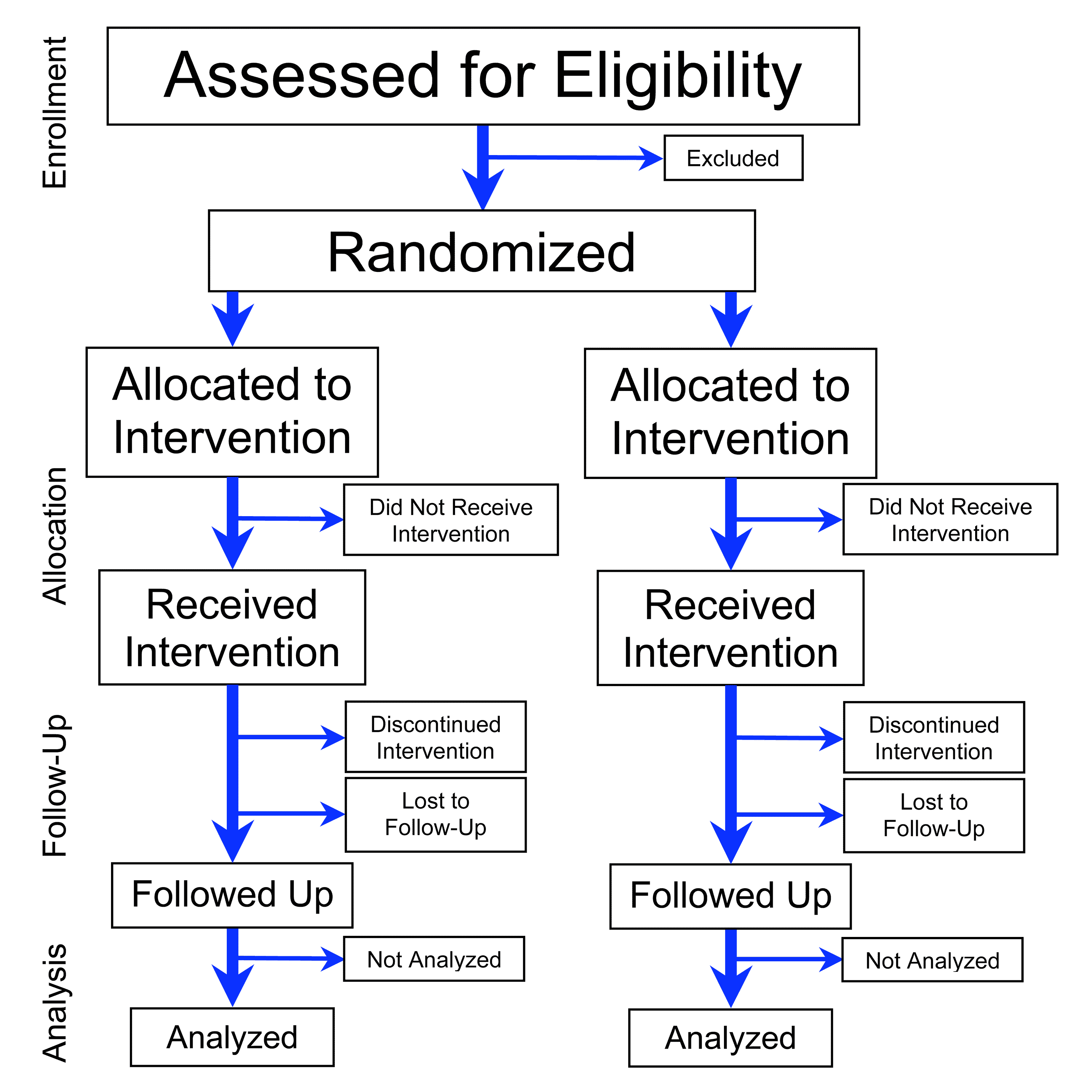
Vignette: To test a drug for chronic stable angina, each participant receives drug A for 6 weeks, then after a washout period receives placebo for 6 weeks; the order is randomized.
Diagnosis of design: This is a crossover trial — each patient serves as their own control, which reduces inter-individual variability and confounding and requires fewer subjects.
Key detail: The washout period prevents a carryover effect from the first treatment. Crossover suits chronic, stable conditions with short-acting, reversible treatments; it is inappropriate for curable or rapidly progressive disease (once a patient is cured, they cannot cross back).
Buzzword: 'each subject received both treatments in random sequence.'
Clinical trial phases = 'SWIM':
- S = Safety → Phase 1 (usually healthy volunteers)
- W = Works (efficacy) → Phase 2 (patients with the disease)
- I = Improvement (is it better than standard?) → Phase 3 (large RCT vs comparator)
- M = Marketing (postmarketing surveillance) → Phase 4
Subject numbers grow as you move S → W → I → M.
ITT vs per-protocol analysis
| Feature | Intention-to-treat (ITT) | Per-protocol |
|---|---|---|
| Who is analyzed | All, as originally randomized | Only adherent completers |
| Randomization | Preserved | Can be broken |
| What it estimates | Real-world effectiveness (conservative) | Biological efficacy (biased toward benefit) |
| Board's default answer | Yes — usually correct | Supplementary only |
Practice Research Methods now
Board-style questions, spaced-repetition flashcards, and a Socratic AI tutor — free to start.