Psychological Testing & Intelligence
A board-focused walkthrough of psychological testing: recognizing intelligence, achievement, and personality (objective vs projective) tests, reading IQ against the normal curve (mean 100, SD 15), the DSM-5 criteria for intellectual disability, and the reliability-versus-validity distinction.
Overview: What the Boards Actually Ask
Psychological tests fall into three families the boards want you to recognize on sight. Intelligence tests measure reasoning and problem-solving as an IQ, standardized to a mean of 100 and standard deviation (SD) of 15. Achievement/aptitude tests measure knowledge or skills (achievement = already learned; aptitude = predicts future performance). Personality tests split into objective (standardized, scored, e.g., MMPI-2) versus projective (ambiguous stimuli meant to reveal unconscious content, e.g., Rorschach).
Step 1 rarely asks you to administer a test. Instead it tests: (1) matching a described test to its category, (2) interpreting an IQ against the normal curve, (3) the DSM-5 criteria for intellectual disability, and (4) distinguishing reliability from validity. Master those four and you own the topic.
- IQ classically = (mental age / chronological age) x 100; modern tests are standardized to mean 100, SD 15
- Normal distribution: ~68% within 1 SD (85-115), ~95% within 2 SD (70-130)
- Wechsler scales are most used: WAIS (adults 16-90), WISC (children 6-16), WPPSI (preschool ~2.5-7)
- Stanford-Binet = the classic test spanning a wide age range (early childhood through adulthood)
- IQ is relatively stable after early childhood and one of the strongest single predictors of academic and job performance
- Fluid intelligence (reasoning through novel problems) declines with age, as does processing speed; crystallized intelligence (accumulated knowledge, vocabulary) is preserved or rises
- Flynn effect: population IQ scores drift upward across generations, so tests are periodically renormed
- Score ~2 SD below mean (≤70) flags possible intellectual disability but is not sufficient alone
Test Categories at a Glance
| Category | What it measures | Classic examples |
|---|---|---|
| Intelligence | Reasoning, problem-solving (IQ) | WAIS (adults), WISC (children), Stanford-Binet |
| Achievement | Knowledge/skills already learned | WRAT, Woodcock-Johnson |
| Objective personality | Traits via standardized, scored items | MMPI-2 (567 true/false items; validity scales) |
| Projective personality | Unconscious processes via ambiguous stimuli | Rorschach inkblots, TAT (Thematic Apperception Test), sentence completion |
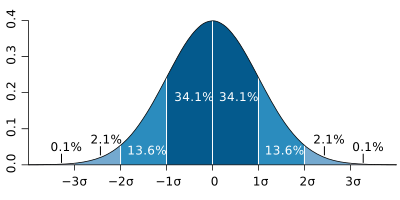
Vignette: A 6-year-old has delayed motor and language milestones and is failing to keep up in first grade. Standardized testing shows an IQ of 60. He cannot dress or feed himself age-appropriately and has limited communication and social skills.
Diagnosis: Intellectual disability (DSM-5). Requires all three: (1) deficits in intellectual functions confirmed by clinical assessment and standardized IQ testing (roughly ≤70, allowing for a ~±5-point measurement error, so ~65-75), (2) deficits in adaptive functioning across conceptual, social, and practical domains, and (3) onset during the developmental period.
Next best step: Formally quantify adaptive functioning with a standardized instrument (e.g., Vineland Adaptive Behavior Scales) — this both confirms criterion B and sets severity, which in DSM-5 is graded by adaptive functioning, not the IQ number.
Classic distractor: Diagnosing intellectual disability on a low IQ alone. Without adaptive-functioning deficits and developmental onset, the criteria are not met — and a score just above 70 can still qualify if adaptive deficits are severe.
Vignette A: During a forensic evaluation a patient is shown a series of symmetric inkblots and asked to describe what each looks like. → Rorschach test, a projective measure used to explore unconscious processes and screen for thought disorder.
Vignette B: A patient in a disability/malingering evaluation completes a 567-item true/false questionnaire that includes validity scales (L, F, K) designed to detect over- or under-reporting of symptoms. → MMPI-2, the most widely used objective personality test.
Next-step logic: Choose an objective test (MMPI-2) when you need standardized, quantifiable, validity-checked data — e.g., suspected malingering or a disability determination. Choose a projective test when probing unconscious conflicts or personality structure.
Reliability vs Validity
| Concept | Meaning | Analogy | Common types |
|---|---|---|---|
| Reliability | Consistency / reproducibility of results | Precision (tight grouping) | Test-retest, inter-rater, internal consistency |
| Validity | Measures what it is intended to measure | Accuracy (on target) | Content, construct, criterion (predictive/concurrent) |

- Intellectual disability: DSM-5 severity (mild/moderate/severe/profound) is set by adaptive functioning, not the IQ cutoff
- ~85% of intellectual disability is mild; many can achieve semi-independent living with support
- MMPI-2 = objective (has validity scales); Rorschach and TAT = projective — do not mix these up
- Achievement = what you already know; aptitude = future potential; intelligence = general reasoning
- Reliable ≠ valid — the single most tested measurement concept in this topic
- Fluid intelligence falls with age; crystallized is preserved — explains why older adults keep vocabulary/knowledge
- A low IQ alone never diagnoses intellectual disability — always look for adaptive deficits + developmental onset
Practice Behavioral Science now
Board-style questions, spaced-repetition flashcards, and a Socratic AI tutor — free to start.