Protozoa & Parasites
A high-yield Step 1 tour of medically important protozoa and helminths, organized by exposure/vector, pathognomonic buzzword, and first-line drug, with comparison tables and classic vignettes (amebic liver abscess, neurocysticercosis).
Framework: exposure → buzzword → drug
Parasites reward pattern-matching: each links a vector/exposure → pathognomonic finding → drug. Split them into two buckets.
Protozoa are single-celled — organize by niche: blood/tissue (Plasmodium, Babesia, Trypanosoma, Leishmania), luminal GI (Giardia, Entamoeba, Cryptosporidium), and CNS/STI/tissue (Toxoplasma, Naegleria, Trichomonas).
Helminths are multicellular worms in three classes: nematodes (roundworms — pinworm, Ascaris, hookworm, Strongyloides, Trichinella, filariae), cestodes (flat, segmented tapeworms — Taenia, Diphyllobothrium, Echinococcus), and trematodes (leaf-shaped flukes — Schistosoma, Clonorchis, Paragonimus).
High-yield hooks: eosinophilia flags tissue-invasive helminths, not luminal protozoa; most flukes and tapeworms → praziquantel; most intestinal roundworms → a -bendazole. Learn the exposure and the buzzword, and diagnosis plus treatment follow.
- Plasmodium (Anopheles mosquito): cyclic fever; vivax/ovale → hypnozoites, relapse (add primaquine, first check G6PD); falciparum → irregular fever, cerebral malaria, blackwater fever
- Babesia (Ixodes tick, NE US): Maltese-cross tetrad, no pigment; severe if asplenic → atovaquone + azithromycin (clindamycin + quinine if severe)
- T. cruzi (reduviid "kissing" bug feces): Chagas — dilated cardiomyopathy, megacolon/megaesophagus → nifurtimox / benznidazole
- T. brucei (tsetse fly): sleeping sickness, Winterbottom posterior-cervical nodes → suramin (blood) / melarsoprol (CNS)
- Leishmania donovani (sandfly): visceral kala-azar — hepatosplenomegaly, pancytopenia; amastigotes in macrophages → amphotericin B / stibogluconate
- Naegleria fowleri (warm freshwater → up the nose via cribriform plate): rapidly fatal meningoencephalitis → amphotericin B

Luminal, CNS & STI protozoa
| Organism | Exposure / Vector | Disease & Buzzword | Treatment |
|---|---|---|---|
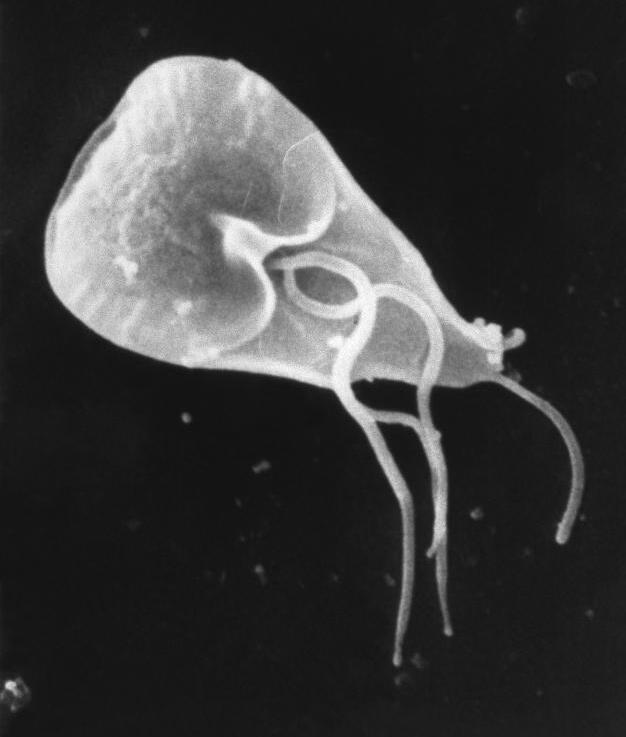
| Giardia lamblia | Freshwater cysts (campers, daycare, IgA deficiency) | Fatty, foul, non-bloody diarrhea; "falling-leaf" trophozoite | Metronidazole |
| Entamoeba histolytica | Fecal-oral cysts | Bloody dysentery, flask-shaped ulcers, RUQ anchovy-paste liver abscess | Metronidazole + paromomycin (luminal) |
| Cryptosporidium | Water oocysts | Watery diarrhea in AIDS; acid-fast oocysts | Nitazoxanide; HAART |
| Trichomonas vaginalis | STI | Green frothy discharge, strawberry cervix, motile; pH >4.5 | Metronidazole (treat partner) |
| Toxoplasma gondii | Cat feces / undercooked meat | AIDS ring-enhancing brain lesions; congenital triad | Sulfadiazine + pyrimethamine |
A 34-year-old man returns from rural Mexico with 2 weeks of fever, RUQ pain, and tender hepatomegaly; he recalls bloody diarrhea a month ago. CT shows a single right-lobe cystic lesion; aspiration would yield "anchovy-paste" fluid. Stool antigen and serology are positive.
Dx: Amebic liver abscess — Entamoeba histolytica.
Next step: Metronidazole for the tissue phase, followed by a luminal agent (paromomycin or iodoquinol) to clear residual colonic cysts and prevent relapse. Unlike a pyogenic abscess, drainage is usually not required.
Contrast: An Echinococcus hydatid cyst (dog feces, eggshell calcification) must not be aspirated blindly — spillage triggers anaphylaxis; treat with albendazole plus careful surgery.
Helminths across all three classes
| Worm (class) | Exposure | Disease & Buzzword | Treatment |
|---|---|---|---|
| Enterobius (nematode) | Fecal-oral eggs | Nocturnal perianal itch; tape test | Pyrantel / albendazole |
| Hookworm — Necator/Ancylostoma (nematode) | Larvae penetrate skin (soil) | Iron-deficiency (microcytic) anemia | Albendazole |
| Strongyloides (nematode) | Skin penetration | Autoinfection; hyperinfection if immunosuppressed | Ivermectin |
| Trichinella spiralis (nematode) | Undercooked pork | Myalgia, periorbital edema, eosinophilia | Albendazole |
| Taenia solium (cestode) | Pork; eggs → tissue | Neurocysticercosis | Praziquantel; albendazole (CNS) |
| Diphyllobothrium latum (cestode) | Raw fish | B12 deficiency (megaloblastic anemia) | Praziquantel |
| Echinococcus granulosus (cestode) | Dog feces (sheep host) | Liver hydatid cyst; anaphylaxis if ruptured | Albendazole + surgery |
| Schistosoma (trematode) | Snail; freshwater cercariae | Portal HTN (mansoni); hematuria → bladder SCC (haematobium) | Praziquantel |
- Ascaris lumbricoides (fecal-oral eggs): intestinal/biliary obstruction, Löffler lung-migration phase → albendazole
- Onchocerca volvulus (blackfly): river blindness, dermatitis, subcutaneous nodules → ivermectin (DEC contraindicated — worsens eye disease)
- Loa loa (deer/mango fly, Chrysops): Calabar swellings, worm crossing the conjunctiva → diethylcarbamazine (DEC)
- Wuchereria bancrofti (mosquito): lymphatic filariasis → elephantiasis → DEC
- Paragonimus westermani (undercooked crab/crayfish): hemoptysis, lung disease → praziquantel
- Clonorchis sinensis (undercooked fish): biliary obstruction, pigmented stones, cholangiocarcinoma → praziquantel
- Drug rule: intestinal roundworms → -bendazoles; Strongyloides & Onchocerca → ivermectin; flukes/tapeworms → praziquantel; Loa loa/Wuchereria → DEC
- IVERmectin cures rIVER blindness (Onchocerca volvulus, blackfly) — the gold-standard hook.
- Praziquantel for the flat worms — flukes + tapeworms.
- Broad fish tapeworm *Diphyllobothrium* steals your B12.
- Babesia = Maltese cross, no pigment; Plasmodium = ring + brown pigment — how to tell them apart on a smear.
- Naegleria fowleri = the "brain-eating amoeba" (warm freshwater, enters via the nose).
- Trypanosoma cruzi — the kissing bug kisses your face; think Chagas cardiomyopathy + megacolon.
A 28-year-old from a rural Latin-American village presents with a first-time generalized seizure and no fever. Non-contrast CT shows multiple small calcified cysts; MRI shows cystic lesions, some containing a scolex ("hole-with-a-dot" sign).
Dx: Neurocysticercosis — tissue larvae of Taenia solium, acquired by ingesting eggs (fecal-oral), not the adult pork tapeworm.
Next step: Control seizures with antiepileptics. For viable cysts, give albendazole (± praziquantel) plus corticosteroids — steroids blunt the inflammatory surge as larvae die. Obtain a funduscopic/ophthalmologic exam first: treating ocular cysts can cause vision-threatening inflammation. Purely calcified (dead) lesions often need no antiparasitic.
Practice Microbiology now
Board-style questions, spaced-repetition flashcards, and a Socratic AI tutor — free to start.