Pharmacokinetics & Pharmacodynamics
A high-yield Step 1 walkthrough of pharmacokinetics (Vd, clearance, half-life, loading vs maintenance dosing, zero- vs first-order elimination) and pharmacodynamics (potency vs efficacy, agonists, competitive vs noncompetitive antagonists, therapeutic index). Formulas and dose-response curve shapes are anchored with worked vignettes and classic exam associations.
PK vs PD: two questions
Pharmacokinetics (PK) asks what the body does to the drug — Absorption, Distribution, Metabolism, Elimination. Pharmacodynamics (PD) asks what the drug does to the body — receptor binding and the dose–response relationship.
- Absorption: bioavailability (F) = fraction of an administered dose reaching systemic circulation unchanged. IV F = 1; oral F < 1 due to incomplete absorption and first-pass metabolism (gut wall + liver).
- Distribution: where the drug goes → volume of distribution (Vd).
- Metabolism: Phase I (CYP450 oxidation/reduction/hydrolysis → slightly polar, often still active metabolites) usually precedes Phase II (conjugation — glucuronidation, acetylation, sulfation → very polar, usually inactive, renally excreted). Geriatric patients lose phase I first.
- Elimination: renal and hepatic.
Boards test the quantitative core of PK (Vd, clearance, half-life, loading vs maintenance dose) and the graphical core of PD (potency vs efficacy, agonists, antagonists). Learn the formulas and curve shapes and most items become plug-and-chug.

- Vd = amount of drug in body ÷ plasma concentration. Low Vd (~3–5 L) → drug trapped in plasma (large/charged, protein-bound); high Vd (can exceed total body water, ~42 L) → drug in tissues (small, lipophilic).
- Clearance CL = rate of elimination ÷ plasma concentration = Vd × ke.
- Half-life t½ = (0.693 × Vd) ÷ CL (first-order). Reach ~94% of steady state in 4 half-lives, ~97% in 5.
- Loading dose = (target Cp × Vd) ÷ F → depends on Vd, so unchanged in renal/hepatic failure.
- Maintenance dose = (target Cp × CL) ÷ F → depends on CL, so decreased in renal/hepatic failure.
- Time to steady state depends only on half-life — not on dose or dosing frequency. A loading dose reaches the target level faster but does not change the time to steady state of the maintenance regimen.
Zero-order vs first-order elimination
| Feature | First-order | Zero-order |
|---|---|---|
| Rate eliminated | Constant fraction/time | Constant amount/time |
| Rate vs [drug] | ∝ concentration | Independent of concentration |
| Enzymes/transport | Not saturated | Saturated (capacity-limited) |
| [Drug] vs time plot | Exponential; linear on a log scale | Linear on a linear scale |
| Half-life | Constant | Varies (not constant) |
| Examples | Most drugs | Phenytoin, ethanol, aspirin (high dose) |

Zero-order (capacity-limited) elimination — PEA:
- Phenytoin
- Ethanol
- Aspirin / salicylates (at high, toxic doses)
Once metabolizing enzymes are saturated, a constant amount is cleared per unit time regardless of plasma level. Clinical upshot: small dose increases can cause disproportionate — even toxic — jumps in plasma concentration, the classic teaching point for phenytoin.
A drug has Vd = 40 L, target steady-state plasma concentration 3 mg/L, and oral bioavailability F = 0.5. Therapy must start quickly.
- Loading dose = (Cp × Vd) ÷ F = (3 mg/L × 40 L) ÷ 0.5 = 240 mg.
- The same patient now has renal failure. Do you change the loading dose? No. Loading dose depends on Vd (usually unchanged); you instead lower the maintenance dose because clearance falls.
Answer: 240 mg loading dose; reduce the maintenance (not loading) dose in renal impairment. Concept: the loading dose fills the volume of distribution, while the maintenance dose replaces what is cleared.
- Potency = dose needed for a given effect (EC50); a left-shifted curve = more potent. Efficacy = maximal achievable effect (Emax); a higher plateau = more efficacious. They are independent.
- Full agonist: maximal Emax. Partial agonist: lower Emax (lower efficacy) even at full receptor occupancy, and acts as a functional antagonist when a full agonist is present.
- Competitive (reversible) antagonist: shifts curve right, ↓potency (↑EC50), Emax unchanged, surmountable with more agonist.
- Noncompetitive / irreversible antagonist: ↓Emax (↓efficacy), insurmountable, curve shifts down.
- Therapeutic index TI = TD50 ÷ ED50 (LD50/ED50 in animals); higher = safer. Narrow-TI drugs needing monitoring: warfarin, digoxin, lithium, theophylline.
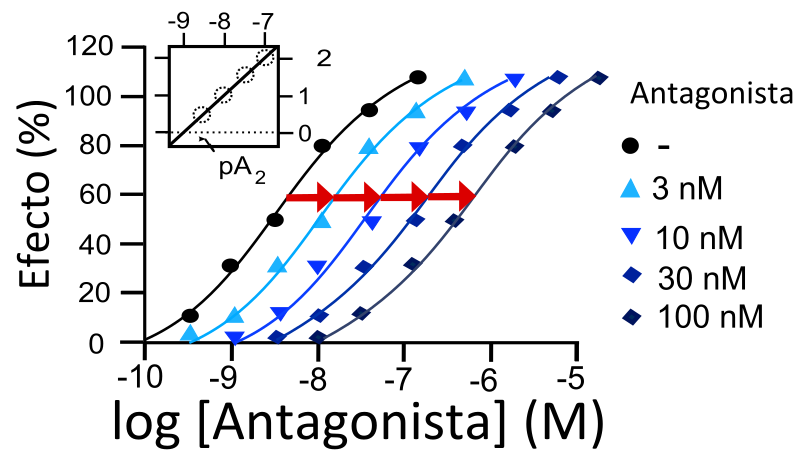
Competitive vs noncompetitive antagonist
| Feature | Competitive | Noncompetitive / irreversible |
|---|---|---|
| Binds | Same (orthosteric) site, reversibly | Different site, or same site irreversibly |
| Potency | ↓ (curve shifts right, ↑EC50) | Unchanged |
| Efficacy (Emax) | Unchanged | ↓ (curve shifts down) |
| Surmountable by ↑agonist? | Yes | No |
| Examples | Naloxone; phentolamine | Phenoxybenzamine; ketamine (NMDA) |
A patient with a catecholamine-secreting pheochromocytoma is scheduled for surgery. Manipulating the tumor releases a surge of catecholamines; you need α-blockade that a flood of endogenous agonist cannot overwhelm.
- Best choice: phenoxybenzamine — an irreversible, noncompetitive α-antagonist. Its covalent binding means even massive norepinephrine release cannot surmount the blockade (↓Emax).
- A competitive α-blocker (e.g., phentolamine) could be overwhelmed — a large enough agonist surge shifts the response back up.
Answer: Phenoxybenzamine, for insurmountable blockade. Always give α-blockade before β-blockade to avoid unopposed α-mediated vasoconstriction and hypertensive crisis.
Practice Pharmacology now
Board-style questions, spaced-repetition flashcards, and a Socratic AI tutor — free to start.