Organ Donation & Determination of Death
A Step 2 CK ethics lesson on determination of death (UDDA, brain-death criteria and apnea testing) and organ-donation ethics (dead donor rule, OPO-driven consent, DBD vs DCD), built around board-style next-best-step decisions.
Two Ways to Be Declared Dead
Death in the US is defined by the Uniform Determination of Death Act (UDDA): a person is legally dead when there is either (1) irreversible cessation of circulatory and respiratory function, or (2) irreversible cessation of all functions of the entire brain, including the brainstem (brain death). Brain death is a clinical diagnosis and is legally equivalent to cardiopulmonary death—the ventilator maintains oxygenation and circulation, but the patient is already dead. Time of death is documented when criteria are met, not when the ventilator is withdrawn. This underlies organ donation, which follows the dead donor rule: the donor must be declared dead first, and procurement itself must never cause or hasten death.
- Prerequisite: a known, irreversible cause of catastrophic brain injury (massive ICH, severe TBI, anoxic injury after cardiac arrest)
- Exclude reversible mimics FIRST: hypothermia (warm to core temp ≥36°C), sedatives/CNS depressants, neuromuscular blockers, severe metabolic/endocrine/acid–base derangement; keep SBP ≥100 mm Hg
- Coma (no response to noxious stimuli) + absent ALL brainstem reflexes: pupillary, corneal, oculocephalic (doll's eyes), oculovestibular (cold caloric), gag, cough
- Apnea test (definitive clinical confirmation): no spontaneous respiratory effort despite PaCO₂ ≥60 mm Hg (or ≥20 above baseline)
- Spinal reflexes (deep tendon reflexes, triple flexion, Lazarus sign) may persist and do NOT exclude brain death
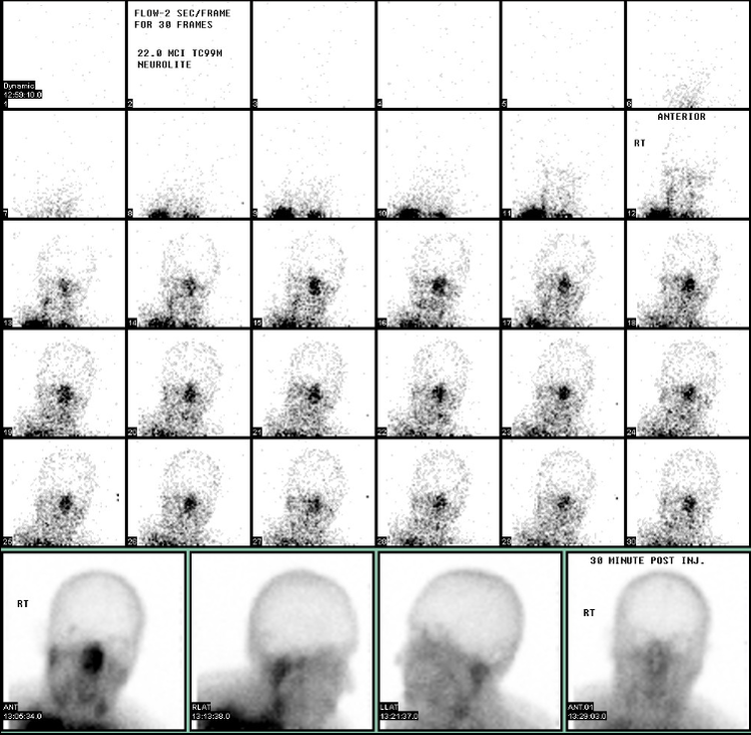
- Ancillary tests (when the clinical exam or apnea test can't be completed): cerebral angiography or nuclear perfusion scan (no flow), EEG (electrocerebral silence), transcranial Doppler
Brain Death vs Coma vs Vegetative State
| Feature | Brain death | Coma | Vegetative state (PVS) |
|---|---|---|---|
| Wakefulness (eyes open, sleep–wake) | No | No | Yes |
| Awareness of self/environment | No | No | No |
| Brainstem reflexes | Absent | Present/variable | Present |
| Spontaneous breathing | No (apnea) | Usually preserved | Yes |
| Legal status | Dead | Alive | Alive |
Vignette: A 24-year-old man is admitted after a motorcycle crash with a massive traumatic brain injury. He is intubated and comatose. Core temp 36.6°C, SBP 112, no sedatives or paralytics given. Pupils are fixed and nonreactive; corneal, gag, and cough reflexes are absent; cold-caloric testing elicits no eye movement.
Diagnosis: Clinical brain death, pending confirmatory testing.
Next best step: Perform the apnea test—preoxygenate, disconnect the ventilator with tracheal O₂, and observe for respiratory effort; no breathing with PaCO₂ ≥60 mm Hg confirms brain death.
Trap: A triple-flexion movement of the leg or a brisk deep tendon reflex is a spinal reflex and does NOT exclude the diagnosis.
Vignette: A patient is declared brain dead. The ICU attending wants to ask the grieving family about organ donation.
Best step: Do NOT raise donation yourself—notify the Organ Procurement Organization (OPO). A trained OPO coordinator, decoupled from the treatment team, approaches the family; this separation prevents a conflict of interest.
Key point: If the patient was a registered donor (first-person authorization), that consent is legally binding and the family cannot override it (the OPO still involves them compassionately). The physician who declares death must not be a member of the transplant team.
- Dead donor rule: death must be declared before vital-organ procurement; donation may not cause death
- Required referral: hospitals must notify the OPO of every imminent/actual death; only the OPO—not the treating physician—requests donation
- Firewall: the physician declaring death is separate from the transplant team (avoids conflict of interest)
- Consent: first-person (registered donor) consent is legally binding; if absent, the next of kin/surrogate decides
- Two pathways: DBD (donation after brain death) and DCD (donation after circulatory death)
- DCD: for a devastating injury not meeting brain-death criteria—organs procured after planned withdrawal of support and cardiac death (declared after ~2–5 min of asystole)
- Selling organs is illegal (National Organ Transplant Act, 1984); allocation is coordinated through UNOS/OPTN
High-Yield Traps
(1) A brain-dead patient is legally dead—continued ventilation is not medically obligatory, and the physician may withdraw it even over family objection, though brief accommodation for religious reasons or to permit organ donation is common. (2) Always exclude reversible mimics first—a hypothermic, barbiturate-overdosed, or pharmacologically paralyzed patient can falsely appear brain dead. (3) Time of death is when brain-death criteria are met, not when the ventilator is stopped. (4) Do not confuse PVS with brain death—a vegetative patient breathes spontaneously, retains brainstem reflexes, and is alive, so the surrogate (not brain-death law) governs decisions.
Practice Medical Ethics now
Board-style questions, spaced-repetition flashcards, and a Socratic AI tutor — free to start.