Oncologic Emergencies
A high-yield STEP 2 CK tour of the oncologic emergencies — tumor lysis syndrome, febrile neutropenia, malignant spinal cord compression, leukostasis, APL-associated DIC, hypercalcemia of malignancy, and SVC syndrome. Everything is framed around board-style next-best-step decisions, classic vignette buzzwords, and the labs/smear/marker patterns that separate one emergency from another.
Framework: recognize, then act before the workup is done
Oncologic emergencies are the life-threatening complications of cancer or its treatment where minutes to hours matter, and the boards reward the correct next best step over a complete workup. Group them into three buckets:
- Metabolic — tumor lysis syndrome, hypercalcemia of malignancy
- Hematologic — leukostasis, APL-associated DIC, febrile neutropenia
- Structural — malignant spinal cord compression, superior vena cava (SVC) syndrome
The recurring test pattern is recognize the buzzword → act before imaging or genetics return: give dexamethasone before the MRI in cord compression, start empiric antibiotics within an hour in febrile neutropenia, and begin ATRA on clinical suspicion of acute promyelocytic leukemia. Many of these appear after the first dose of chemotherapy, so the timing in the vignette is itself a major clue.
- Mechanism: massive tumor cell death dumps intracellular contents into the blood.
- Classic setting: Burkitt lymphoma, ALL, AML — bulky, chemo-sensitive tumors with high LDH; usually 12–72 h after starting chemo (can be spontaneous in Burkitt).
- Labs (Cairo–Bishop): ↑ potassium, ↑ phosphate, ↑ uric acid, ↓ calcium (calcium is consumed binding the excess phosphate).
- How it kills: hyperkalemic arrhythmia, acute kidney injury (uric acid + calcium-phosphate crystal deposition), seizures/tetany from hypocalcemia.
- Prevent (low risk): aggressive IV fluids + allopurinol (xanthine oxidase inhibitor — blocks new urate).
- Treat / high risk: rasburicase (recombinant urate oxidase — degrades existing uric acid). Contraindicated in G6PD deficiency (hemolysis, methemoglobinemia).
- Do NOT give calcium unless symptomatic hypocalcemia (risk of calcium-phosphate precipitation).
Vignette: A 9-year-old with a rapidly enlarging jaw and abdominal mass is diagnosed with Burkitt lymphoma. Two days after starting induction chemotherapy he becomes oliguric. Labs: K 6.4, phosphate 8.9, uric acid 13, calcium 6.8, rising creatinine, and a markedly elevated LDH.
- Diagnosis: tumor lysis syndrome.
- Best next step: aggressive IV isotonic fluids + IV rasburicase (established, high-risk TLS); treat the hyperkalemia and place on a cardiac monitor.
- Avoid: correcting the asymptomatic hypocalcemia with calcium; routine urine alkalinization is no longer recommended.
- Prophylaxis pearl: in a lower-risk patient, hydration + allopurinol before chemo would have been the preventive strategy.

- Definition: ANC < 500/µL (or < 1000 and expected to fall) plus a single temp ≥ 38.3°C (101°F) or ≥ 38.0°C (100.4°F) sustained ≥ 1 h.
- Timing: typically the chemo nadir, ~7–14 days after treatment. Most have no identifiable source — do not wait to find one.
- Best next step: draw blood cultures, then start empiric antipseudomonal β-lactam monotherapy within 1 hour — cefepime, piperacillin-tazobactam, or a carbapenem.
- Add vancomycin only for: suspected catheter/line or skin/soft-tissue infection, hemodynamic instability, severe mucositis, or known MRSA.
- Add empiric antifungal (echinocandin/voriconazole) if fever persists > 4–7 days.
- Use a risk score (e.g., MASCC) to choose inpatient IV vs. selected outpatient oral therapy (ciprofloxacin + amoxicillin-clavulanate).
Vignette: A 68-year-old man with metastatic prostate cancer reports 2 weeks of progressive mid-back pain that is worse at night and when lying down, now with bilateral leg weakness, a T6 sensory level, and new urinary retention.
- Diagnosis: malignant epidural spinal cord compression (thoracic spine most common; classic primaries = prostate, breast, lung, also myeloma/renal).
- Best next step: IV dexamethasone immediately — do not wait for imaging.
- Then: urgent MRI of the entire spine (gold standard; skip lesions are common).
- Definitive: radiation therapy and/or surgical decompression (surgery for spinal instability, tissue diagnosis, radioresistant tumor, or progression despite RT).
- Pearl: back pain is the earliest symptom — treat before the weakness becomes irreversible.
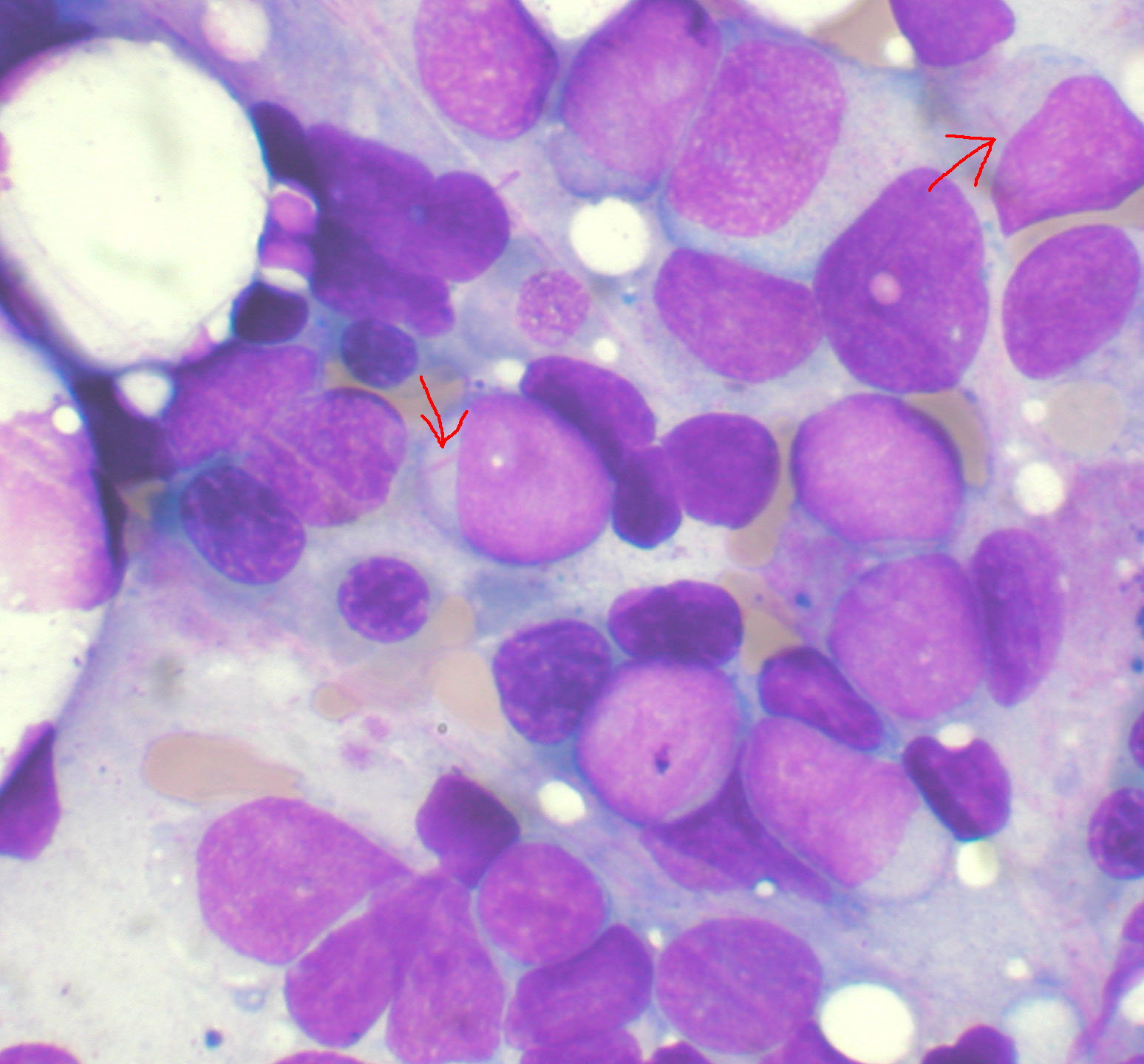
- Leukostasis (symptomatic hyperleukocytosis): hyperleukocytosis is usually WBC > 100,000 with circulating blasts, but in AML symptoms can begin above ~50,000 (myeloblasts are large and rigid), whereas ALL/CLL tolerate far higher lymphoid counts. Dyspnea/hypoxia + CNS signs (headache, confusion, visual changes, stroke), priapism. Treat with leukapheresis + hydroxyurea + urgent induction; avoid RBC transfusion (raises viscosity); give TLS prophylaxis.
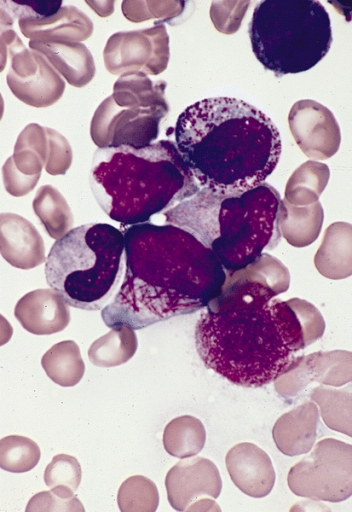
- APL with DIC: acute promyelocytic leukemia (AML-M3), t(15;17) PML-RARA. Smear: hypergranular promyelocytes, Auer rods, faggot cells (bundles of Auer rods). Life-threatening DIC/bleeding → start ATRA immediately on suspicion (before genetics confirm) + aggressive blood-product support; add arsenic trioxide. Watch for differentiation syndrome (fever, edema, pulmonary infiltrates → dexamethasone).
- SVC syndrome: facial/neck swelling, plethora, distended veins, Pemberton sign; causes = small cell lung cancer, NSCLC, NHL, indwelling catheters. CT chest with contrast; obtain tissue diagnosis before treatment unless airway compromise or cerebral edema → endovascular stent.
- Most common metabolic oncologic emergency; signals poor prognosis.
- Mechanisms / associations:
- PTHrP (humoral, most common): squamous cell carcinoma (lung, head & neck), renal cell, breast, bladder → PTH low, PTHrP high.
- Osteolytic (local bone destruction/cytokines): multiple myeloma, breast mets.
- 1,25-(OH)₂ vitamin D production: Hodgkin and non-Hodgkin lymphoma.
- Symptoms: polyuria/dehydration, kidney stones, bone pain, constipation/nausea, confusion/lethargy; short QT on ECG.
- Best next step: aggressive IV normal saline (first-line volume repletion).
- Then: bisphosphonate (zoledronic acid; peak effect 2–4 days) + calcitonin for rapid, short-term lowering; denosumab if bisphosphonate-refractory or in significant renal impairment.
- Avoid routine loop diuretics unless the patient is volume-overloaded.
Hypercalcemia — "Stones, bones, groans, thrones, and psychiatric overtones":
- Stones — kidney stones, nephrogenic DI
- Bones — bone pain, lytic lesions
- Groans — abdominal pain, constipation, nausea
- Thrones — polyuria (frequent trips to the toilet), dehydration
- Psychiatric overtones — lethargy, confusion, depression
Tumor lysis syndrome — "everything up but calcium":
- ↑ K⁺, ↑ phosphate, ↑ uric acid — and the odd one out, ↓ calcium.
Cord compression reflex — "steroids first, scan second": give dexamethasone before the MRI.
Rapid comparison — setting, labs/smear/markers, first move
| Emergency | Classic vignette | Key labs / smear / markers | First next step |
|---|---|---|---|
| Tumor lysis syndrome | Burkitt/ALL, 1–3 d post-chemo | ↑K, ↑PO₄, ↑uric acid, ↓Ca, ↑LDH | IV fluids + rasburicase (allopurinol if low-risk) |
| Leukostasis | AML, WBC >100k with blasts | Blasts ± Auer rods on smear | Leukapheresis + hydroxyurea; no RBC transfusion |
| APL + DIC | AML-M3, t(15;17) PML-RARA | Faggot cells; ↓fibrinogen, ↑PT/PTT/D-dimer | ATRA now + blood-product support |
| Febrile neutropenia | ANC <500, ~nadir post-chemo | Neutropenia on CBC | Cultures + antipseudomonal β-lactam <1 h |
| Hypercalcemia | Squamous lung (PTHrP), myeloma | ↑Ca; PTHrP↑/PTH↓; short QT | IV normal saline + bisphosphonate |
| Cord compression | Prostate/breast/lung mets, night back pain | MRI whole spine (skip lesions) | IV dexamethasone, then MRI |
| SVC syndrome | SCLC/NHL, facial swelling, Pemberton sign | CT chest with contrast | Tissue dx; stent if emergent |
Practice Heme/Onc now
Board-style questions, spaced-repetition flashcards, and a Socratic AI tutor — free to start.