Neurophysiology: Action Potentials & Synaptic Transmission
A Step 1-focused walk through the neuronal action potential (resting potential, channel gating, refractory periods, conduction) and chemical synaptic transmission at the NMJ, anchored to the numbers, curves, and feedback the boards test — plus the classic disease correlations (MG vs LEMS, botulinum/tetanus, hyperkalemia, demyelination, local anesthetics).
The Resting Membrane Potential: The Charged Setup
A typical neuron sits at a resting membrane potential (RMP) of about −70 mV (inside negative). Two things create it: ion gradients maintained by the Na⁺/K⁺-ATPase (pumps 3 Na⁺ out / 2 K⁺ in per ATP — electrogenic, and the target of ouabain/digoxin), and selective permeability. At rest the membrane is far more permeable to K⁺ (through K⁺ leak channels) than to Na⁺, so the RMP drifts close to the K⁺ equilibrium potential (E_K ≈ −90 mV) but not all the way, because a small Na⁺ leak pulls it positive.
The Nernst equation gives the equilibrium potential for a single ion — the voltage at which its chemical and electrical drives balance: E_ion = (61/z) · log([out]/[in]) mV at 37 °C. The Goldman-Hodgkin-Katz (GHK) equation gives the actual membrane potential by weighting each permeant ion by its permeability. The rule the boards want: the membrane potential moves toward the equilibrium potential of whichever ion is most permeant at that moment — K⁺ at rest, Na⁺ during the upstroke.
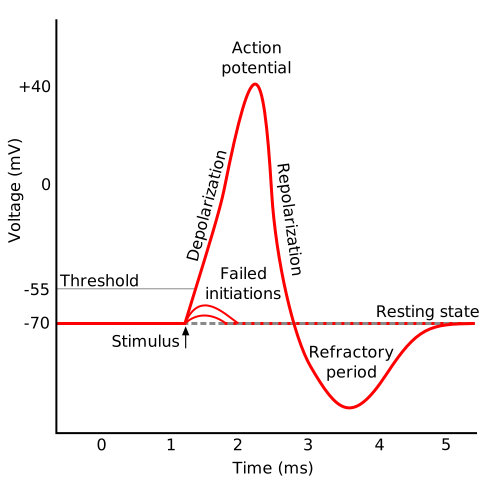
- Threshold ≈ −55 mV. Subthreshold stimuli give graded, decremental responses; reaching threshold triggers an all-or-none action potential (AP).
- Upstroke (depolarization): voltage-gated Na⁺ channels open — the fast activation (m) gate swings open — Na⁺ rushes in, overshooting to about +30 mV. Regenerative positive feedback (depolarization opens more Na⁺ channels).
- Repolarization: Na⁺ channels inactivate (the slower inactivation / h gate closes) and voltage-gated K⁺ channels open → K⁺ efflux drives the membrane back down.
- Hyperpolarizing undershoot: the slow (delayed-rectifier) K⁺ channels stay open past RMP, pulling toward E_K, before closing.
- The voltage-gated Na⁺ channel has TWO gates: at rest m is closed / h is open; on depolarization m opens fast then h closes (inactivation); repolarization is required to reset h back to open.
- Ca²⁺ influx does NOT drive the neuronal upstroke (that's Na⁺) — but it does drive phase 0 in SA/AV nodal and other slow-response tissue (L-type Ca²⁺). Don't mix them up.
Ions at Rest: Gradients & Equilibrium Potentials
| Ion | Intracellular (mM) | Extracellular (mM) | Equilibrium potential | Main role |
|---|---|---|---|---|
| Na⁺ | ~15 | ~145 | ≈ +60 mV | AP upstroke (depolarization) |
| K⁺ | ~150 | ~4.5 | ≈ −90 mV | Sets RMP; repolarization |
| Ca²⁺ | ~0.0001 | ~2 | ≈ +120 mV | Triggers neurotransmitter release |
| Cl⁻ | ~9 | ~125 | ≈ −70 mV | IPSP (at / just below RMP) |
- Conduction velocity ↑ with (1) larger axon diameter (lower internal resistance) and (2) myelination.
- Myelin ↑ membrane resistance and ↓ capacitance → current spreads farther with less leak → the AP regenerates only at nodes of Ranvier, which concentrate voltage-gated Na⁺ channels = saltatory conduction.
- Length (space) constant λ = distance a passive signal decays to 37%; bigger λ → faster conduction. Time constant τ = R·C; myelin lowers C, shortening τ (faster membrane charging).
- Absolute refractory period (ARP): enough Na⁺ channels are inactivated (h gate shut) that no AP fires at any stimulus strength. Sets the maximum firing frequency and enforces one-way propagation.
- Relative refractory period (RRP): some Na⁺ channels have reset but K⁺ conductance is still high (membrane hyperpolarized) → an AP is possible only with a larger-than-normal stimulus.
- AP invades the presynaptic terminal → opens voltage-gated Ca²⁺ channels (P/Q-type at the NMJ).
- Ca²⁺ influx is the trigger: synaptotagmin senses Ca²⁺ and SNARE proteins (v-SNARE synaptobrevin/VAMP + t-SNAREs syntaxin and SNAP-25) drive vesicle fusion → neurotransmitter release.
- Postsynaptic receptors respond:
- EPSP — glutamate opens a nonselective Na⁺/K⁺ cation channel → net inward current → depolarize.
- IPSP — GABA_A / glycine open Cl⁻ channels (hyperpolarize/shunt); GABA_B (metabotropic, Gi) opens K⁺.
- NMJ: ACh binds the nicotinic (N_M) receptor — a ligand-gated cation channel → end-plate potential → muscle AP.
- Termination: acetylcholinesterase hydrolyzes ACh in the cleft; glutamate and monoamines are cleared by reuptake transporters.
- Summation decides firing: temporal (rapid repeats at one synapse) + spatial (many synapses at once).

Comparison: Myasthenia Gravis vs Lambert-Eaton
| Feature | Myasthenia Gravis (MG) | Lambert-Eaton (LEMS) |
|---|---|---|
| Antibody target | Postsynaptic nicotinic ACh receptor | Presynaptic P/Q voltage-gated Ca²⁺ channel |
| Effect on ACh | Normal release, fewer receptors | ↓ ACh release |
| Weakness with repeated use | Worsens (fatigable) | Improves (facilitation) |
| Ocular (ptosis/diplopia) | Common, early | Uncommon |
| Autonomic symptoms (dry mouth) | Absent | Present |
| Associated neoplasm | Thymoma / thymic hyperplasia | Small cell lung cancer |
| EMG on repetitive stimulation | Decremental response | Incremental response |
| Response to AChE inhibitors | Improves | Minimal |
CNS demyelination → conduction failure. A 29-year-old woman has an episode of painful monocular vision loss and, on a hot day, transiently blurred vision (Uhthoff phenomenon); MRI shows periventricular white-matter lesions. Mechanism: loss of oligodendrocyte myelin raises membrane capacitance and current leak, so saltatory conduction slows or fails → multiple sclerosis.
Hyperkalemia → depolarization block. A dialysis patient misses a session and develops ascending weakness with peaked T waves on ECG. Mechanism: elevated extracellular K⁺ makes E_K less negative and depolarizes RMP; sustained depolarization holds voltage-gated Na⁺ channels inactivated (h gate shut), so cells cannot fire → weakness and cardiac conduction disturbance.
Local anesthetic fails in an abscess. A dentist injects lidocaine near an infected tooth but can't achieve numbness. Mechanism: local anesthetics block voltage-gated Na⁺ channels from the intracellular side and must cross the membrane in their neutral (unionized) form. Acidic (infected) tissue protonates the weak-base drug, trapping it in the charged form outside the cell → poor penetration and block. Small Aδ and C (pain) fibers are blocked before large motor fibers.
Toxins & Drugs That Hit the Circuit
| Agent | Target / mechanism | Clinical effect |
|---|---|---|
| Tetrodotoxin / saxitoxin | Block voltage-gated Na⁺ channels | No AP → paralysis, paresthesias |
| Local anesthetics (lidocaine) | Block VG Na⁺ channels (intracellular, use-dependent) | Loss of pain (small fibers first) |
| Botulinum toxin | Cleaves SNARE (SNAP-25) → ↓ ACh release | Flaccid paralysis, autonomic signs |
| Tetanospasmin (tetanus) | Cleaves synaptobrevin/VAMP in inhibitory interneurons → ↓ glycine/GABA | Spastic paralysis, lockjaw, risus sardonicus |
| Organophosphates / neostigmine | Inhibit acetylcholinesterase → ↑ ACh | Cholinergic crisis (SLUDGE / DUMBELS) |
| Curare / rocuronium | Competitive nicotinic antagonist (postsynaptic) | Flaccid paralysis (reversed by neostigmine) |
| Succinylcholine | Nicotinic agonist → sustained depolarization | Depolarizing (phase I) blockade |
- "Salty banana": the extracellular fluid is salty seawater = high Na⁺; the cell interior is a banana = high K⁺ (bananas are potassium-rich).
- Botulinum vs Tetanus = Bendy vs Tense: Botulinum → flaccid/floppy (blocks ACh release at the NMJ); Tetanus blocks inhibitory transmitters (glycine/GABA) centrally → rigid/spastic.
- Cholinergic excess (AChE inhibitors / organophosphates) = DUMBELS: Diarrhea, Urination, Miosis, Bradycardia/Bronchospasm/Bronchorrhea, Emesis, Lacrimation, Salivation/Sweating. (Sister mnemonic: SLUDGE — Salivation, Lacrimation, Urination, Defecation, GI distress, Emesis.)
- MG vs LEMS: Myasthenia gets More tired with use (decremental); Lambert-Eaton Lifts/improves with repeated use (incremental).
Practice Physiology now
Board-style questions, spaced-repetition flashcards, and a Socratic AI tutor — free to start.