Neonatal Complications: RDS, NEC & Sepsis
A boards-focused walkthrough of the three classic neonatal emergencies—RDS, NEC, and sepsis—using timing, feeding status, and the signature radiograph to drive diagnosis and the correct next-best step. Built around vignette buzzwords and management decisions tested on Step 1 and Step 2 CK.
The three neonatal emergencies at a glance
Prematurity is the thread linking the three classic neonatal emergencies, and timing is how the boards make you tell them apart. Respiratory distress syndrome (RDS) strikes within minutes to hours of birth from surfactant deficiency. Necrotizing enterocolitis (NEC) appears only after enteral feeds begin, typically in the 2nd–3rd week of life in premature infants. Neonatal sepsis can present at any time and is stratified into early- vs late-onset by age at presentation.
The high-yield exam skill is combining three clues—age at onset, feeding status, and the classic radiograph—to reach the diagnosis, then choosing the correct NEXT step. That step is frequently imaging or empiric antibiotics started before the workup is complete, because in the neonate you treat presumptively rather than wait for cultures.
- Cause: surfactant deficiency (type II pneumocytes) → ↑ alveolar surface tension → diffuse atelectasis; aka hyaline membrane disease.
- Risk: prematurity (esp. <28 wk), maternal diabetes (fetal hyperinsulinemia delays surfactant), elective C-section without labor, male sex, second twin, perinatal asphyxia.
- Presentation: tachypnea, grunting, nasal flaring, retractions, cyanosis within minutes–hours of birth.
- CXR: low lung volumes, diffuse reticulogranular "ground-glass" opacities, air bronchograms.
- Lung maturity: L/S ratio <2 or absent phosphatidylglycerol = immature.
- Prevent: antenatal betamethasone to mother in preterm labor. Treat: exogenous surfactant + CPAP / O₂ / mechanical ventilation.
- Complications: PDA, pneumothorax, IVH, bronchopulmonary dysplasia, retinopathy of prematurity (O₂ toxicity).
Vignette: A male infant born at 30 weeks by C-section to a mother with poorly controlled diabetes develops grunting, nasal flaring, and tachypnea 1 hour after birth. CXR shows low lung volumes with diffuse ground-glass opacities and air bronchograms.
Diagnosis: Respiratory distress syndrome (surfactant deficiency).
Next best step: Respiratory support with CPAP and administer exogenous surfactant via endotracheal tube.
Board pearl: The intervention that would have prevented this is antenatal betamethasone given to the mother during preterm labor—not something you give the neonate after delivery. Watch for the distractor that offers steroids to the newborn.

- Risk: prematurity (#1) plus enteral feeding (formula > breast milk) and bacterial colonization; begins once feeds are started, usually week 2–3.
- Presentation: feeding intolerance, abdominal distension, bloody stools, bilious emesis / gastric residuals, lethargy, temperature instability.
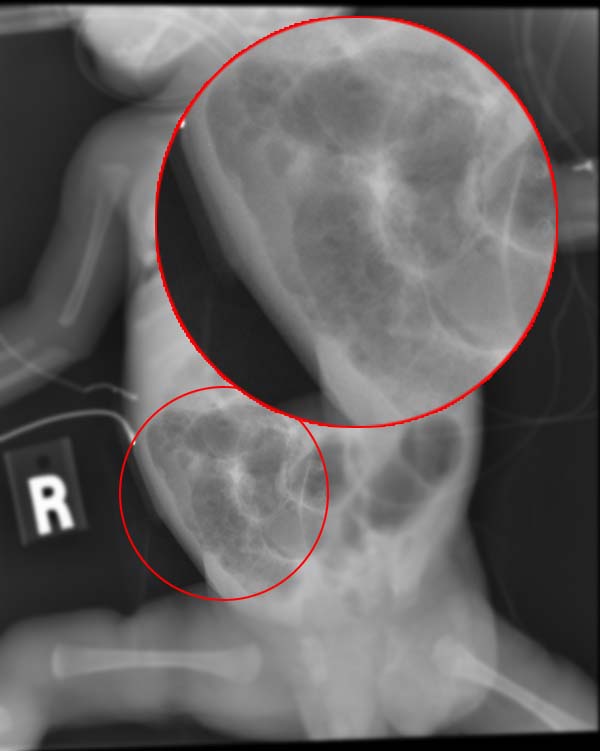
- Diagnosis — abdominal X-ray: pneumatosis intestinalis (air in the bowel wall = hallmark); portal venous gas; free air / pneumoperitoneum = perforation.
- Management: NPO / bowel rest, NG (orogastric) decompression, IV fluids, broad-spectrum IV antibiotics, TPN, and serial abdominal films.
- Surgery for perforation or necrotic bowel.
- Protective factor: breast milk (vs formula).
Vignette: A 28-week preterm infant on day 10 of life, whose formula feeds were recently advanced, develops abdominal distension, bloody stools, and bilious gastric residuals with new lethargy.
Next best step: Stop feeds (make NPO) and obtain an abdominal X-ray → shows pneumatosis intestinalis, confirming necrotizing enterocolitis.
Management: NPO, NG decompression, IV fluids, and broad-spectrum IV antibiotics; follow serial films.
Escalate to surgery if the film shows free air (pneumoperitoneum), indicating perforation—the massive free-air "football sign."
Early-onset (<7 d, often <24 h) — vertical/perinatal spread:
- Group B Strep (S. agalactiae), E. coli, Listeria monocytogenes
- Risk: maternal GBS colonization, PROM >18 h, chorioamnionitis / maternal fever, prematurity
Late-onset (>7 d) — nosocomial / catheter-related:
- Coagulase-negative staph, S. aureus, Klebsiella, Pseudomonas, Candida
Presentation: temperature instability, poor feeding, lethargy, apnea, respiratory distress, hypotension. Workup: blood culture, CBC, CRP, lumbar puncture, urine culture (late-onset). Empiric tx: ampicillin + gentamicin (early; ampicillin covers GBS + Listeria); add cefotaxime for suspected meningitis. Late-onset → vancomycin + gentamicin/cefotaxime. (Avoid ceftriaxone in neonates—bilirubin displacement → kernicterus.) GBS prevention: screen at 36–37 wk; intrapartum penicillin (or ampicillin).
Side-by-side comparison
| Feature | RDS | NEC | Early sepsis |
|---|---|---|---|
| Timing | Minutes–hours after birth | After feeds, wk 2–3 | <7 d (often <24 h) |
| Key driver | Surfactant deficiency; prematurity, maternal DM | Prematurity + enteral feeds | GBS / E. coli / Listeria; PROM, maternal fever |
| Hallmark clue | Ground-glass CXR, air bronchograms | Pneumatosis intestinalis on AXR | Positive blood/CSF culture |
| First move | Surfactant + CPAP (steroids antenatally) | AXR → NPO, NG, antibiotics | Cultures + ampicillin + gentamicin |
GEL = the three classic causes of early-onset neonatal sepsis:
- G — Group B Streptococcus (S. agalactiae) — #1 cause
- E — Escherichia coli
- L — Listeria monocytogenes (gram-positive rod; maternal unpasteurized dairy / deli meats)
Why it matters: empiric ampicillin + gentamicin is chosen specifically because ampicillin covers Listeria and GBS, which cephalosporins miss. That is the reasoning behind the "add ampicillin" answer choice.
Practice Pediatrics now
Board-style questions, spaced-repetition flashcards, and a Socratic AI tutor — free to start.