Neonatal Assessment & Resuscitation (APGAR)
High-yield STEP 2 CK lesson on the APGAR score and neonatal resuscitation (NRP): the five scored components and cutoffs, the golden-minute algorithm, and next-best-step decisions—PPV at HR <100 or apnea, chest compressions + 100% O₂ at HR <60, and epinephrine for persistent HR <60. Corrected: removed the unsourced Joseph Butterfield backronym-origin claim (replaced with an accurate eponym/backronym note), tightened golden-minute airway wording away from routine suctioning, and specified 'effective PPV (chest moving)' before compressions.
Overview: What APGAR Does (and Doesn't) Do
The APGAR score is a rapid, standardized snapshot of a newborn's transition to extrauterine life, scored at 1 and 5 minutes of life (and then every 5 minutes up to 20 minutes if the 5-minute score is <7). Five parameters—color, heart rate, reflex irritability, tone, and respiratory effort—are each scored 0, 1, or 2 for a total of 0–10.
Critically for the boards: the APGAR does not direct resuscitation. Resuscitation is guided by three questions asked immediately at birth—Term gestation? Good tone? Breathing or crying?—not by waiting for the 1-minute score. APGAR instead communicates the infant's status and the response to interventions. A low score is not by itself diagnostic of intrapartum asphyxia, nor does it reliably predict long-term neurologic outcome in an individual infant.
- 7–10: reassuring, normal transition
- 4–6: moderately depressed → stimulate, anticipate possible need for PPV
- 0–3: severely depressed → active resuscitation
- Each of 5 components scored 0, 1, or 2; maximum = 10
- Acrocyanosis (blue hands/feet, pink trunk) is a normal early finding—it costs the 1 color point, so a healthy vigorous newborn typically scores 8–9, not 10
- A perfect 10 is uncommon in the first minutes precisely because of acrocyanosis
- The 5-minute score is more prognostically useful than the 1-minute score, but neither alone diagnoses hypoxic-ischemic injury
- Continue scoring q5min to 20 min if the 5-minute score is <7
APGAR Component Scoring (0 / 1 / 2)
| Sign | 0 | 1 | 2 |
|---|---|---|---|
| Appearance (color) | Blue or pale all over | Acrocyanosis (blue extremities, pink body) | Completely pink |
| Pulse (heart rate) | Absent | <100 bpm | ≥100 bpm |
| Grimace (reflex) | No response | Grimace | Cough, sneeze, cry, or pulls away |
| Activity (tone) | Limp | Some flexion of extremities | Active, spontaneous motion |
| Respiration (effort) | Absent | Slow, irregular, weak cry | Strong, vigorous cry |
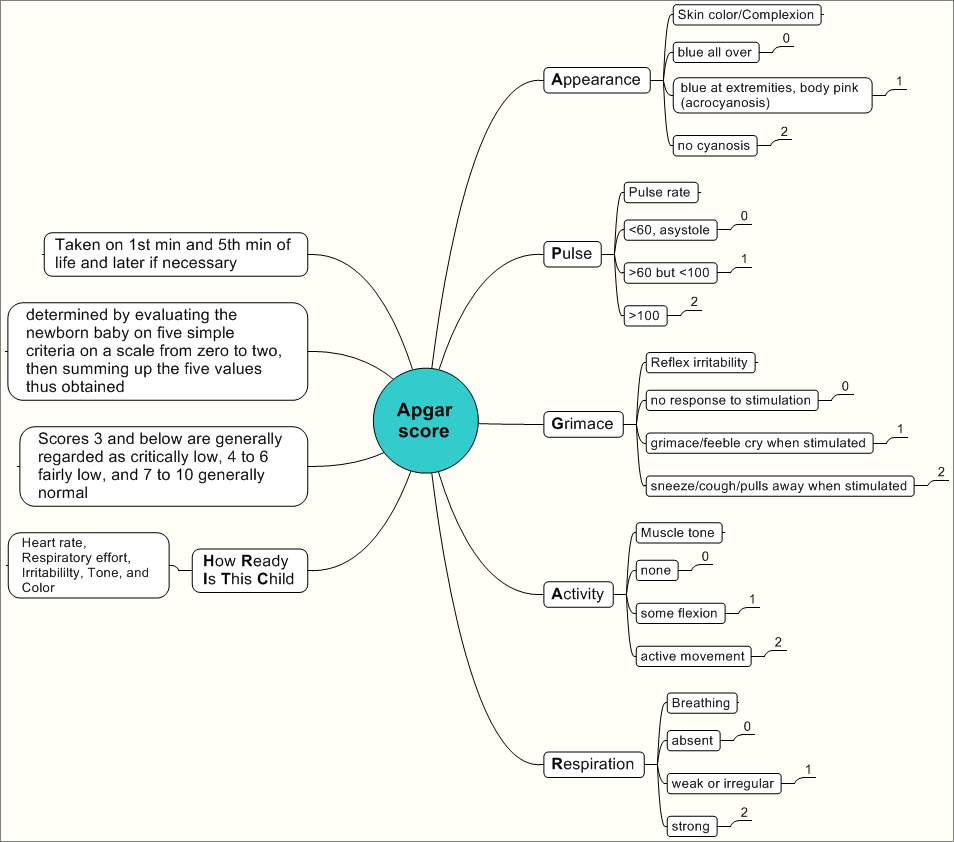
The score is an eponym named for Dr. Virginia Apgar, who devised it; APGAR is also used as a backronym for the five signs:
- Appearance (color)
- Pulse (heart rate)
- Grimace (reflex irritability)
- Activity (muscle tone)
- Respiration (respiratory effort)
Link the numbers (high-yield):
- 100 bpm appears twice—<100 = 1 point on APGAR and the heart-rate threshold to start positive-pressure ventilation (PPV)
- 60 bpm is the resuscitation threshold for chest compressions (and, if persistent, epinephrine)
- Golden minute: warm, dry, stimulate, position airway, and clear the airway only if needed (routine suctioning is not recommended)—accomplished within the first 60 seconds
- HR <100 bpm OR apnea/gasping → begin positive-pressure ventilation (PPV)—the single most important step in neonatal resuscitation
- Start PPV with room air (21% O₂) in term infants; use blended O₂ + pulse oximetry in preterm
- If HR isn't rising, run corrective steps MRSOPA (Mask adjust, Reposition, Suction, Open mouth, increase Pressure, Airway alternative)
- HR <60 bpm after ≥30 sec of effective PPV (chest moving) → chest compressions, coordinated 3:1 with breaths (90 compressions + 30 breaths/min), and increase O₂ to 100%
- HR persistently <60 despite compressions + PPV → epinephrine (IV/UVC preferred, 0.01–0.03 mg/kg of 1:10,000); give volume (normal saline 10 mL/kg) if blood loss/hypovolemia
Stem: A term neonate is delivered vaginally. At 1 minute she is crying vigorously with strong respiratory effort, HR 150, grimaces and pulls away from suctioning, and has flexed, actively moving extremities. Her trunk is pink but her hands and feet are blue.
Score: APGAR = 9 — full marks except 1 point lost for acrocyanosis (color).
Next best step: Routine newborn care—dry, keep warm skin-to-skin with mother, delayed cord clamping, and continued observation. No resuscitation is indicated; acrocyanosis is a normal finding and is not a reason to give oxygen.
Stem: A term newborn is limp and apneic after delivery. He is warmed, dried, stimulated, and his airway is positioned. At 30 seconds he remains apneic with HR 80 bpm.
Next best step: Begin positive-pressure ventilation—not chest compressions, deep suctioning, or epinephrine. PPV is indicated for HR <100 or apnea/gasping and is the priority intervention that reverses most neonatal bradycardia (which is usually respiratory in origin).
Escalation: If effective PPV (chest moving) for ≥30 sec fails to raise HR above 60 bpm → add chest compressions 3:1 with ventilation and escalate O₂ to 100%; if HR stays <60, give epinephrine.
- Meconium-stained fluid + non-vigorous infant: routine intubation and tracheal suctioning are NO LONGER recommended—manage like any depressed newborn (warm, stimulate, PPV if HR <100 or apneic)
- Delayed cord clamping (at least 30–60 sec) is recommended for vigorous term and preterm infants
- Preductal SpO₂ (right hand) rises gradually: ~60–65% at 1 min, 80–85% at 5 min, 85–95% by 10 min—do not expect 100% and do not over-oxygenate
- APGAR is not proof of asphyxia; attributing injury to an intrapartum hypoxic-ischemic event requires cord-gas metabolic acidemia, a low APGAR, neonatal encephalopathy, and evidence of multi-organ dysfunction
- Preterm thermoregulation: polyethylene/plastic wrap + radiant warmer, avoid hypothermia
Practice Pediatrics now
Board-style questions, spaced-repetition flashcards, and a Socratic AI tutor — free to start.