MHC & Antigen Presentation
A Step 1 high-yield walkthrough of MHC/HLA antigen presentation: MHC I (endogenous → CD8) versus MHC II (exogenous → CD4), the proteasome/TAP and invariant-chain/CLIP/HLA-DM loading pathways, the defect-to-disease correlations (bare lymphocyte syndromes types I and II), and the classic HLA disease and drug-hypersensitivity associations.
The core idea
The major histocompatibility complex (MHC) — called HLA (human leukocyte antigen) in humans — is a cluster of genes on the short arm of chromosome 6 that encodes the cell-surface molecules displaying peptide antigens to T cells. MHC genes are highly polymorphic and codominantly expressed (you display both parental alleles), which underlies transplant rejection and individual variation in immune responses.
The central rule is MHC restriction: a T-cell receptor recognizes antigen only as a peptide bound within an MHC groove, never free antigen. Two classes divide the labor — MHC class I presents endogenous (intracellular) peptides to CD8+ cytotoxic T cells, while MHC class II presents exogenous (extracellular) peptides to CD4+ helper T cells. This lets the immune system distinguish "what is happening inside my cells" (viral/tumor surveillance) from "what is floating outside" (extracellular microbes).
- MHC I = HLA-A, -B, -C; on all nucleated cells + platelets (NOT mature RBCs); presents endogenous peptides (viral, tumor, self) to CD8+ cytotoxic T cells
- MHC I structure: one heavy (α) chain + β2-microglobulin — note β2-microglobulin is encoded on chromosome 15, outside the chr 6 MHC (classic trap); closed groove binds short peptides (~8–10 aa); CD8 binds the α3 domain
- MHC II = HLA-DP, -DQ, -DR; only on professional APCs — dendritic cells, macrophages, B cells; presents exogenous peptides to CD4+ helper T cells
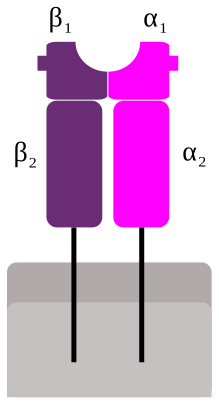
- MHC II structure: α + β chains; open groove binds longer peptides (~13–25 aa); CD4 binds the β2 domain
- Rule of 8: MHC class × CD number = 8 → MHC 1 × CD8, MHC 2 × CD4
- Loading: MHC I needs the proteasome + TAP in the rough ER; MHC II needs the invariant chain → CLIP → HLA-DM in the endosome
- Cross-presentation: dendritic cells can load exogenous antigen onto MHC I to prime naïve CD8+ cytotoxic T cells
- "Missing self": viral/tumor down-regulation of MHC I removes NK-cell inhibition → NK cells kill the cell
MHC I vs MHC II
| Feature | MHC class I | MHC class II |
|---|---|---|
| HLA loci | HLA-A, -B, -C | HLA-DP, -DQ, -DR |
| Chains | 1 heavy (α) chain + β2-microglobulin | α + β chains |
| Expressed on | All nucleated cells + platelets | Professional APCs (dendritic cells, macrophages, B cells) |
| Antigen source | Endogenous (cytosolic: viral, tumor, self) | Exogenous (phagocytosed / extracellular) |
| Peptide length | ~8–10 aa (closed groove) | ~13–25 aa (open groove) |
| Loading compartment | Rough ER | Acidified endosome / lysosome |
| Loading machinery | Proteasome + TAP (+ tapasin) | Invariant chain → CLIP → HLA-DM |
| Presents to | CD8+ cytotoxic T cell | CD4+ helper T cell |
| Coreceptor binding site | α3 domain | β2 domain |

The two processing pathways
Endogenous pathway (MHC I). Cytosolic proteins (including viral or tumor proteins) are tagged and degraded by the proteasome into peptides. TAP (transporter associated with antigen processing) pumps these peptides from the cytosol into the rough ER, where they are loaded onto newly made MHC I (chaperoned by tapasin, calnexin, calreticulin). The peptide–MHC I complex then travels through the Golgi to the surface for inspection by CD8+ T cells.
Exogenous pathway (MHC II). MHC II is assembled in the rough ER with its groove plugged by the invariant chain (Ii / CD74) — this prevents endogenous ER peptides from binding. The complex is routed to an acidified endosome, where proteases digest the invariant chain down to a small remnant called CLIP still sitting in the groove. HLA-DM then catalyzes removal of CLIP and exchange for a high-affinity exogenous peptide. The loaded MHC II moves to the surface for CD4+ T cells.

Key molecules: function → defect
| Molecule / factor | Function | Defect / association |
|---|---|---|
| Proteasome | Degrades cytosolic proteins into MHC I peptides | — |
| TAP1 / TAP2 | Pump peptides cytosol → rough ER for MHC I loading | Bare lymphocyte syndrome type I (↓ surface MHC I → ↓ CD8+ T cells) |
| β2-microglobulin | Stabilizes MHC I heavy chain; required for surface MHC I (encoded on chromosome 15) | Loss → no surface MHC I |
| Invariant chain (CD74) | Blocks MHC II groove in ER; targets MHC II to endosome | — |
| CLIP | Invariant-chain remnant occupying the MHC II groove | Must be removed before peptide loads |
| HLA-DM | Removes CLIP; loads high-affinity peptide onto MHC II | — |
| CIITA / RFX (transcription factors) | Drive MHC II gene expression | Bare lymphocyte syndrome type II (↓ MHC II → ↓ CD4+ T cells) |
Vignette (BLS type II). A 5-month-old boy has failure to thrive and recurrent bacterial, viral, and fungal infections, including Pneumocystis jirovecii pneumonia and chronic diarrhea. Labs show a very low CD4+ T-cell count with relatively preserved CD8+, low immunoglobulins, and absent MHC II on his cells. → Bare lymphocyte syndrome type II, a combined (SCID-like) immunodeficiency caused by mutations in MHC II transcription factors (CIITA, RFX) — not the MHC gene itself. Without MHC II, CD4+ helper T cells cannot be positively selected or activated, and B cells lack help (hypogammaglobulinemia). Treatment: hematopoietic stem cell transplant.
Vignette (BLS type I). Recurrent bacterial sinopulmonary infections, chronic lung disease, and necrotizing granulomatous skin lesions; CD8+ T cells are low and MHC I is absent from the cell surface. → TAP1/TAP2 deficiency (BLS type I) — peptides cannot reach MHC I in the ER, so MHC I never reaches the surface.
Concept link. Because cells with no/low MHC I lose the inhibitory "self" signal, NK cells attack them ("missing self") — the mechanism by which the immune system catches virus-infected or tumor cells that shed MHC I to evade CD8+ T cells.
HLA associations (high-yield)
| HLA allele | Associated disease(s) |
|---|---|
| A3 | Hereditary hemochromatosis |
| B8 | Addison disease, myasthenia gravis, Graves disease |
| B27 | PAIR — Psoriatic arthritis, Ankylosing spondylitis, IBD-associated arthritis, Reactive arthritis (seronegative spondyloarthropathies) |
| B*57:01 | Abacavir hypersensitivity |
| B*15:02 | Carbamazepine-induced SJS/TEN (esp. Southeast Asian ancestry) |
| B*58:01 | Allopurinol severe cutaneous reaction / SJS/TEN |
| DQ2 / DQ8 | Celiac disease |
| DR2 | Multiple sclerosis, SLE, Goodpasture syndrome, hay fever |
| DR3 | Type 1 diabetes mellitus, SLE, Graves, Hashimoto thyroiditis, Addison disease |
| DR4 | Rheumatoid arthritis, type 1 diabetes mellitus, Addison disease |
| DR5 | Hashimoto thyroiditis, pernicious anemia |
- Rule of 8 — MHC class × CD coreceptor = 8: MHC 1 × CD8 = 8, MHC 2 × CD4 = 8
- HLA-B27 → PAIR — Psoriatic arthritis, Ankylosing spondylitis, IBD-associated arthritis, Reactive arthritis
- Class I = Intracellular / Endogenous (both key words start with "I") → CD8; class II = Extracellular / Exogenous → CD4
Practice Immunology now
Board-style questions, spaced-repetition flashcards, and a Socratic AI tutor — free to start.