Male Reproductive: BPH, Prostate & Testicular Disease
A high-yield walkthrough of male GU disease anchored to prostate zonal anatomy — BPH, acute prostatitis, and adenocarcinoma — plus the acute scrotum (torsion vs epididymitis) and painless testicular masses, emphasizing next-best-step decisions and classic vignette buzzwords. Built for STEP 1 and STEP 2 CK.
Framing male GU disease
Male genitourinary vignettes cluster around two organs: the prostate (BPH, prostatitis, adenocarcinoma) and the scrotum (the acute scrotum and painless masses). Anchor everything to zonal anatomy. The transition/periurethral zone enlarges in BPH, compressing the urethra → obstructive symptoms — but it is not premalignant. Adenocarcinoma arises in the peripheral (posterior) zone, so it is palpable on DRE yet silent until PSA rises or bone mets appear. Prostate growth is androgen-driven: testosterone → DHT via 5α-reductase, the drug target of finasteride/dutasteride.
On the scrotal side, boards force one high-stakes fork: is acute testicular pain torsion (surgical emergency, salvage best <6 h) or epididymitis (antibiotics)? And a painless solid intratesticular mass is cancer until proven otherwise. Learn a handful of discriminators — DRE texture, PSA behavior, cremasteric reflex, Prehn sign, transillumination, and tumor markers — and most vignettes collapse to a clean next-best-step.
- Pathophysiology: DHT-driven hyperplasia of the transition/periurethral zone; does NOT cause prostate cancer.
- LUTS — obstructive/voiding: hesitancy, weak/intermittent stream, incomplete emptying, terminal dribbling.
- LUTS — irritative/storage: frequency, urgency, nocturia.
- DRE: smooth, symmetric, rubbery, non-tender enlargement.
- Labs: urinalysis (exclude infection/hematuria); PSA may be mildly elevated.
- Complications: acute urinary retention, recurrent UTIs, bladder calculi, bilateral hydronephrosis → post-renal AKI.
- Management (stepwise):
- α1-blockers ("-osin": tamsulosin, alfuzosin, doxazosin) — relax prostatic/bladder-neck smooth muscle, fast symptom relief; SEs: orthostatic hypotension, retrograde/abnormal ejaculation, intraoperative floppy iris syndrome (esp. tamsulosin).
- 5α-reductase inhibitors (finasteride, dutasteride) — shrink the gland over months (best for large prostates); lower PSA ~50% (double the measured value to interpret); SEs: ↓libido, ED, gynecomastia.
- Combination (α1-blocker + 5-ARI) for large glands; tadalafil if concurrent ED.
- TURP for refractory symptoms or complications.
Vignette: A 68-year-old man with a year of nocturia and a weak stream takes diphenhydramine for a cold and develops 12 hours of suprapubic pain and inability to void. Suprapubic fullness is palpable; DRE shows a smooth, enlarged prostate.
- Dx: Acute urinary retention on chronic BPH — an anticholinergic (and often an α-agonist decongestant) tipped a marginally compensated bladder into retention.
- Next best step: Immediate bladder catheterization (decompression) — relieves pain and protects the kidneys; investigate afterward.
- Monitor: post-obstructive diuresis (urine output, electrolytes) and creatinine for post-renal AKI.
- Then: start an α1-blocker, stop the offending anticholinergic/sympathomimetic, plan a voiding trial; recurrent/refractory retention → TURP.
- Board trap: avoid anticholinergics and α-agonist (pseudoephedrine) cold remedies in men with BPH — a classic precipitant.
- Adenocarcinoma: arises in the peripheral zone → hard, irregular, asymmetric nodule on DRE; usually asymptomatic and often indolent.
- Spread: osteoblastic (bone-forming) mets to the lumbar spine/axial skeleton → back pain, ↑alkaline phosphatase, ↑PSA; watch for cord compression.
- Workup: ↑PSA or abnormal DRE → multiparametric MRI ± TRUS/MRI-guided biopsy → Gleason score / Grade Group; bone scan for staging.
- Treatment: low-risk → active surveillance; localized → radical prostatectomy or radiotherapy; metastatic → androgen-deprivation therapy — GnRH agonist leuprolide (co-give an antiandrogen, e.g. bicalutamide, for the first weeks to prevent testosterone flare), GnRH antagonist degarelix, abiraterone/enzalutamide, or orchiectomy.
- Screening: individualized/shared-decision PSA, ages 55–69 (USPSTF Grade C); do not routinely screen ≥70 (Grade D).
- Acute bacterial prostatitis: fever, dysuria, perineal pain, exquisitely tender, boggy prostate (avoid vigorous massage → bacteremia). *E. coli* and enterics (older men); consider gonorrhea/chlamydia if <35. Treat fluoroquinolone or TMP-SMX.
BPH vs cancer vs prostatitis
| Feature | BPH | Prostate adenocarcinoma | Acute bacterial prostatitis |
|---|---|---|---|
| Zone | Transition/periurethral | Peripheral (posterior) | Diffuse |
| DRE | Smooth, symmetric, rubbery | Hard, nodular, irregular | Warm, tender, boggy |
| Symptoms | LUTS (obstructive/irritative) | Silent early; bone/back pain late | Fever, dysuria, perineal pain |
| PSA | Normal–mildly ↑ | ↑↑ (rising velocity) | ↑ (inflammation) |
| Key test | Clinical / IPSS + UA | mpMRI → biopsy (Gleason) | UA + culture |
| First-line Tx | α1-blocker ± 5-ARI | Surveillance / surgery / RT / ADT | Fluoroquinolone or TMP-SMX |

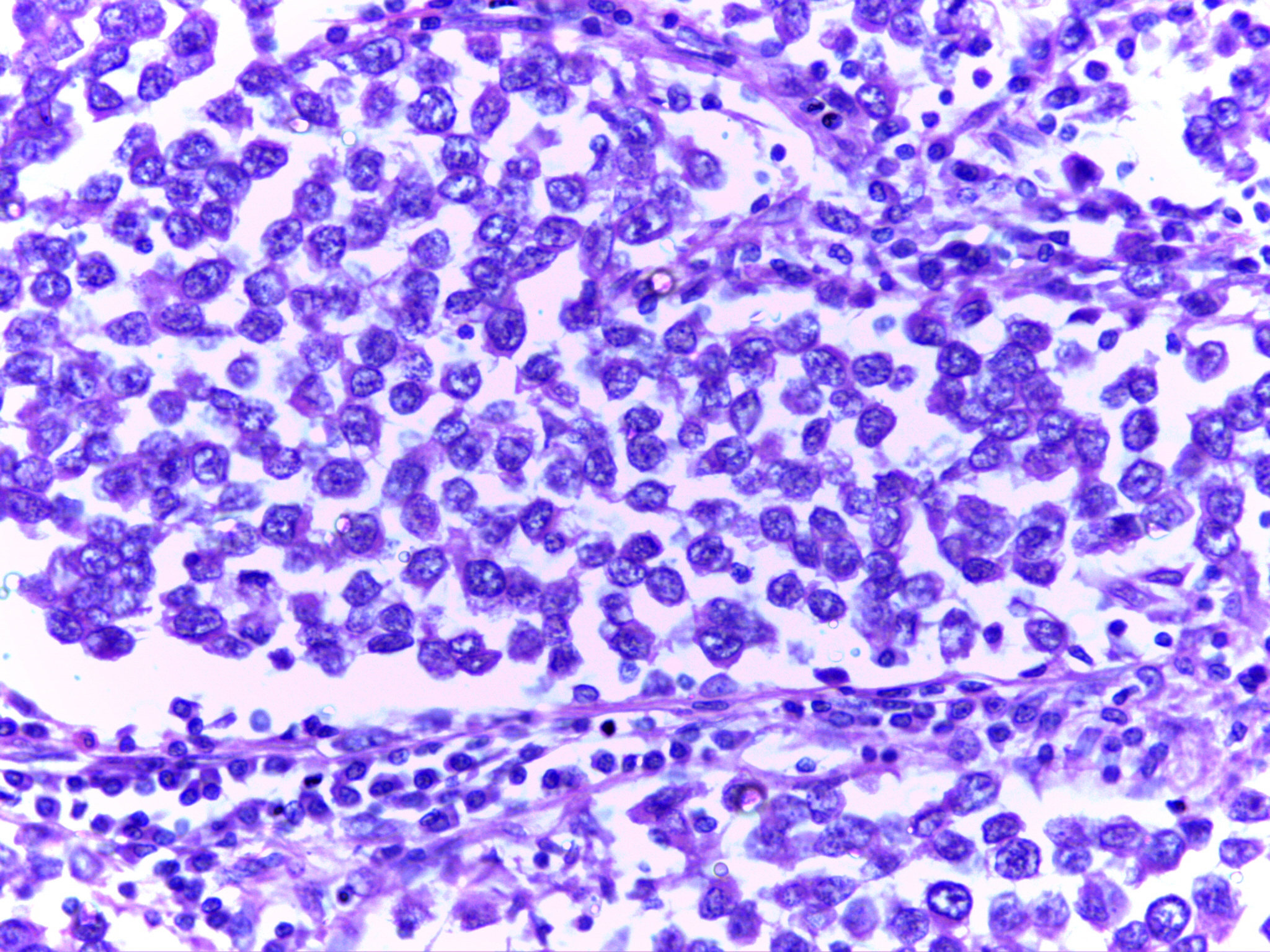
- Germ cell tumors: most common solid cancer in men 15–35; key risk factor cryptorchidism (↑risk in BOTH testes, even after orchiopexy). Presents as a painless, firm intratesticular mass that does NOT transilluminate.
- Seminoma: most common, radiosensitive, excellent prognosis; AFP is NEVER elevated in pure seminoma — if AFP is up, treat as NSGCT. β-hCG mildly ↑ in a minority (syncytiotrophoblasts).
- Nonseminomatous (NSGCT): yolk sac → ↑AFP (Schiller-Duval bodies; most common testicular tumor in young children); choriocarcinoma → ↑β-hCG (gynecomastia, early hematogenous spread); embryonal; teratoma. LDH tracks tumor burden.
- Workup: scrotal ultrasound first + tumor markers (AFP, β-hCG, LDH). NEVER trans-scrotal biopsy (seeding risk) → radical inguinal orchiectomy.
- Benign masses:
- Varicocele: "bag of worms," usually left-sided, decompresses when supine, can impair fertility; new/right-sided or non-reducing → image for RCC/retroperitoneal mass.
- Hydrocele: transilluminates; infant = patent processus vaginalis.
- Spermatocele: cystic, superior to the testis, transilluminates.
Vignette: A 14-year-old boy wakes with sudden, severe left testicular pain and vomiting. The testis is high-riding with a horizontal lie and diffusely tender; the cremasteric reflex is absent; elevating the testis gives no relief (negative Prehn sign).
- Dx: Testicular torsion (bell-clapper deformity) — a surgical emergency.
- Next best step: Immediate urologic exploration → detorsion with bilateral orchiopexy. Do not delay for imaging; salvage is high <6 h and poor >12 h.
- If the OR isn't instantly available: attempt manual detorsion ("open-book," medial→lateral) and obtain Doppler US (↓/absent flow) — but imaging must never postpone surgery.
- Contrast — epididymitis: gradual onset, positive Prehn (relief on elevation), intact cremasteric reflex, dysuria/pyuria, increased Doppler flow.

Acute scrotum differential
| Feature | Testicular torsion | Epididymitis | Torsion of appendix testis |
|---|---|---|---|
| Onset | Sudden, severe | Gradual | Sudden, milder |
| Peak age | Neonates, 12–18 y | Sexually active / older | Prepubertal (7–12 y) |
| Cremasteric reflex | Absent | Present | Present |
| Prehn sign | Negative (no relief) | Positive (relief) | Variable |
| Classic clue | High-riding, horizontal lie | Dysuria, pyuria | "Blue dot" sign |
| Doppler flow | ↓ / absent | Increased (hyperemia) | Normal |
| Management | Emergent surgery | Ceftriaxone + doxycycline (<35); levofloxacin (≥35) | Supportive / NSAIDs |
- α1-blockers end in "-osin" (tamsulosin, alfuzosin, doxazosin) → relax prostatic/bladder-neck smooth muscle.
- Prehn's sign — "Pain Relieved = Epididymitis" (elevation helps); no relief → suspect torsion.
- Seminoma is "Simple" — radioSensitive and AFP Stays normal (pure seminoma never elevates AFP).
- Left varicocele → Left renal vein (left gonadal vein drains there at a right angle) → "bag of worms"; an abrupt/new left varicocele can signal renal cell carcinoma.
- "Prostate builds bone" — prostate cancer classically throws osteoBlastic vertebral mets with ↑alkaline phosphatase.
Practice Reproductive now
Board-style questions, spaced-repetition flashcards, and a Socratic AI tutor — free to start.