Learning Theory & Conditioning
A board-focused tour of learning theory — classical vs. operant conditioning, the reinforcement/punishment quadrant, reinforcement schedules (variable ratio = most extinction-resistant), and non-associative learning — anchored to classic Step 1 vignettes like anticipatory chemo nausea and the tantrum extinction burst.
Overview: how behavior is learned
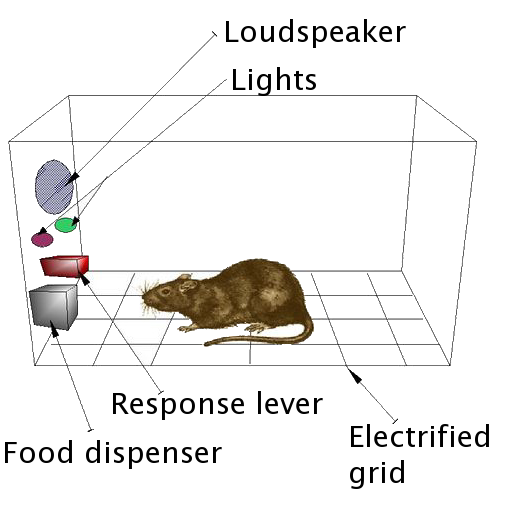
Learning theory explains how behavior is acquired and modified — a reliable Step 1 behavioral-science topic. Two associative paradigms dominate. In classical (Pavlovian) conditioning the organism learns to link two stimuli, producing an involuntary, reflexive response (salivation, nausea, fear). In operant (instrumental) conditioning behavior is shaped by its consequences — the subject actively "operates" on the environment to gain reward or avoid harm. A quick decoder: classical = passive/involuntary responses; operant = voluntary behaviors driven by reinforcement or punishment. Non-associative learning (habituation, sensitization) rounds out the topic. Vignettes rarely name the phenomenon outright — you must recognize it from the stem and choose the correct term or the next-best behavioral intervention.
- Classical conditioning: a neutral stimulus paired with an unconditioned stimulus (US) becomes a conditioned stimulus (CS) that alone triggers the conditioned response (CR).
- Operant rule: Reinforcement raises behavior; punishment lowers it. Positive = add a stimulus; Negative = remove one.
- Negative reinforcement ≠ punishment — it removes an aversive stimulus to increase a behavior (taking an analgesic that relieves pain → you keep taking it). This is the single most-tested trap in the topic.
- Variable-ratio schedule (reward after an unpredictable number of responses) gives the highest, steadiest response rate and is most resistant to extinction — the slot-machine/gambling schedule.
- Extinction: withdrawing the US (classical) or reinforcement (operant) fades the response; a transient extinction burst often precedes the decline.
- Spontaneous recovery: an extinguished response reappears after a rest period.
- Learned helplessness (Seligman): repeated inescapable aversive stimuli → passivity even when escape becomes possible → animal model of depression.
Reinforcement vs. punishment (the 2×2)
| Positive — add stimulus | Negative — remove stimulus | |
|---|---|---|
| Reinforcement (↑ behavior) | Candy for finishing homework | Seatbelt beep stops when buckled |
| Punishment (↓ behavior) | Scolding; extra chores | Phone taken away; "time-out" |

Two independent switches:
- Reinforcement Raises behavior; Punishment droPs it.
- Positive = Present (add) a stimulus; Negative = Negate (remove) one.
Cross them: Negative reinforcement = remove something bad to raise behavior (analgesic relieves pain → keep taking it); Negative punishment = remove something good to drop behavior (lose phone privileges).
Slot machine = variable ratio — the unpredictable payoff is why gambling resists extinction.
Reinforcement schedules
| Schedule | Reward delivered | Response pattern | Extinction |
|---|---|---|---|
| Continuous | Every response | Fastest acquisition | Fast |
| Fixed ratio | After set # of responses | High rate, brief post-reward pause | Moderate |
| Variable ratio | After unpredictable # | Highest, steady | Most resistant |
| Fixed interval | 1st response after set time | Scalloped — surges near deadline | Moderate |
| Variable interval | 1st response after variable time | Steady, moderate | Resistant |
Non-associative learning & classical phenomena
Non-associative learning shows up in stems too. Habituation — the simplest form of learning — is a decreased response to a repeated harmless stimulus (you stop noticing a ticking clock) and is a core principle behind exposure/desensitization-based therapies. Sensitization is an increased response after an intense or noxious stimulus (an exaggerated startle after a gunshot). Within classical conditioning, know stimulus generalization (responding to stimuli resembling the CS — "Little Albert," conditioned to fear a white rat, came to fear other furry white objects), stimulus discrimination (responding only to the specific CS), and spontaneous recovery (an extinguished CR briefly returns after rest — evidence that extinction suppresses rather than erases the learned association).
Vignette: A 54-year-old woman on her 4th cycle of chemotherapy becomes nauseated and vomits in the waiting room before any drug is infused; earlier cycles caused vomiting only after infusion.
Concept — Classical (Pavlovian) conditioning: chemotherapy (US) caused nausea (UR); the clinic setting, repeatedly paired with it, became a conditioned stimulus now eliciting anticipatory nausea (CR).
Next best step (behavioral): relaxation training / systematic desensitization (also guided imagery, hypnosis); a benzodiazepine such as lorazepam is an effective adjunct for anticipatory nausea. Simply escalating the antiemetic dose does not address the conditioned response.
Vignette: A 4-year-old screams at the supermarket checkout until his mother buys him candy. A pediatrician advises her to stop giving in; over the next week the tantrums briefly worsen, then fade.
Concept — Operant conditioning: the candy was positive reinforcement; withholding it produces extinction, and the temporary escalation is an extinction burst.
Next best step: counsel the parent to withhold the reward consistently — intermittent giving-in creates a variable-ratio schedule that makes tantrums harder to extinguish — while praising calm behavior (positive reinforcement of the desired alternative).
Practice Behavioral Science now
Board-style questions, spaced-repetition flashcards, and a Socratic AI tutor — free to start.