GI Physiology: Secretions & Motility
A Step 1-focused tour of GI secretion and motility built around two hubs — the parietal cell (three secretagogues, H⁺/K⁺-ATPase, alkaline tide) and the interstitial cells of Cajal (slow waves, MMC) — with the GI-hormone table, pancreatic/salivary flow-rate curves, feedback loops, and mechanism-driven vignettes (Zollinger-Ellison, achalasia, pernicious anemia).
The two programs: secretion and motility
The GI tract runs two parallel programs the boards love to test: secretion (delivering the right fluid, enzymes, and acid into the lumen at the right time) and motility (moving contents at the right speed). Both are governed by a small cast of endocrine hormones (gastrin, CCK, secretin, GIP), paracrine/neurocrine signals (histamine, somatostatin, VIP, NO), and an intrinsic enteric nervous system.
Two control hubs anchor almost every question:
- Secretory hub — the parietal cell. It integrates three stimulatory inputs (ACh, gastrin, histamine) and is the target of the acid-suppressing drugs you must know.
- Motility hub — the interstitial cells of Cajal (ICC). They set the pacemaker rhythm (slow waves) that times every contraction.
Master those two hubs, the flow-rate curves for pancreas and saliva, and the feedback loops that switch acid on and off, and the classic vignettes (Zollinger-Ellison, achalasia, pernicious anemia) fall out mechanistically.
GI hormones — source, stimulus, action
| Hormone | Source (cell / location) | Major stimuli | Key actions |
|---|---|---|---|
| Gastrin | G cells, gastric antrum | Peptides/amino acids (Phe, Trp), distension, vagus (via GRP) | ↑ H⁺ (mostly indirectly via ECL histamine); trophic to mucosa |
| CCK | I cells, duodenum/jejunum | Fatty acids, amino acids | Gallbladder contraction, sphincter of Oddi relaxation, ↑ pancreatic enzymes, ↓ gastric emptying |
| Secretin | S cells, duodenum | H⁺ (acid), fatty acids | ↑ pancreatic & biliary HCO₃⁻, ↓ gastric acid — "nature's antacid" |
| GIP | K cells, duodenum/jejunum | Fatty acids, amino acids, oral glucose | ↑ insulin (incretin), ↓ gastric acid |
| Motilin | M cells, small intestine | Fasting state | Initiates the MMC (erythromycin = motilin agonist) |
| Somatostatin | D cells, islets & GI mucosa | Luminal acid (↓pH) | Inhibits ~everything (gastrin, secretin, insulin, glucagon, acid) |
| VIP | Enteric neurons (islet-derived in VIPoma) | Distension, vagus | Relaxes smooth muscle/sphincters, ↑ intestinal water/electrolyte secretion |
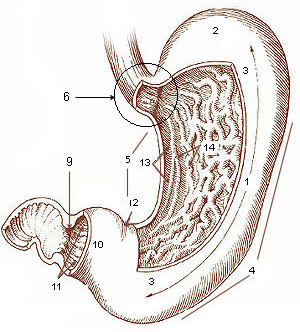
- Apical H⁺/K⁺-ATPase pumps H⁺ into the lumen against a >10⁶ gradient; it is the irreversible target of PPIs. K⁺ recycles; Cl⁻ follows into the lumen as HCl.
- CO₂ + H₂O →(carbonic anhydrase)→ H⁺ + HCO₃⁻. HCO₃⁻ exits basolaterally via a Cl⁻/HCO₃⁻ exchanger → the postprandial "alkaline tide" (venous blood transiently alkaline; loss of gastric H⁺ with vomiting → metabolic alkalosis).
- Three secretagogues: ACh (M3, Gq→Ca²⁺), gastrin (CCK-B, Gq→Ca²⁺; acts largely indirectly by stimulating ECL-cell histamine), and histamine (H2, Gs→cAMP). Histamine is the final common potentiator — why H2 blockers and PPIs are so effective.
- Brakes: somatostatin and prostaglandins (Gi → ↓cAMP). NSAIDs block PGE₂ → ↓ mucus/HCO₃⁻ → ulcers; misoprostol (PGE₁ analog) is protective.
- Parietal cells also make intrinsic factor (binds B12 for terminal ileal absorption) — the only indispensable gastric secretion.
- Phases of acid secretion: cephalic (~30%, vagal), gastric (~50–60%, distension + peptides), intestinal (~10%).
Flow-rate curves: pancreas vs. saliva
| Component | Low flow | High flow (secretin) |
|---|---|---|
| HCO₃⁻ | Low | High (up to ~140 mEq/L) |
| Cl⁻ | High | Low |
| Na⁺, K⁺ | ≈ plasma | ≈ plasma (constant) |
| Tonicity | Isotonic | Isotonic at all rates |
| Component | Low flow | High flow |
| Na⁺, Cl⁻ | Low | Higher (toward plasma) |
| K⁺ | High (highest here) | High (falls slightly, still > plasma) |
| HCO₃⁻ | Lower | Higher (stimulated) |
| Tonicity | Very hypotonic | Always hypotonic (less so) |

Mechanism: an autonomous gastrinoma (duodenal wall or pancreas, often part of MEN1) secretes gastrin independent of pH feedback → parietal-cell hyperplasia → massive acid output. The acid load ulcerates mucosa distal to the duodenal bulb and inactivates pancreatic enzymes / injures villi, producing malabsorptive steatorrhea plus secretory diarrhea.
Vignette: A 46-year-old with multiple, recurrent duodenal/jejunal ulcers refractory to PPIs, chronic diarrhea, and weight loss.
Diagnosis:
- ↑ fasting serum gastrin with gastric pH < 2.
- Secretin stimulation test → paradoxical ↑ gastrin. Normal G cells are inhibited by secretin; tumor cells are stimulated.
- ICC = pacemaker. They generate slow waves (basal electrical rhythm) — subthreshold membrane oscillations that set contraction frequency. A contraction fires only when spike potentials ride atop a wave; ACh/gastrin depolarize (more spikes), VIP/NO hyperpolarize (fewer).
- Slow-wave frequency falls distally: stomach ~3/min, duodenum ~12/min, ileum ~8–9/min.
- Migrating motor complex (MMC): sweeps every ~90 min in the fasted state, driven by motilin — the GI "housekeeper." Erythromycin (motilin agonist) accelerates gastric emptying.
- Enteric nervous system: myenteric (Auerbach) plexus → motility; submucosal (Meissner) plexus → secretion & blood flow.
- Receptive relaxation / gastric accommodation: a vagovagal reflex relaxes the gastric fundus (NO/VIP) to accommodate a meal.
- Gastric emptying is slowed by duodenal fat, acid, hypertonicity (enterogastric reflex + CCK/secretin/GIP).
- LES relaxation depends on NO/VIP inhibitory neurons — the neurons destroyed in achalasia.
Mechanism: degeneration of the inhibitory (NO/VIP) neurons of the myenteric plexus → the LES fails to relax and esophageal peristalsis is lost. Primary/idiopathic, or secondary to Chagas disease (Trypanosoma cruzi).
Vignette: Progressive dysphagia to BOTH solids and liquids (a key contrast with a mechanical stricture, which starts with solids), regurgitation of undigested food, and weight loss.
Workup:
- Barium swallow: dilated esophagus tapering to a "bird's beak" at the GE junction.
- Manometry (gold standard): ↑ resting LES pressure, incomplete LES relaxation, and aperistalsis.
- Long-standing disease carries ↑ risk of esophageal squamous cell carcinoma.
Mechanism: autoimmune chronic atrophic gastritis destroys parietal cells of the gastric body/fundus → loss of intrinsic factor + achlorhydria. Two downstream consequences:
- B12 deficiency (no IF → no terminal-ileal absorption) → megaloblastic anemia and subacute combined degeneration (dorsal columns + lateral corticospinal tracts).
- Achlorhydria removes acid feedback → ↑ gastrin → ECL-cell hyperplasia (risk of gastric carcinoid); also ↑ risk of gastric adenocarcinoma.
Vignette: An older patient with fatigue, glossitis, paresthesias with ↓ vibration/proprioception, macrocytic anemia with hypersegmented neutrophils, ↑ methylmalonic acid and homocysteine, and anti-IF antibodies.

- MEN1 = the "3 P's" → Pituitary, Parathyroid, Pancreas — the last includes the gastrinoma of Zollinger-Ellison.
- VIPoma = "WDHA" (Verner-Morrison / "pancreatic cholera") → Watery Diarrhea, Hypokalemia, Achlorhydria.
- CCK → Cholecystokinin Contracts the gallbladder (and Kills appetite).
Practice Physiology now
Board-style questions, spaced-repetition flashcards, and a Socratic AI tutor — free to start.