Fluid & Electrolyte Management
A Step 2 CK management lesson on fluid and electrolyte emergencies, framed around volume status, symptom severity, and safe correction rate — covering the hyperkalemia stabilize-shift-eliminate algorithm, hyponatremia treatment by volume status with hypertonic-saline rescue, and the correction-rate pitfalls (osmotic demyelination, cerebral edema) that drive the "next best step" answer.
The four-question framework
Every fluid and electrolyte question on Step 2 CK reduces to four decisions, in order: (1) What is the volume status? (2) What is the disorder and how severe/symptomatic is it? (3) How fast can I correct it safely? and (4) What underlying cause must I treat?
The single highest-yield principle is that the rate of correction matters as much as the endpoint. Correct too fast and you trade one emergency for a worse, often irreversible one — osmotic demyelination or cerebral edema. So the algorithm splits early: severe, symptomatic, acute derangements get rapid targeted rescue aimed only at relieving symptoms, while asymptomatic or chronic ones get slow, controlled correction plus treatment of the cause. Match tonicity to the problem, reassess labs frequently, and never over-shoot.
- Severe symptomatic hyponatremia (seizure, coma): 3% hypertonic saline 100–150 mL IV over ~10 min, repeat up to 2–3× until symptoms abate — goal is a quick 4–6 mEq/L rise, NOT normalization.
- Hyponatremia correction limit: ≤ 8 mEq/L per 24 h (use ≤ 6 in high-risk patients) to avoid osmotic demyelination syndrome. If overcorrecting, re-lower Na with D5W ± desmopressin.
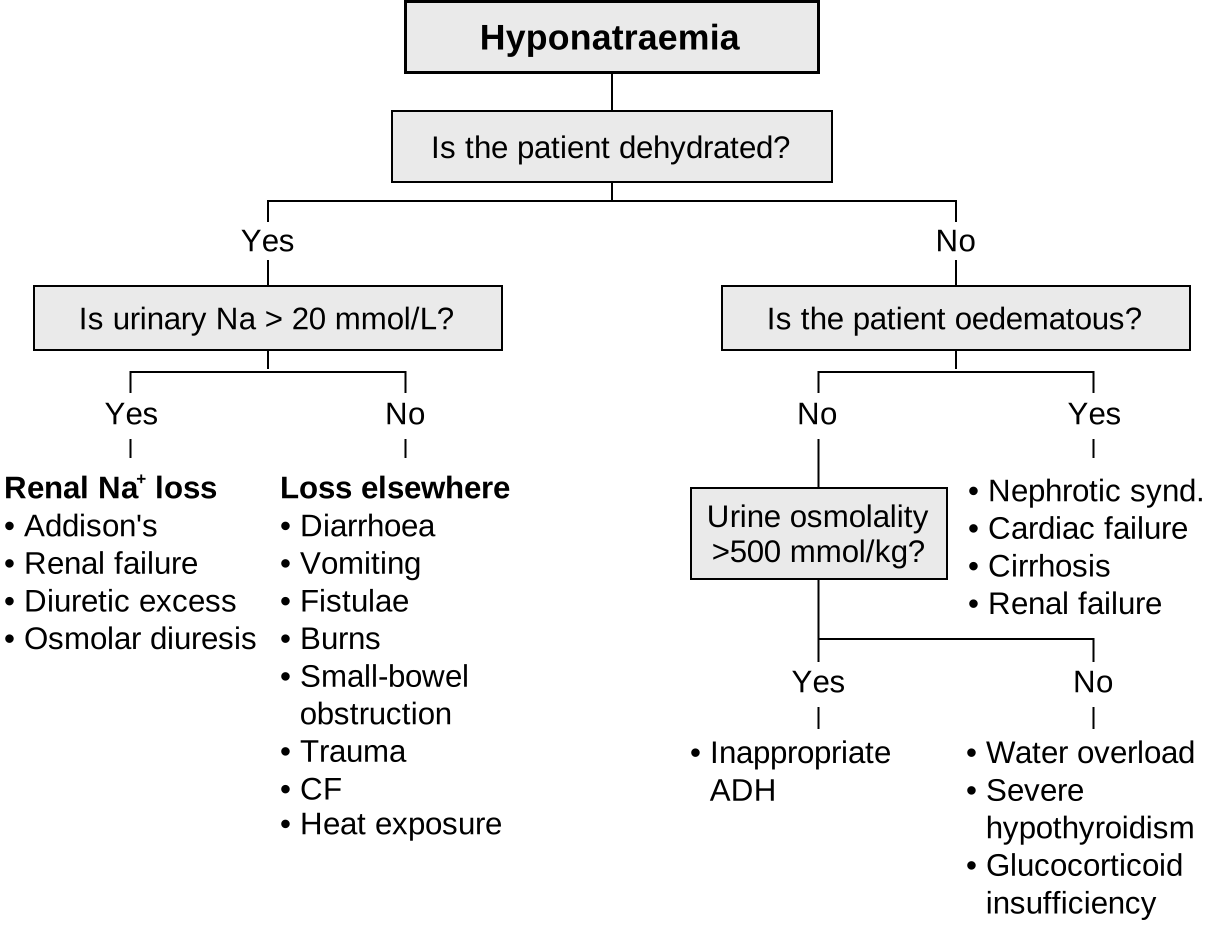
- Hyponatremia by volume: hypovolemic → 0.9% saline; euvolemic/SIADH → fluid restriction (± salt tabs, loop diuretic, vaptan/urea); hypervolemic (HF, cirrhosis) → fluid restriction + loop diuretic + treat cause. Never give hypotonic fluid to fix hyponatremia.
- Hyperkalemia with ECG changes → IV calcium FIRST (stabilizes myocardium, does not lower K), then insulin + glucose ± albuterol to shift, then remove K (loop diuretic, GI binder, dialysis = definitive).
- Hypernatremia: correct the free-water deficit slowly, ≤ 10–12 mEq/L per 24 h (chronic); too-fast correction → cerebral edema.
- Refractory hypokalemia → replace magnesium. Hypomagnesemia drives renal K wasting; K won't stay up until Mg is repleted (same rule for refractory hypocalcemia).
- DKA: isotonic fluids first, then insulin infusion; replete K and HOLD insulin if K < 3.3; do not stop the drip until the anion gap closes.
Hyperkalemia: stepwise management
| Priority | Agent | Typical dose | Action | Onset / Duration |
|---|---|---|---|---|
| 1. Stabilize membrane | Calcium gluconate 10% | 10 mL IV over 2–3 min | Antagonizes cardiac membrane effects; does NOT lower K | 1–3 min / 30–60 min |
| 2. Shift K in | Regular insulin + dextrose | 10 U IV + 25 g dextrose (D50 50 mL) | Drives K intracellularly (workhorse) | 15–30 min / 4–6 h |
| 2. Shift (adjunct) | Albuterol nebulized | 10–20 mg neb | β2-driven intracellular shift | ~30 min / ~2 h |
| 2. Shift (if acidotic) | Sodium bicarbonate | — | Modest and unreliable; only if metabolic acidosis, not a stand-alone acute agent | Slow |
| 3. Remove K | Loop diuretic / GI cation exchanger / dialysis | — | Only step that removes K from the body; dialysis is definitive (anuria/refractory) | Varies |

A 68-year-old woman on hydrochlorothiazide presents with confusion and a witnessed generalized seizure. Exam is euvolemic. Labs: Na 112 mEq/L, serum osm 245, urine osm 480.
Next best step in management: 3% hypertonic saline, 100–150 mL IV bolus over ~10 min, repeated until the seizure stops — targeting only a 4–6 mEq/L rise over the first few hours. Stop the thiazide. Check Na every 2 h; keep the total rise ≤ 8 mEq/L in 24 h.
- Why not normal saline? Too slow for an actively seizing patient — a symptomatic emergency demands hypertonic saline regardless of volume status.
- Why not full/rapid correction to normal? Over-rapid correction of chronic hyponatremia causes osmotic demyelination (central pontine myelinolysis).
- If Na rises too fast, re-lower with D5W ± desmopressin.
Hyponatremia management by volume status
| Volume status | Typical causes | First-line management | Avoid |
|---|---|---|---|
| Hypovolemic | GI/renal losses, diuretics, adrenal insufficiency, cerebral salt wasting | Isotonic 0.9% saline + treat cause | Over-rapid rise once volume repletes |
| Euvolemic | SIADH, hypothyroidism, psychogenic polydipsia, beer potomania (low solute) | Fluid restriction; add salt tabs ± loop diuretic; vaptan/urea if refractory | Free water; isotonic fluid in true SIADH |
| Hypervolemic | Heart failure, cirrhosis, nephrotic, renal failure | Fluid restriction + loop diuretic; treat the underlying disease | Isotonic/free water loading |
| Any — if severe symptoms | Seizure, coma, obtundation | 3% hypertonic saline bolus, target 4–6 mEq/L rise | Correction > 8 mEq/L / 24 h |
Direction of osmotic injury (a true, high-yield rhyme):
*"From low to high, the pons will die; from high to low, the brain will blow."*
- Correcting hyponatremia too fast (low→high) → osmotic demyelination / central pontine myelinolysis.
- Correcting hypernatremia too fast (high→low) → cerebral edema.
Hyperkalemia — the three-step sequence: _Stabilize → Shift → Eliminate_:
- Stabilize the myocardium — IV calcium (does not lower K; buys ~30–60 min).
- Shift K intracellularly — insulin + glucose (the workhorse) and nebulized albuterol; bicarbonate only if the patient is acidotic (weak, not a reliable acute agent).
- Eliminate K from the body — loop diuretic (if making urine), GI K-binder, and dialysis (definitive).
Only the last step actually removes potassium — calcium and the shifters buy time but leave total-body K unchanged.
A 55-year-old man with CKD has K 7.1 mEq/L; ECG shows peaked T waves and a widening QRS.
Next best step in management: IV calcium gluconate immediately to stabilize the myocardium — the answer to "next step" whenever ECG changes are present. Then regular insulin 10 U + D50 (± nebulized albuterol) to shift K intracellularly, and arrange definitive removal — dialysis given CKD/likely anuria (a loop diuretic only if he is still making urine).
- Recheck K and ECG after intervention.
- Stop the offenders: ACE inhibitor/ARB, K-sparing diuretics, K supplements, NSAIDs.
- Do not stop after calcium — it buys ~30–60 min but does not lower the potassium.
Pitfalls and monitoring
The classic wrong answers cluster around rate and sequencing:
- Overcorrection is the trap. Reassess sodium q2–4 h during active treatment; when in doubt, correct slower.
- Calcium does not lower potassium — never treat hyperkalemia with calcium alone.
- Don't give insulin without glucose (unless the patient is hyperglycemic) — you will cause hypoglycemia.
- Kayexalate (sodium polystyrene sulfonate) is slow and risks colonic necrosis — it is not an acute rescue; newer binders (patiromer, sodium zirconium cyclosilicate) are preferred for subacute/chronic control.
- In DKA the potassium can look normal or high while total-body K is depleted — it will fall once insulin starts, so replete early and hold insulin if K < 3.3.
- Chase magnesium in refractory hypokalemia and hypocalcemia.
- Match the fluid to the problem: isotonic saline for resuscitation and hypovolemic hyponatremia; free water/hypotonic fluid to correct a hypernatremic deficit — never the reverse.
Practice Clinical Management now
Board-style questions, spaced-repetition flashcards, and a Socratic AI tutor — free to start.