Endometriosis, Adenomyosis & Uterine Fibroids
A high-yield board lesson contrasting endometriosis, adenomyosis, and uterine leiomyomas by tissue location and exam findings, then walking pathophysiology to presentation to diagnosis to management with classic vignette buzzwords and fertility-keyed next-best-step decisions. Anchored by a side-by-side comparison table and two clinical vignettes.
The three great uterine mimics
Endometriosis, adenomyosis, and uterine leiomyomas are the three estrogen-dependent disorders behind most chronic pelvic pain and abnormal uterine bleeding (AUB) in reproductive-age women, and all three tend to regress after menopause as ovarian estrogen falls (fibroid growth is also progesterone-driven). Boards separate them by where the tissue is and how the uterus feels: endometrial-like glands + stroma outside the uterus (endometriosis), endometrial tissue burrowed into the myometrium (adenomyosis), or a benign smooth-muscle tumor of the myometrium (leiomyoma). Nail the exam finding — a fixed, often retroverted uterus with tender uterosacral nodularity; a boggy, symmetrically enlarged, tender uterus; or a firm, irregular, "lumpy-bumpy" uterus — and the diagnosis usually declares itself before imaging. Management then hinges on age, symptom severity, and whether fertility must be preserved.
- Endometriosis = endometrial glands + stroma outside the uterus. Leading theory: retrograde menstruation (Sampson); also coelomic metaplasia (Meyer). Classic sites: ovary (endometrioma = "chocolate cyst") — the most common site, posterior cul-de-sac, uterosacral ligaments, and pelvic peritoneum ("powder-burn" lesions). Classic patient: nulliparous, 25–35; a leading cause of infertility.
- Adenomyosis = endometrial tissue within the myometrium → diffuse, symmetric uterine enlargement. Classic in multiparous women in their 40s.
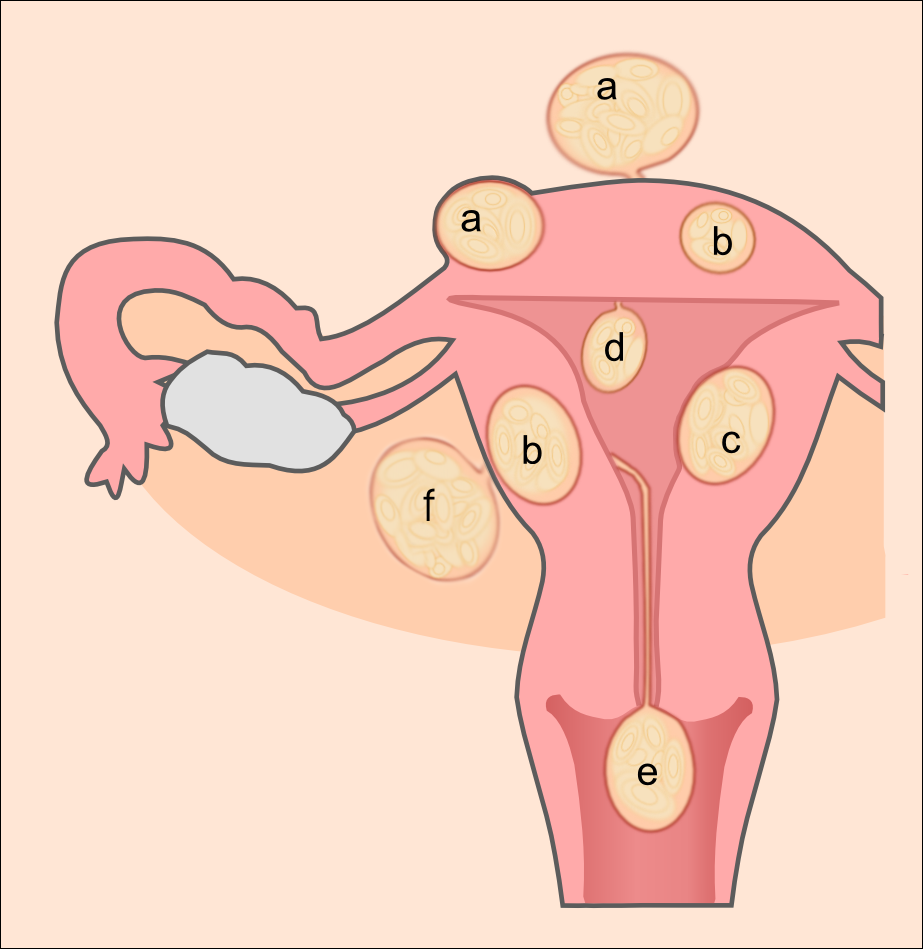
- Leiomyoma (fibroid) = benign monoclonal smooth-muscle tumor, estrogen- and progesterone-responsive. Most common benign tumor in women; more frequent, larger, and earlier in Black women. Histology: whorled bundles of smooth muscle.
- Subtypes: submucosal → most bleeding/infertility (least common); intramural → most common; subserosal → bulk/mass effect; pedunculated can torse.
Head-to-head comparison
| Feature | Endometriosis | Adenomyosis | Leiomyoma (fibroid) |
|---|---|---|---|
| Pathology | Endometrium outside uterus | Endometrium within myometrium | Benign smooth-muscle tumor |
| Typical patient | Nulliparous, 25–35, infertility | Multiparous, 40s | 30s–40s; worse in Black women |
| Pain / bleeding | Cyclic dysmenorrhea, dyspareunia, dyschezia | Dysmenorrhea + menorrhagia | Often painless; menorrhagia, bulk |
| Uterus on exam | Normal size, fixed/retroverted, uterosacral nodularity | Boggy, symmetric, tender, enlarged | Firm, irregular, "lumpy-bumpy," nontender |
| Best diagnostic | Laparoscopy (gold standard, ± biopsy) | MRI/TVUS; histology definitive | TVUS (first-line) |
| Definitive tx | Laparoscopic excision/ablation; TAH-BSO if childbearing complete | Hysterectomy | Hysterectomy; myomectomy if fertility desired |
Stem: A 29-year-old nulligravida reports 3 years of pelvic pain starting 1–2 days before menses, deep dyspareunia, and painful defecation during periods. Exam: tender nodularity along the uterosacral ligaments and a fixed, retroverted uterus. She has been trying to conceive for 14 months.
- Diagnosis: Endometriosis. Definitive dx = diagnostic laparoscopy with direct visualization ± biopsy; TVUS may reveal an endometrioma, but a normal scan does not exclude disease.
- Next best step — she is actively trying to conceive, so hormonal suppression is inappropriate (combined OCPs, progestins, and GnRH agonists all prevent pregnancy). Go to diagnostic laparoscopy, which confirms the diagnosis and lets you ablate/excise implants — improving both pain and fertility; refer for infertility evaluation/ART as needed.
- When pregnancy is not the immediate goal, first-line endometriosis pain therapy is empiric NSAIDs + combined OCPs (or a progestin), escalating to a GnRH agonist with add-back or a GnRH antagonist (elagolix) if refractory.
- CA-125 may be elevated but is nonspecific — do not use it to diagnose.
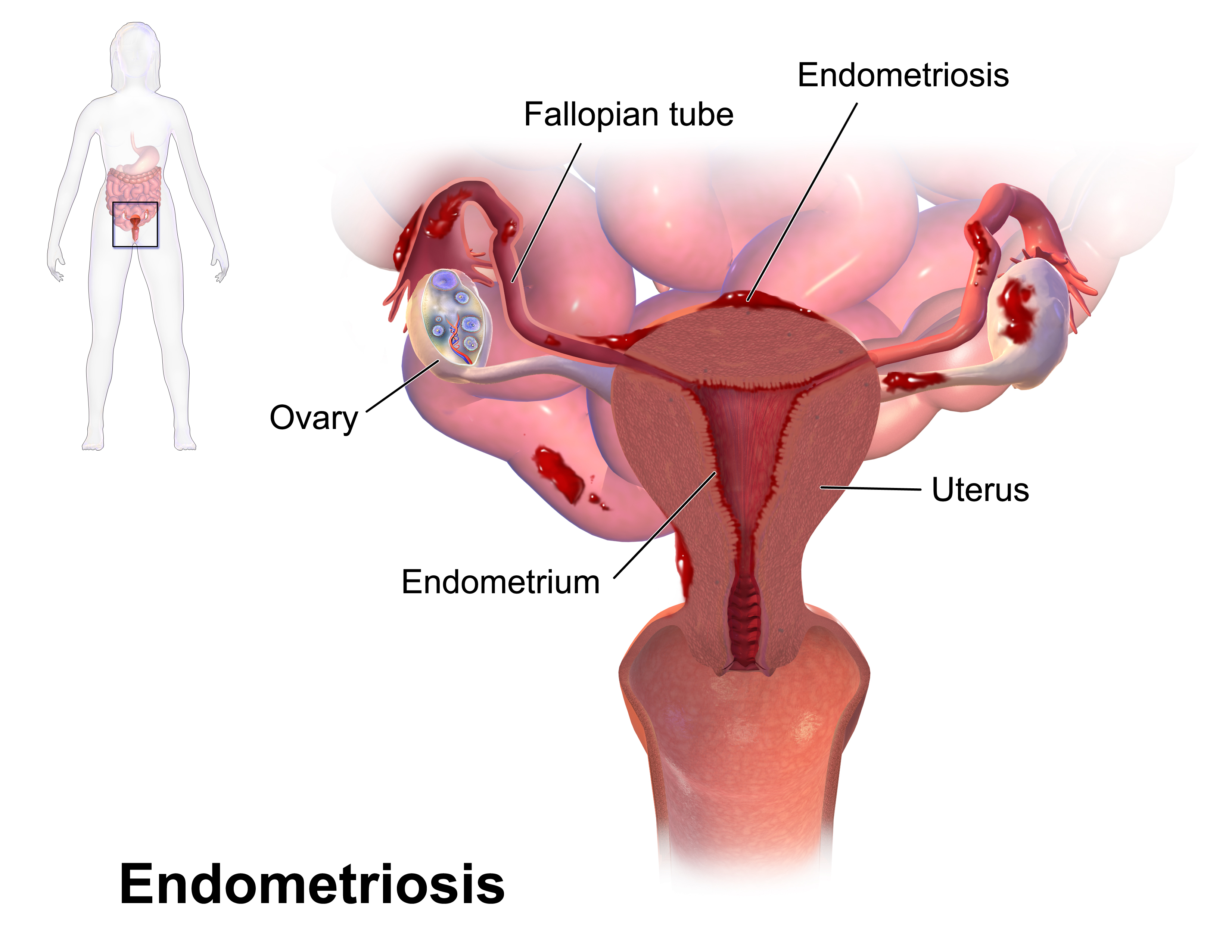
- Best test by disease: endometriosis → laparoscopy (gold standard, direct visualization ± biopsy); adenomyosis → MRI (junctional zone ≥12 mm) or TVUS, definitive = histology after hysterectomy; fibroids → transvaginal ultrasound (first-line), with saline-infusion sonohysterography / hysteroscopy to define submucosal lesions and the cavity.
- Buzzwords: "chocolate cyst" = endometrioma; "powder-burn" peritoneal lesions = endometriosis; "boggy, symmetrically enlarged, tender" uterus = adenomyosis; "irregular, lumpy-bumpy, firm, nontender" uterus = fibroids.
- Red (carneous) degeneration of a fibroid → acute focal pain in pregnancy (fibroid outgrows its blood supply).
- Leiomyosarcoma is rare (<1%) and arises de novo, not from a benign fibroid — the red flag is an enlarging uterine mass, especially new growth after menopause.
- Always exclude the dangerous mimic in AUB: obtain an endometrial biopsy to rule out hyperplasia/carcinoma in women ≥45, or younger with risk factors (unopposed estrogen/obesity/PCOS, or failed medical therapy).
- Chronic menorrhagia → iron-deficiency anemia: check a CBC.
- Endometriosis: NSAIDs + OCPs/progestins → GnRH agonist (leuprolide) with add-back or GnRH antagonist (elagolix) → laparoscopic ablation/excision; TAH-BSO is definitive once childbearing is complete.
- Adenomyosis: LNG-IUD, OCPs, NSAIDs for symptoms; hysterectomy is the only cure.
- Fibroids:
- Asymptomatic → observe.
- Bleeding, wants fertility → tranexamic acid / OCPs / LNG-IUD (the IUD is less reliable if a submucosal fibroid distorts the cavity → higher expulsion); short-course GnRH agonist to shrink the fibroid and correct anemia before surgery.
- Myomectomy = fertility-sparing surgery (hysteroscopic for submucosal); uterine artery embolization — avoid if future pregnancy is desired; hysterectomy = definitive.
- Add-back estrogen/progestin blunts the vasomotor symptoms and bone loss from prolonged GnRH-agonist use.
- The 4 D's of endometriosis: Dysmenorrhea, Dyspareunia, Dyschezia, Dysuria — cyclic pain across multiple pelvic tracts (plus subfertility).
- Sampson's theory = retrograde menstruation — the leading explanation for how implants seed the pelvis.
- Adenomyosis = "boggy" uterus in a parous woman with heavy, painful periods.
- Fibroid = "whorls" of smooth muscle on histology; a "lumpy-bumpy," firm, enlarged, nontender uterus on exam.
Stem: A 44-year-old G3P3 has 6 months of heavy, prolonged menses and fatigue; Hb 9.2 g/dL. Exam reveals an enlarged, firm, irregular, nontender uterus.
- Next best step: transvaginal ultrasound → a hypoechoic submucosal leiomyoma. Because she is 44 with new AUB, also obtain an endometrial biopsy to exclude hyperplasia/carcinoma before attributing bleeding to the fibroid.
- Management: replete iron; control bleeding with tranexamic acid (or hormonal therapy); hysteroscopic myomectomy is definitive for a symptomatic submucosal fibroid and preserves the uterus; hysterectomy if childbearing is complete and she wants definitive treatment.
- Contrast: the same heavy, painful menses in this parous 40-something but with a symmetrically enlarged, boggy, tender uterus → think adenomyosis → confirm with TVUS/MRI, treat with LNG-IUD, cure with hysterectomy.
Practice Reproductive now
Board-style questions, spaced-repetition flashcards, and a Socratic AI tutor — free to start.