Endocrine Physiology: Hormone Axes & Feedback
A Step 1-focused tour of the hypothalamic-pituitary axes, built around the three-tier feedback logic that localizes disease (primary/secondary/tertiary), the second-messenger buckets every hormone falls into, and the classic clinical breaks — adrenal insufficiency and prolactinoma. Emphasizes the rules the boards actually test: pulsatile GnRH, diurnal cortisol, POMC-driven hyperpigmentation, and mid-cycle estrogen positive feedback.
The three-tier axis and how feedback localizes disease
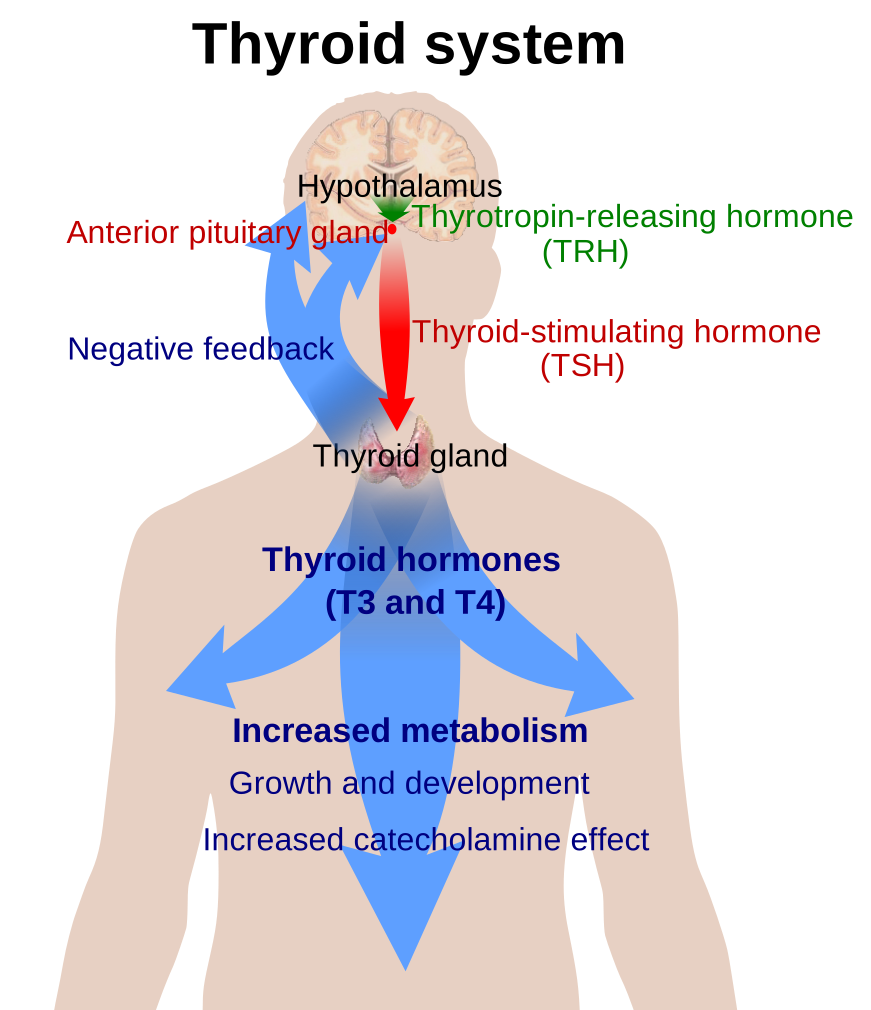
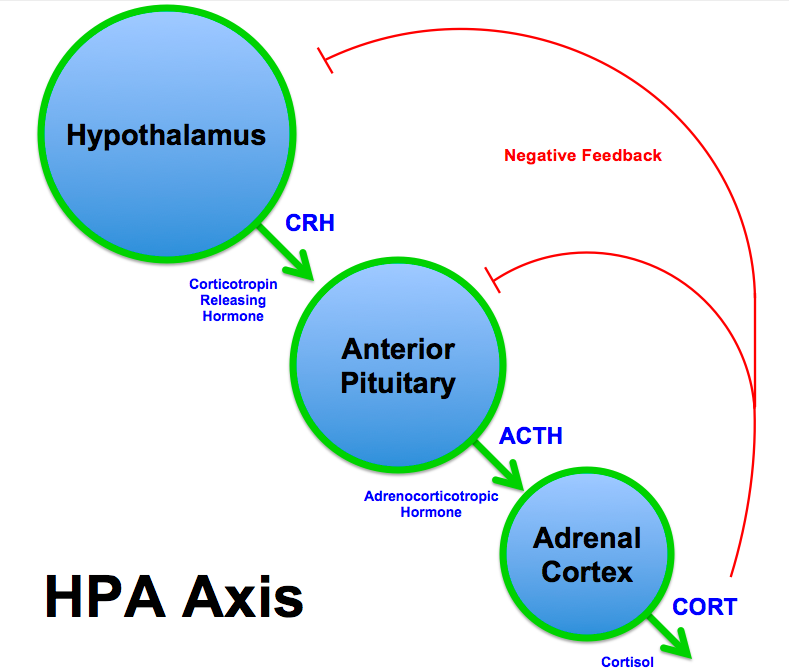
Every classic endocrine axis is a three-tier relay governed by negative feedback. The hypothalamus releases a releasing hormone into the hypophyseal portal veins → the anterior pituitary secretes a tropic hormone → the peripheral gland makes the final effector hormone, which loops back to shut off the tiers above it.
- Long-loop feedback: the peripheral hormone (cortisol, T3/T4, sex steroids) inhibits both hypothalamus and pituitary.
- Short-loop feedback: the pituitary hormone inhibits the hypothalamus.
- Ultra-short-loop feedback: a hypothalamic hormone inhibits its own release.
Localize any lesion by pairing the two hormones:
- Primary = target gland fails → low effector hormone, high tropic hormone (feedback lost).
- Secondary = pituitary fails → low effector, low/inappropriately normal tropic hormone.
- Tertiary = hypothalamus fails → low releasing hormone → low tropic and effector.
The posterior pituitary is not a feedback axis — it merely stores ADH and oxytocin synthesized in the hypothalamic supraoptic/paraventricular nuclei and releases them down axons.

- Anterior pituitary is controlled through the hypophyseal PORTAL veins; posterior pituitary hormones arrive by axonal transport.
- GnRH must be PULSATILE to stimulate LH/FSH — continuous GnRH agonist (steady-state leuprolide) suppresses gonadotropins via receptor downregulation.
- Prolactin is unique: tonically INHIBITED by dopamine. Remove dopamine tone (stalk section, D2-blocking drugs) → prolactin rises.
- ACTH is cleaved from POMC (which also yields MSH); low cortisol → high POMC → hyperpigmentation.
- Cortisol follows a diurnal rhythm: peak in the early morning, nadir near midnight.
- Inhibin selectively inhibits FSH; activin stimulates it.
- Mid-cycle estrogen flips to POSITIVE feedback → the LH surge → ovulation.
- GH works directly (insulin-antagonist / diabetogenic) and indirectly via liver IGF-1 (growth).
The five anterior-pituitary axes
| Axis | Hypothalamus | Anterior pituitary | Target → effector | Feedback signal |
|---|---|---|---|---|
| Adrenal (HPA) | CRH | ACTH | Adrenal cortex → cortisol | Cortisol ⊣ CRH/ACTH; AM peak, midnight nadir |
| Thyroid (HPT) | TRH | TSH | Thyroid → T3/T4 | T3/T4 ⊣ TRH & TSH |
| Gonadal (HPG) | GnRH (pulsatile) | LH, FSH | Gonads → estrogen / testosterone / progesterone; inhibin | Sex steroids ⊣ (but mid-cycle estrogen ⊕ LH surge); inhibin ⊣ FSH only |
| Growth | GHRH (+); somatostatin (–) | GH | Liver → IGF-1 | IGF-1 & GH ⊣ GHRH and ⊕ somatostatin |
| Prolactin | Dopamine (–, tonic); TRH (+) | Prolactin | Breast → milk | Prolactin ⊕ its own dopamine (short loop); prolactin ⊣ GnRH |
Signal transduction — sort every hormone into a bucket
| Pathway | Second messenger | Hormones (mnemonic) |
|---|---|---|
| Gs → adenylyl cyclase | ↑ cAMP → PKA | FLAT ChAMP: FSH, LH, ACTH, TSH, CRH, hCG, ADH (V2), MSH, PTH — plus Calcitonin, GHRH, Glucagon |
| Gi | ↓ cAMP | M2, α2, D2 |
| Gq → phospholipase C | ↑ IP3 / DAG → ↑Ca²⁺, PKC | GOAT HAG: GnRH, Oxytocin, ADH (V1), TRH, Histamine (H1), Angiotensin II, Gastrin (+ α1, M1, M3) |
| Receptor tyrosine kinase | RAS → MAP kinase | Insulin, IGF-1, FGF, PDGF, EGF |
| JAK/STAT | non-receptor tyrosine kinase | GH, Prolactin, cytokines (IL-2/6, IFN), G-CSF, EPO, TPO, leptin |
| Intracellular / nuclear receptor | alters gene transcription | VET CAP: Vit D, Estrogen, Testosterone, Cortisol, Aldosterone, Progesterone (+ T3/T4) |
Mechanism: In primary adrenal insufficiency the cortex itself is destroyed, so both cortisol and aldosterone fall. Lost cortisol feedback drives POMC → ↑ACTH + ↑MSH, and absent aldosterone produces hyperkalemia + hyponatremia (± mild metabolic acidosis). In secondary disease the pituitary fails: ACTH is low so cortisol falls, but aldosterone is preserved because it is driven mainly by the renin–angiotensin system and K⁺, not ACTH.
Vignette (primary): A 42-year-old woman has months of fatigue, weight loss, salt craving, and orthostatic hypotension. Exam shows hyperpigmented palmar creases and buccal mucosa. Labs: Na⁺ 128, K⁺ 5.8, low glucose; ACTH high, cortisol low → Addison disease (autoimmune adrenalitis in developed countries; TB the leading cause worldwide).
Contrast (secondary): A patient on chronic high-dose prednisone stops abruptly and crashes during an infection. No hyperpigmentation, K⁺ normal (aldosterone intact), ACTH low — HPA suppression from exogenous steroid and adrenal atrophy, not gland destruction. Note Na⁺ can still dip in secondary disease (cortisol loss disinhibits ADH), so the true discriminators from primary are the normal K⁺ and absent hyperpigmentation, not the sodium.
Mechanism: Prolactin is held down by hypothalamic dopamine. A prolactinoma — or loss of dopamine tone from stalk compression or D2-blocking antipsychotics — raises prolactin, which inhibits GnRH → ↓LH/FSH → hypogonadism, plus direct galactorrhea.
Vignette: A 28-year-old woman reports 6 months of amenorrhea, milky nipple discharge, low libido, and new bitemporal hemianopia (a macroadenoma compressing the optic chiasm). Prolactin is markedly elevated. First-line therapy is a dopamine agonist (cabergoline or bromocriptine), which also shrinks the tumor — not upfront surgery, even with visual-field loss.
Board trap: Primary hypothyroidism raises TRH, and TRH stimulates prolactin — always check TSH before calling it a prolactinoma.
Cortisol — "A BIG FIB" (everything up except bone):
- Appetite ↑
- Blood pressure ↑ (upregulates α1 receptors → permissive for catecholamines & angiotensin II)
- Insulin resistance ↑ (diabetogenic)
- Gluconeogenesis, lipolysis, and proteolysis ↑
- Fibroblast activity ↓ (thin skin, striae, poor wound healing)
- Immune / Inflammatory suppression (↓ phospholipase A2 via annexin A1, ↓ IL-2, ↓ leukocyte adhesion → neutrophilia with ↓ eosinophils/lymphocytes)
- Bone formation ↓ (osteoporosis)
Growth hormone:
- Secreted in pulses, greatest during slow-wave (deep) sleep; ↑ by exercise, hypoglycemia, stress, puberty; inhibited by somatostatin and by glucose/IGF-1.
- Direct effect: ↓ peripheral glucose uptake + ↑ lipolysis → insulin resistance.
- Indirect effect: stimulates hepatic IGF-1 (somatomedin C) → bone/cartilage and muscle growth.
- FLAT ChAMP → Gs / cAMP hormones: FSH, LH, ACTH, TSH, CRH, hCG, ADH (V2), MSH, PTH — plus Calcitonin, GHRH, Glucagon.
- GOAT HAG → Gq / IP3 hormones: GnRH, Oxytocin, ADH (V1), TRH, Histamine (H1), Angiotensin II, Gastrin.
- VET CAP → intracellular (steroid/nuclear) receptors: Vit D, Estrogen, Testosterone, Cortisol, Aldosterone, Progesterone (thyroid hormone too).
- A BIG FIB → cortisol's actions (see above).
- "Primary raises the tropic hormone": if the target gland is the problem, the pituitary hormone (TSH, ACTH, LH/FSH) goes UP.
- Pulsatile = GO, continuous = STOP for GnRH therapy.
Second-order feedback patterns the boards test
Exam questions live in the downstream consequences of feedback. A few reliably tested patterns:
- Dexamethasone suppression: low-dose suppresses a normal axis; high-dose suppresses a pituitary (Cushing disease) source but NOT an adrenal tumor or ectopic ACTH.
- Exogenous hormone excess suppresses the tropic hormone and atrophies the gland — abrupt steroid withdrawal → adrenal crisis.
- Primary hypothyroidism raises TRH, which can also raise prolactin → galactorrhea alongside a high TSH in the same patient.
- Estrogen's dual feedback: negative through most of the cycle, positive at mid-cycle to trigger the LH surge — the one setting where a peripheral hormone drives its own axis up.
Master the tier-pairing logic plus the signal-transduction buckets, and most endocrine physiology questions collapse into pattern recognition.
Practice Physiology now
Board-style questions, spaced-repetition flashcards, and a Socratic AI tutor — free to start.