Early Pregnancy: Ectopic & Miscarriage
A Step 2 CK high-yield lesson on early-pregnancy emergencies, walking ectopic pregnancy and spontaneous abortion from pathophysiology through β-hCG/TVUS diagnosis to next-best-step management, anchored by stable-vs-unstable vignettes, a cervical-os comparison table, and board decision rules.
Ectopic pregnancy is implantation outside the endometrial cavity — ~95% tubal, most often in the ampulla. The risk factors share one theme: tubal damage or dysmotility — prior ectopic, pelvic inflammatory disease (Chlamydia/gonorrhea salpingitis), tubal surgery or ligation, IVF/assisted reproduction, and smoking; an IUD in place raises the relative likelihood that a pregnancy is ectopic. Untreated tubal rupture causes life-threatening hemoperitoneum.
Miscarriage (spontaneous abortion) is pregnancy loss before 20 weeks and complicates ~10–15% of recognized pregnancies. The dominant cause of sporadic first-trimester loss is fetal chromosomal abnormality — autosomal trisomies as a group are most common (trisomy 16 the most frequent single trisomy), while 45,X (Turner) is the single most frequent karyotype overall.
On boards, both diagnoses hinge on the same first two tests: quantitative β-hCG and transvaginal ultrasound (TVUS) — and in any reproductive-age woman with abdominal pain or bleeding, the pregnancy test comes first.

- Classic triad: amenorrhea + unilateral pelvic pain + vaginal bleeding, ~6–8 weeks from LMP.
- Discriminatory zone: an intrauterine pregnancy (IUP) should be visible on TVUS once β-hCG is >1,500–2,000 mIU/mL (many centers now use 3,500 to avoid acting against a potentially viable IUP). Above the zone with an empty uterus = ectopic until proven otherwise.
- Normal early IUP β-hCG rises ≥35% per 48 h (the modern minimal-rise threshold; older texts cite doubling). A plateau or sluggish rise suggests ectopic or nonviable pregnancy.
- TVUS clues: empty uterus, adnexal mass / tubal ring, free fluid in the cul-de-sac.
- Ruptured ectopic: sudden severe pain, syncope, hypotension, Kehr sign (referred left-shoulder pain), cervical-motion + adnexal tenderness.
- Do not be fooled by a pseudogestational sac (endometrial fluid) — a true IUP requires a yolk sac or embryo.
Vignette: A 27-year-old with prior chlamydial PID, 7 weeks from her LMP, presents with sudden severe right-lower-quadrant pain and near-syncope. BP 82/50, HR 122; the abdomen is rigid with rebound. Urine β-hCG is positive.
Diagnosis: Ruptured ectopic pregnancy with hemoperitoneum and hemorrhagic shock.
Next best step: She is hemodynamically unstable — do not wait for quantitative labs or formal imaging. Resuscitate with IV fluids/blood and go to immediate surgery (laparotomy, or laparoscopy if a team is instantly ready) → salpingectomy. A bedside FAST/TVUS showing free fluid confirms but must not delay the OR. Methotrexate is contraindicated with rupture or instability. Give anti-D immune globulin if Rh(D)-negative.
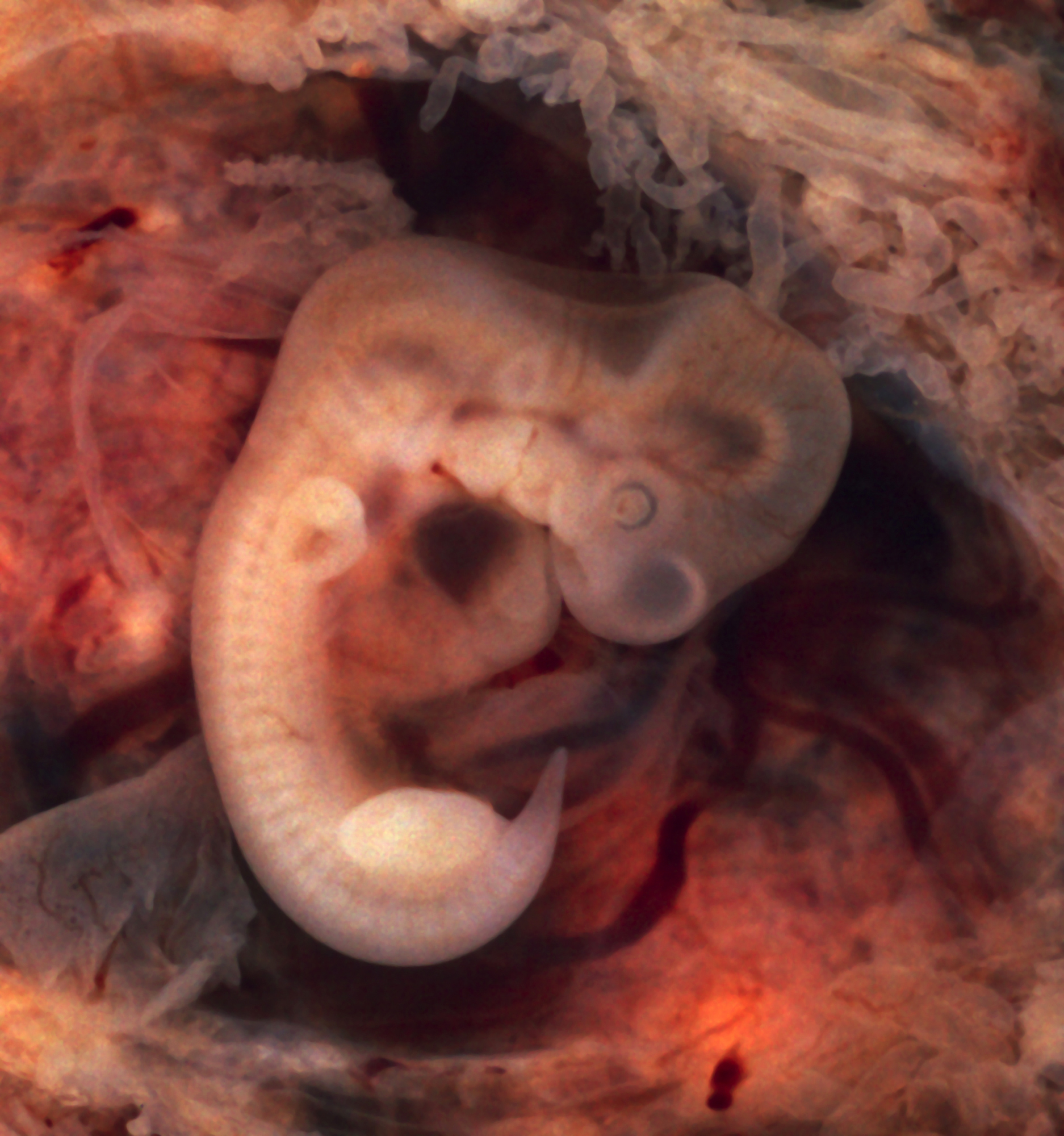
Types of spontaneous abortion
| Type | Cervical os | Products passed | Key finding |
|---|---|---|---|
| Threatened | Closed | None | Bleeding + viable IUP; good prognosis (~90% continue) once cardiac activity is confirmed |
| Inevitable | Open | None yet | Bleeding/cramps; POC not yet expelled — cannot be stopped |
| Incomplete | Open | Partial | Retained POC on US; ongoing bleeding/cramping |
| Complete | Closed | All | Empty uterus; bleeding and pain resolving |
| Missed | Closed | None | Fetal demise (no cardiac activity), often asymptomatic |
| Septic | Open | ± | Fever, uterine tenderness, foul discharge — emergency |
- Sonographic criteria for a nonviable pregnancy (definitive): crown-rump length ≥7 mm with no cardiac activity, or mean sac diameter ≥25 mm with no embryo.
- Threatened abortion: expectant management; bed rest is not proven to help. Reassure.
- Missed / incomplete abortion (stable): offer expectant, medical (misoprostol ± mifepristone), or surgical (uterine aspiration/D&C) — patient preference drives the choice.
- Go straight to surgical evacuation if hemorrhage, hemodynamic instability, or infection.
- Septic abortion: broad-spectrum IV antibiotics + prompt uterine evacuation — do not delay.
- Give anti-D immune globulin to Rh(D)-negative patients with first-trimester bleeding or loss.
- Recurrent loss (≥2–3): work up antiphospholipid syndrome, uterine anomalies, parental balanced translocations, and thyroid/glycemic control.
Vignette: A stable 24-year-old presents with mild left pelvic pain and spotting. β-hCG is 1,900 mIU/mL; TVUS shows an empty uterus with a 2-cm left adnexal mass and no cardiac activity. A repeat β-hCG at 48 h fails to rise appropriately.
Diagnosis: Unruptured tubal ectopic pregnancy (hemodynamically stable).
Next best step: She is a candidate for medical management with single-dose IM methotrexate. Ideal criteria: stable, unruptured, mass <3.5–4 cm, β-hCG <5,000, no fetal cardiac activity, reliable follow-up. Track β-hCG on days 4 and 7 — expect a ≥15% decline between them; if not, give a second dose or operate. Counsel to avoid folic acid/folate supplements, NSAIDs, alcohol, and sun exposure. Contraindications: hepatic/renal disease, blood dyscrasias/immunodeficiency, active pulmonary or peptic ulcer disease, and breastfeeding.
- Kehr sign — referred left-shoulder pain = blood irritating the diaphragm → suspect ruptured ectopic (classically also splenic rupture).
- Discriminatory zone (~1,500–2,000, up to 3,500): above it + empty uterus = ectopic.
- "35% in 48 h": a normal early IUP's β-hCG climbs at least that much; a lazy rise is abnormal.
- Methotrexate "4 and 7, ≥15%": compare β-hCG on day 4 vs day 7 — a ≥15% fall means it is responding.
- The os tells the story: closed os → threatened, missed, or complete; open os → inevitable, incomplete, or septic.
High-yield traps
- In any reproductive-age woman with abdominal pain, check a pregnancy test first — a positive β-hCG with an empty uterus reframes the whole workup.
- A pseudogestational sac mimics an early IUP; a true IUP requires a yolk sac or embryo.
- Never give methotrexate to an unstable or ruptured patient — that is the OR.
- Heterotopic pregnancy (simultaneous intrauterine + ectopic) is rare but rising with IVF — seeing an IUP does not fully exclude ectopic in these patients.
- Anti-D immune globulin applies to Rh(D)-negative patients in both ectopic and miscarriage.
- For a pregnancy of unknown location (β-hCG below the discriminatory zone, nothing seen), the answer is serial β-hCG in 48 h, not immediate intervention.
Practice Reproductive now
Board-style questions, spaced-repetition flashcards, and a Socratic AI tutor — free to start.