DNA Viruses
A board-focused tour of the seven human DNA virus families (HHAPPPy), pairing each with its structural rules, cytopathic buzzwords, diseases, and antivirals. Anchored by high-yield herpesvirus and non-herpesvirus vignettes plus a comparison table.
How the boards think about DNA viruses
DNA viruses are a Step 1 favorite because they obey tidy rules with a few must-know exceptions. All DNA viruses are double-stranded except Parvovirus (ssDNA). All have linear genomes except the Papovaviruses (Papilloma, Polyoma) and Hepadnavirus, which are circular. All replicate in the host-cell nucleus except Poxvirus, which replicates in the cytoplasm and therefore packages its own DNA-dependent RNA polymerase. The enveloped families are Herpes, Hepadna, and Pox; the rest (Papilloma, Polyoma, Adeno, Parvo) are naked. Seven families cause human disease, and the exam tests them through cytopathic buzzwords (inclusion bodies, giant cells, koilocytes), latency and reactivation behavior, and a short list of antivirals.
HHAPPPy = the human DNA virus families: Hepadna, Herpes, Adeno, Pox, Parvo, Papilloma, Polyoma.
Naked DNA viruses = PAPP: Papilloma, Adeno, Parvo, Polyoma. Everything else (Herpes, Hepadna, Pox) is enveloped.
Three exceptions to lock in:
- ssDNA → Parvovirus (the lone single-stranded DNA virus)
- Cytoplasmic replication → Poxvirus (brings its own DNA-dependent RNA polymerase)
- Circular genome → Papova (Papilloma/Polyoma) and Hepadna
- HSV-1 (HHV-1): gingivostomatitis, herpes labialis, dendritic keratitis, and temporal-lobe encephalitis (most common cause of sporadic viral encephalitis). Latent in the trigeminal ganglia. Tx: acyclovir.
- HSV-2 (HHV-2): genital herpes and neonatal herpes. Latent in the sacral (dorsal root) ganglia. Tx: acyclovir/valacyclovir.
- VZV (HHV-3): chickenpox, then reactivation as dermatomal shingles; geniculate-ganglion reactivation = Ramsay Hunt. Latent in dorsal root/trigeminal ganglia. Tx: acyclovir.
- EBV (HHV-4): mononucleosis — fever, exudative pharyngitis, posterior cervical lymphadenopathy, splenomegaly, atypical (reactive CD8+) lymphocytes, positive Monospot (heterophile antibodies). Infects B cells via CD21. Oncogenic: Burkitt and Hodgkin lymphoma, nasopharyngeal carcinoma, CNS lymphoma in HIV. Ampicillin/amoxicillin → rash. Tx: supportive.
- CMV (HHV-5): most common congenital infection (periventricular calcifications, sensorineural hearing loss); heterophile-negative mono; retinitis and colitis in AIDS; pneumonitis in transplant. "Owl's eye" inclusions. Tx: ganciclovir (foscarnet if resistant).
- HHV-6 / HHV-7: roseola (exanthem subitum) — high fever, then a rose-colored trunk rash as the fever breaks; febrile seizures.
- HHV-8: Kaposi sarcoma (violaceous skin/mucosal lesions in HIV) and primary effusion lymphoma. Tx: antiretroviral therapy.
- "Branching dendritic corneal ulcer on fluorescein; multinucleated giant cells on Tzanck smear" → HSV-1 keratitis → topical trifluridine; avoid isolated corticosteroids.
- "Fever + altered mental status localizing to the temporal lobe; RBCs in CSF" → HSV-1 encephalitis → start IV acyclovir immediately.
- "Painful vesicular rash in a single dermatome, not crossing the midline, in an older adult" → VZV (shingles) → acyclovir/valacyclovir; Shingrix prevents it.
- "Teen with fatigue, exudative pharyngitis, posterior cervical nodes, splenomegaly; rash after amoxicillin; positive Monospot" → EBV mononucleosis → supportive; avoid contact sports (splenic rupture).
- "AIDS patient, CD4 < 50, with 'pizza-pie' retinal hemorrhages and exudates" → CMV retinitis → ganciclovir/valganciclovir.
- "Neonate with periventricular calcifications, sensorineural hearing loss, and a petechial ('blueberry-muffin') rash" → congenital CMV → valganciclovir/ganciclovir for symptomatic disease.
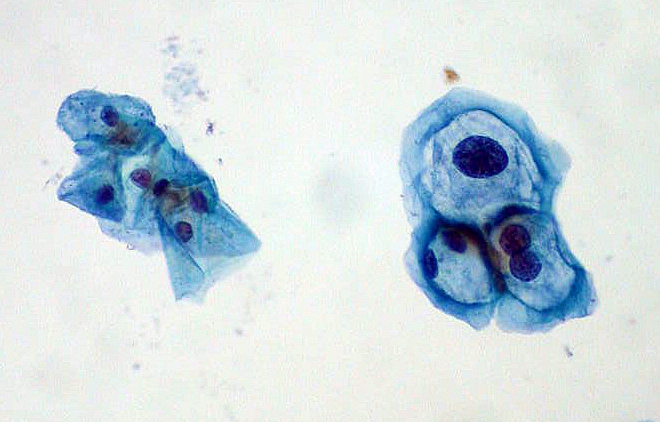
- HPV (Papilloma, naked dsDNA): low-risk 6/11 → anogenital warts (condyloma acuminata); high-risk 16/18 → cervical, anal, and oropharyngeal cancer. E6 degrades p53, E7 inhibits Rb. Koilocytes on cytology. Prevent with Gardasil-9.
- Parvovirus B19 (only ssDNA virus; smallest, naked): infects erythroid precursors via the P antigen. Children → erythema infectiosum ("slapped-cheek" fifth disease); adults → symmetric arthralgias; sickle cell/hereditary spherocytosis → transient aplastic crisis; pregnancy → hydrops fetalis.
- Adenovirus (naked dsDNA): pharyngoconjunctival fever (swimming pools), epidemic keratoconjunctivitis, acute hemorrhagic cystitis, pneumonia in military recruits (vaccine used), and gastroenteritis (serotypes 40/41).
- Poxvirus (largest virus, enveloped, cytoplasmic): molluscum contagiosum — umbilicated, dome-shaped, flesh-colored papules; also smallpox (variola) and monkeypox (mpox).
- Polyomavirus (naked dsDNA): JC virus → progressive multifocal leukoencephalopathy (PML) in HIV or on natalizumab; BK virus → nephropathy and hemorrhagic cystitis in transplant patients.
- HBV (Hepadnavirus, enveloped, partially dsDNA, circular): uses reverse transcriptase; chronic hepatitis → cirrhosis and hepatocellular carcinoma.

- "Child with bright-red 'slapped cheeks' followed by a lacy reticular rash on the arms" → Parvovirus B19 (fifth disease) → supportive.
- "Sickle cell patient with a sudden hemoglobin drop and near-zero reticulocytes" → Parvovirus B19 aplastic crisis → transfusion/supportive.
- "Koilocytes on Pap smear; high-risk HPV DNA positive" → HPV 16/18 → colposcopy/excision; prevent with vaccine.
- "Military recruit with fever, sore throat, and conjunctivitis during a barracks outbreak" → Adenovirus → supportive.
- "HIV or natalizumab patient with progressive weakness, ataxia, and nonenhancing white-matter lesions; JC virus PCR positive" → PML → restore immune function / stop natalizumab.
- "Child with clusters of umbilicated, flesh-colored papules" → Molluscum contagiosum (poxvirus) → self-limited; curettage/cryotherapy.
- Cowdry type A intranuclear inclusions + multinucleated giant cells (Tzanck smear): HSV-1, HSV-2, VZV.
- "Owl's eye" intranuclear inclusions: CMV.
- Koilocytes (perinuclear halo, raisinoid wrinkled nucleus): HPV.
- Atypical/reactive (Downey) lymphocytes: EBV mononucleosis — these are reactive CD8+ T cells, not the infected B cells.
- Molluscum (Henderson–Patterson) bodies: poxvirus (molluscum contagiosum).
- "Starry-sky" pattern, t(8;14), c-myc: EBV-associated Burkitt lymphoma.
DNA virus quick-reference
| Virus (family) | Key feature / lab clue | Classic disease | Treatment |
|---|---|---|---|
| HSV-1 (Herpes) | Tzanck giant cells; temporal lobe; latent trigeminal ganglia | Cold sores, keratitis, encephalitis | Acyclovir |
| HSV-2 (Herpes) | Latent in sacral ganglia | Genital & neonatal herpes | Acyclovir/valacyclovir |
| VZV (Herpes) | Dermatomal vesicles | Chickenpox, shingles | Acyclovir; Shingrix (prevention) |
| EBV (Herpes) | + Monospot; atypical lymphocytes; CD21 entry | Mononucleosis; Burkitt/nasopharyngeal ca | Supportive |
| CMV (Herpes) | "Owl's eye" inclusions | Congenital infection; retinitis; transplant pneumonitis | Ganciclovir (foscarnet if resistant) |
| HHV-8 (Herpes) | Violaceous lesions in HIV | Kaposi sarcoma | Antiretroviral therapy |
| HPV (Papilloma) | Koilocytes; E6/E7 oncoproteins | Warts (6/11); cervical/anal ca (16/18) | Excision; Gardasil-9 (prevention) |
| Parvovirus B19 | Only ssDNA; P-antigen entry | Fifth disease; aplastic crisis; hydrops fetalis | Supportive/transfusion |
| Adenovirus | Naked dsDNA | Pharyngoconjunctival fever; hemorrhagic cystitis; recruit pneumonia | Supportive; vaccine (military) |
| Poxvirus | Largest; cytoplasmic replication | Molluscum contagiosum; smallpox | Supportive/curettage |
| JC virus (Polyoma) | White-matter demyelination; JC PCR | PML in immunosuppressed | Restore immunity / stop natalizumab |
| HBV (Hepadna) | Partial dsDNA; reverse transcriptase | Hepatitis B, HCC | Tenofovir/entecavir |
Practice Microbiology now
Board-style questions, spaced-repetition flashcards, and a Socratic AI tutor — free to start.