Developmental Milestones (0–5 Years)
A boards-focused map of the four developmental streams (gross motor, fine motor, language, social/cognitive) from birth to 5 years, anchored to median ages and the upper-limit red flags. Emphasizes the classic delay vignettes and their NEXT BEST STEP — hearing test first for isolated language delay, serum CK for the boy with Gower sign and calf pseudohypertrophy, and chromosomal microarray plus Fragile X with immediate Early Intervention for global developmental delay.
The Four Streams and Why Limits Matter
Developmental assessment tracks four parallel streams: gross motor, fine motor (visual-motor), language, and social-emotional/cognitive. Boards test the median age a skill appears and — more importantly — the upper age limit beyond which its absence is a red flag. Development proceeds cephalocaudal (head → trunk → legs) and proximal → distal, and primitive reflexes must extinguish before the corresponding voluntary motor skill can emerge. A single lagging stream suggests an isolated delay (e.g., isolated language delay → first check hearing); two or more lagging streams define global developmental delay (GDD). Above all, loss of previously acquired milestones (regression) is never normal and mandates workup at any age.
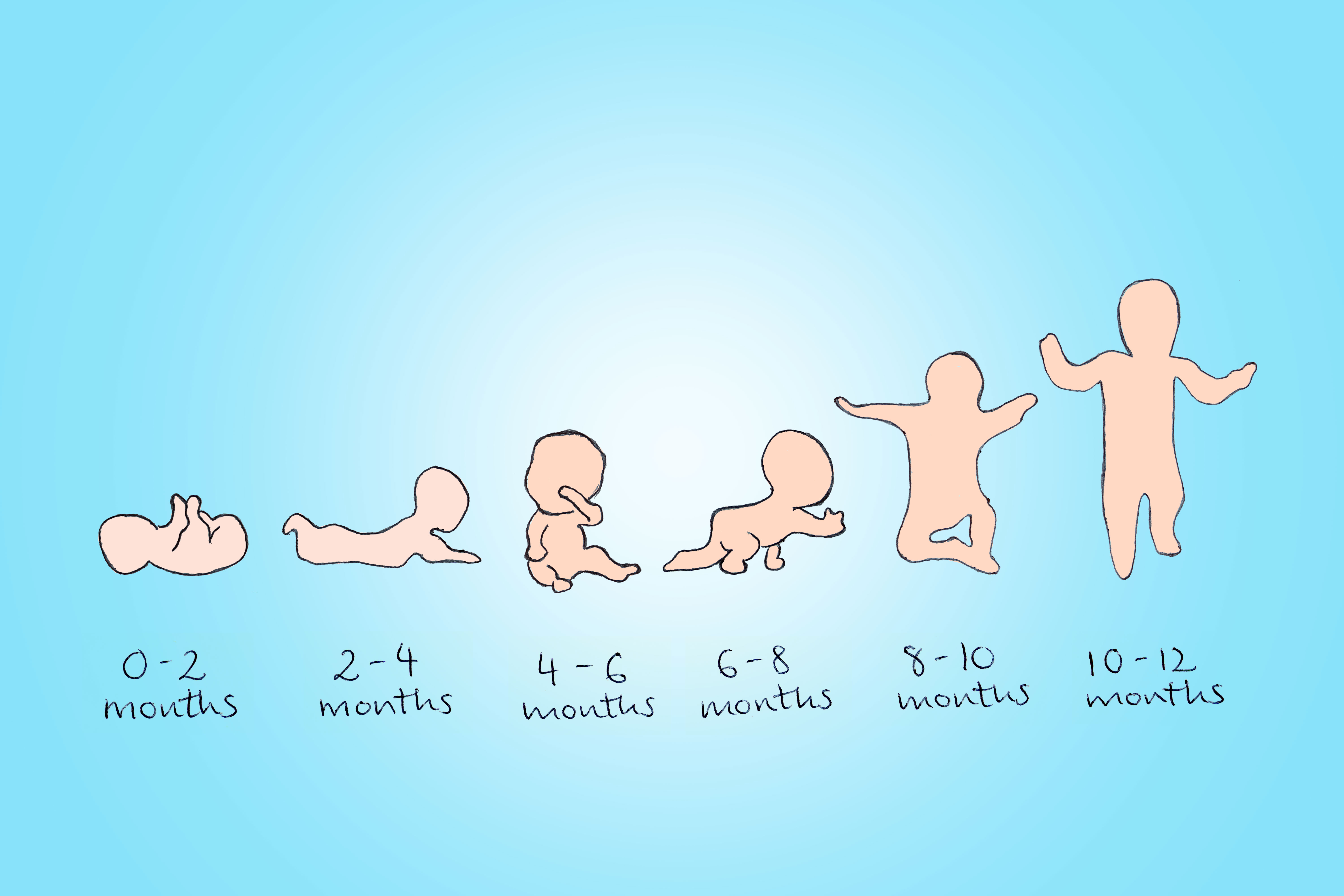
- 2 mo: social smile, coos, lifts head prone
- 4 mo: rolls front→back, laughs, hands to midline
- 6 mo: sits tripod/propped (true unsupported sitting by ~7–8 mo), babbles, transfers objects, stranger anxiety begins
- 9 mo: crawls + pulls to stand, immature pincer, object permanence + separation anxiety, waves bye-bye, "mama/dada" (nonspecific)
- 12 mo: first steps/cruises, mature (neat) pincer grasp, 1–3 words, "mama/dada" specific
- 18 mo: runs, tower of 3–4 blocks, uses spoon, ~10–25 words, temper tantrums, imitates chores
- 2 yr: up/down stairs (both feet per step) + jumps, tower of 6, 2-word phrases (50% intelligible), follows 2-step commands, parallel play
- 3 yr: rides tricycle + alternates feet upstairs, copies a circle, 3-word sentences (75% intelligible), group/associative play
- 4 yr: hops on one foot, copies cross/square, 100% intelligible, cooperative/imaginative play
- 5 yr: skips, copies a triangle, fluent speech, has a best friend
Milestones by Age Across the Four Streams
| Age | Gross Motor | Fine Motor | Language | Social / Cognitive |
|---|---|---|---|---|
| 2 mo | Lifts head & chest prone | Tracks past midline | Coos | Social smile |
| 6 mo | Sits tripod/propped (unsupported by ~7–8 mo); rolls both ways | Palmar grasp; transfers hand-to-hand | Babbles | Stranger anxiety begins |
| 9 mo | Crawls; pulls to stand | Immature pincer | "Mama/dada" nonspecific; understands "no" | Object permanence; separation anxiety; waves bye-bye |
| 12 mo | Stands alone; first steps / cruises | Mature (neat) pincer; voluntary release | 1–3 words; "mama/dada" specific | Follows 1-step command with gesture |
| 18 mo | Runs; walks up stairs holding rail | Tower of 3–4 blocks; uses spoon | 10–25 words; points to body parts | Temper tantrums; imitates household tasks |
| 2 yr | Up/down stairs (both feet per step); jumps | Tower of 6; imitates vertical line | 2-word phrases; 50% intelligible | Parallel play; follows 2-step command |
| 3 yr | Tricycle; alternates feet going upstairs | Copies circle; tower of 9; draws person (3 parts) | 3-word sentences; 75% intelligible; knows age/gender | Associative/group play; knows full name |
| 4 yr | Hops on one foot; downstairs alternating feet | Copies cross / square | 100% intelligible; tells stories | Cooperative + imaginative play |
| 5 yr | Skips; balances on one foot | Copies triangle; draws person (6 parts) | Fluent; counts | Has a best friend |

- Blocks in a tower ≈ 3 × age (yr): 18 mo → 3–4, 2 yr → 6, 3 yr → 9.
- Speech intelligibility ≈ 25% × age (yr) (Coplan rule): 1 yr → 25%, 2 yr → 50%, 3 yr → 75%, 4 yr → 100%.
- Words per phrase ≈ age (yr): 2-word phrases at 2, 3-word sentences at 3.
- Copy-a-shape ladder (complexity rises with age): ○ circle at 3, + / □ cross/square at 4, △ triangle at 5.
- Tricycle peg: a tricycle (3 wheels) is pedaled at 3 yr.
- Fear timeline: social smile at 2 mo → stranger anxiety at 6 mo → separation anxiety at 9 mo (parallels object permanence).
- No social smile by 2 mo; not fixing/following a face or orienting to sound.
- Not rolling either direction by 6 mo; cannot sit unsupported by 9 mo.
- No reciprocal babble, pointing/gestures, or response to name by 12 mo (early autism-spectrum markers).
- No single words by 16 mo; no meaningful 2-word phrases by 24 mo.
- Not walking independently by 18 mo.
- Hand dominance before 18 mo → suspect contralateral weakness (hemiplegic cerebral palsy).
- Persistent primitive reflexes, or toe-walking + hypertonia/spasticity → upper-motor-neuron lesion / cerebral palsy.
- Regression / loss of any acquired skill at any age → always pathologic (Rett, metabolic/storage disease, ASD).
- 18-mo-old, no words, not following commands. Before speech therapy → formal audiologic (hearing) evaluation first — hearing loss is the most common reversible cause of language delay.
- Boy ~2–3 yr, late/waddling walker, difficulty rising from the floor (Gower sign), calf pseudohypertrophy. → serum creatine kinase (CK) (markedly elevated) → then dystrophin genetic testing (deletion/duplication analysis) for Duchenne.
- 18-mo girl loses purposeful hand use, develops hand-wringing stereotypies, decelerating head growth. → recognize Rett syndrome (MECP2); any regression = neurology referral + workup.
- Two or more streams delayed (global developmental delay). First-line genetic workup → chromosomal microarray + Fragile X testing; add vision/hearing testing; refer to Early Intervention now (don't wait for results).
- 14-mo-old with fixed right-hand preference and a persistently fisted left hand. → early handedness is abnormal → evaluate for hemiplegic cerebral palsy with brain MRI.
- Moro (startle), palmar grasp, rooting, ATNR ("fencing"): present at birth, gone by ~4–6 mo. Persistence beyond 6 mo → CNS / upper-motor-neuron pathology (cerebral palsy).
- Asymmetric Moro in a newborn → think clavicle fracture or brachial plexus injury (Erb palsy).
- Parachute reflex: appears at ~8–9 mo and persists for life; its absence is abnormal (protective readiness for walking).
- Babinski (up-going great toe): can be normal until ~1–2 yr due to incomplete myelination.

- Developmental surveillance at every well-child visit.
- Standardized developmental screening at 9, 18, and 30 months.
- Autism-specific screening (M-CHAT-R/F) at 18 and 24 months.
- Any delay or positive screen → refer to Early Intervention (IDEA Part C, birth–3 yr; age ≥3 yr → public-school special-education services, IDEA Part B). Never "wait and see" when there is regression.
Practice Pediatrics now
Board-style questions, spaced-repetition flashcards, and a Socratic AI tutor — free to start.