Cutaneous Drug Reactions: SJS/TEN & DRESS
A boards-focused dermatology lesson on severe cutaneous adverse drug reactions, contrasting SJS/TEN (painful mucocutaneous sloughing, granulysin-driven keratinocyte apoptosis) with DRESS (long-latency morbilliform rash with facial edema, eosinophilia, HHV-6 reactivation, and organ injury). Emphasizes classic vignette buzzwords, latency-based discrimination, HLA pharmacogenetics, biopsy/DIF findings, and next-best-step management.
Overview: The SCAR Spectrum
Severe cutaneous adverse reactions (SCARs) are delayed, type IV (T-cell–mediated) drug hypersensitivities — not IgE-mediated, so they lack urticaria/anaphylaxis and instead evolve over days to weeks. Boards test one severity spectrum: benign morbilliform (exanthematous) drug eruption → DRESS → SJS/TEN.
In SJS/TEN, drug-specific CD8⁺ cytotoxic T cells and NK cells drive widespread keratinocyte apoptosis; granulysin is the key effector (with FasL and perforin/granzyme), producing full-thickness epidermal necrosis and sloughing.
In DRESS, T-cell activation is coupled to reactivation of herpesviruses (classically HHV-6; also EBV/CMV/HHV-7), which helps explain its long latency, and its relapsing/late-autoimmune course.
The single most important step in any suspected SCAR — and the recurring next-best-step answer — is to identify and stop the culprit drug immediately. Delay worsens mortality.
- Classic culprits (both syndromes): allopurinol; aromatic anticonvulsants that share arene-oxide cross-reactivity (carbamazepine, phenytoin, phenobarbital); lamotrigine (a phenyltriazine — not aromatic, but a top SJS/TEN trigger, especially with rapid titration or co-administered valproate); sulfonamides (sulfamethoxazole); oxicam NSAIDs; nevirapine.
- DRESS-leaning extras: vancomycin, minocycline, dapsone, sulfasalazine.
- Latency is the key discriminator: SJS/TEN ~1–3 weeks; DRESS longer, ~2–8 weeks after starting the drug.
- HLA pharmacogenetics (high-yield): HLA-B\*15:02 → carbamazepine SJS/TEN (Han Chinese/SE Asian); HLA-B\*58:01 → allopurinol; HLA-B\*57:01 → abacavir hypersensitivity (screen before use).
- SJS/TEN classification by epidermal detachment (BSA): SJS <10%, overlap 10–30%, TEN >30%.
- Peripheral eosinophilia + transaminitis point to DRESS, not SJS/TEN.
SJS/TEN: Morphology & Diagnosis
Prodrome: 1–3 days of fever, malaise, sore throat, and painful skin/eyes before the rash. Lesions begin as dusky red–purple macules with atypical (flat, two-zone) targetoid centers on the face and trunk (central onset), then coalesce into flaccid bullae and sheets of sloughing epidermis ("wet cigarette paper"/scalded look). Nikolsky sign positive (lateral pressure shears epidermis); Asboe-Hansen (bulla-spread) sign positive.
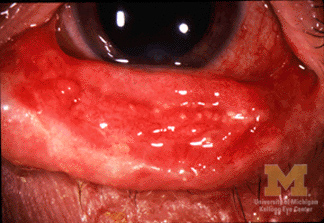
Mucosal involvement is prominent and near-universal (≥2 sites in the vast majority): hemorrhagic crusting of the lips, oral erosions, purulent conjunctivitis/ocular pseudomembranes, urogenital erosions.
The skin is painful and tender out of proportion to appearance — a key discriminator from DRESS (a morbilliform, often pruritic rather than painful rash). Distinguish from SSSS instead by mucosal involvement (SSSS spares mucosa) and the cleavage plane on biopsy: SSSS splits superficially (subcorneal/granular layer) whereas TEN shows full-thickness necrosis with subepidermal separation.
Biopsy (definitive): full-thickness epidermal necrosis with subepidermal separation and a sparse (paucicellular) dermal lymphocytic infiltrate; DIF is negative (excludes autoimmune bullous disease).
Prognosis: SCORTEN (age, heart rate, malignancy, BSA detached, BUN, glucose, bicarbonate) predicts mortality; TEN mortality ~25–35%.
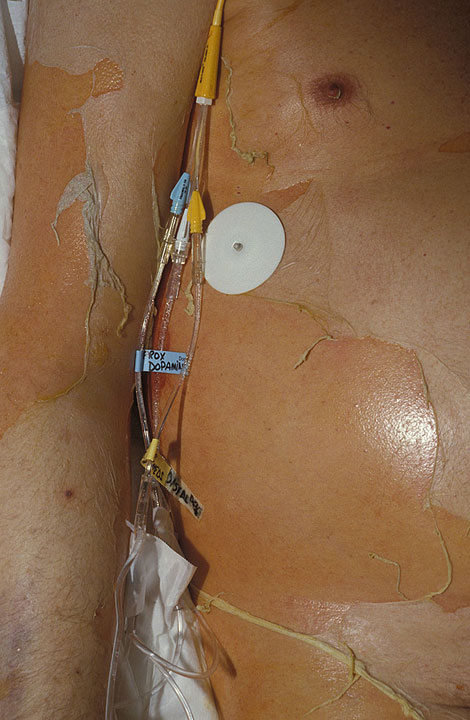
Vignette: A 34-year-old woman started lamotrigine 2 weeks ago for bipolar disorder. She has fever to 39°C, a painful dusky rash spreading from the trunk, hemorrhagic crusting of the lips, red eyes, and dysuria. Exam shows flaccid bullae and epidermal detachment over ~15% BSA with a positive Nikolsky sign.
- Diagnosis: SJS/TEN overlap (10–30% BSA), drug-induced.
- Best initial step: immediately discontinue lamotrigine.
- Then: admit to a burn unit/ICU for fluid–electrolyte resuscitation, wound care, and analgesia; urgent ophthalmology consult to prevent synechiae/scarring.
- Adjuncts (debated): cyclosporine or etanercept (TNF-α inhibitor); IVIG data mixed. Systemic corticosteroids remain controversial.
- Do NOT re-challenge with lamotrigine, and counsel on potential cross-reactivity among anticonvulsants — avoid empiric aromatic anticonvulsants (carbamazepine/phenytoin/phenobarbital) without allergy input.
DRESS: Morphology & Systemic Injury
DRESS = Drug Reaction with Eosinophilia and Systemic Symptoms (aka DiHS). Long latency (~2–8 weeks) separates it from other drug eruptions.
Morphology: a widespread morbilliform (maculopapular) eruption, often >50% BSA, classically with facial edema (a hallmark) and later desquamation.
Systemic features (the "S"): high fever, lymphadenopathy, and internal-organ injury — the liver is most commonly involved and the leading cause of death (transaminitis/hepatitis), plus interstitial nephritis, pneumonitis, myocarditis, and late autoimmune sequelae such as thyroiditis and type 1 diabetes (weeks–months later).
Labs: peripheral eosinophilia (≥700/µL), atypical lymphocytosis, transaminitis. RegiSCAR criteria formalize the diagnosis; HHV-6 reactivation supports it.
Because organ inflammation persists, DRESS can flare weeks after the drug is stopped, mandating prolonged monitoring.
Vignette: A 45-year-old man started allopurinol 4 weeks ago for gout. He has fever, a diffuse morbilliform rash, and puffy facial edema. Exam: cervical lymphadenopathy. Labs: eosinophils 2,200/µL, atypical lymphocytes, ALT/AST ~6× normal, mild creatinine rise.
- Diagnosis: DRESS syndrome.
- Best initial step: stop allopurinol.
- First-line therapy: systemic corticosteroids (e.g., prednisone ~0.5–1 mg/kg/day) with a slow taper to prevent relapse, given organ involvement.
- Monitor: LFTs, renal function, CBC, and thyroid function at 6–12 weeks (late thyroiditis).
- Key contrast: eosinophilia + hepatitis + facial edema + long latency = DRESS, not SJS/TEN (painful skin with mucosal sloughing).
SJS/TEN vs DRESS
| Feature | SJS/TEN | DRESS |
|---|---|---|
| Mechanism | CD8⁺ T-cell keratinocyte apoptosis (granulysin) | T-cell activation + HHV-6 reactivation |
| Latency | ~1–3 weeks | ~2–8 weeks (longer) |
| Rash | Painful dusky/atypical-target macules → bullae, sheet detachment | Morbilliform + facial edema |
| Mucosa | Prominent (≥2 sites); hemorrhagic lip crusting | Usually spared/mild |
| Nikolsky | Positive | Negative |
| Key labs | Biopsy: full-thickness necrosis; DIF negative | Eosinophilia, atypical lymphs, transaminitis |
| Main organ risk | Skin/eyes, sepsis, fluid loss | Liver (top killer), kidney, late thyroid |
| First-line Rx | Stop drug + supportive (burn unit); steroids controversial; ± cyclosporine/etanercept | Stop drug + systemic corticosteroids (slow taper) |
| Mortality | TEN ~25–35% | ~10% |
DRESS — the name is the mnemonic: Drug Reaction (long latency) with Eosinophilia and Systemic Symptoms (fever, lymphadenopathy, organ injury — liver first).
HLA–drug pairings (exam favorites):
- B\15:02 → carB*amazepine (SJS/TEN, Asian ancestry)
- B\*57:01 → abacavir (screen first)
- B\*58:01 → allopurinol
"Pain + mucosa" steers you to SJS/TEN: painful skin with mucosal sloughing / hemorrhagic lip crusting and a positive Nikolsky = SJS/TEN; a morbilliform rash with facial edema, eosinophilia, and hepatitis = DRESS.
- Universal first step in any SCAR: stop the offending drug — the recurring "next best step" answer.
- SJS/TEN: supportive care in a burn unit/ICU (fluids, electrolytes, wound care, nutrition, analgesia) + early ophthalmology; systemic steroids are controversial, with evidence favoring cyclosporine and/or etanercept; IVIG data mixed.
- DRESS: systemic corticosteroids with a slow taper are first-line when organs are involved; watch for relapse and late autoimmune thyroiditis/hypothyroidism.
- On re-exposure: avoid re-challenge with the culprit; use caution with cross-reacting aromatic anticonvulsants and empiric sulfonamides.
- SCORTEN risk-stratifies TEN mortality (not used for DRESS).
- Ocular sequelae (symblepharon, blindness) are the major long-term SJS/TEN morbidity — hence urgent ophthalmology.
Practice Dermatology now
Board-style questions, spaced-repetition flashcards, and a Socratic AI tutor — free to start.