Chronic Leukemias (CLL & CML)
A Step 1 high-yield lesson on the chronic leukemias, contrasting CLL (mature B-cell clone, smudge cells, CD5+/CD19+/CD23+) with CML (Philadelphia chromosome t(9;22)/BCR-ABL1, basophilia, low LAP), built around classic vignette buzzwords and next-best-step diagnostic and management decisions.
Overview & Pathophysiology
Chronic leukemias are clonal expansions of mature, well-differentiated leukocytes — in contrast to acute leukemias, which are dominated by blasts. They present insidiously in older adults and are frequently discovered incidentally on a routine CBC.
CLL (chronic lymphocytic leukemia) is a monoclonal proliferation of mature but functionally incompetent B lymphocytes. It is the most common leukemia in Western adults (typically >60 yrs). CLL and small lymphocytic lymphoma (SLL) are the same disease — CLL is simply the leukemic (blood/marrow) phase.
CML (chronic myeloid leukemia) is a myeloproliferative neoplasm driven by the Philadelphia chromosome, t(9;22), which fuses BCR–ABL1 into a constitutively active tyrosine kinase that drives unchecked granulocyte production. It classically affects middle-aged adults (~45–55 yrs on boards) and evolves through chronic → accelerated → blast crisis phases.
- Cell of origin: mature B cell; smear shows absolute lymphocytosis plus smudge (smear) cells — fragile lymphocytes crushed during slide prep
- Flow cytometry: CD5+, CD19+, CD23+, CD20 dim, dim surface Ig — aberrant CD5 (normally a T-cell marker) on a clonal B-cell population is the classic clue
- Often asymptomatic; may show painless lymphadenopathy, hepatosplenomegaly, fatigue
- Autoimmune complications: warm AIHA (IgG, positive direct Coombs) and ITP
- Hypogammaglobulinemia → recurrent infections (leading cause of death)
- Richter transformation: abrupt shift to aggressive diffuse large B-cell lymphoma (rapidly enlarging node, B symptoms, rising LDH)
- Prognosis: del(17p)/TP53 mutation and unmutated IGHV = worse; isolated del(13q) = favorable
- Management: asymptomatic early-stage = watch and wait; treat when symptomatic — BTK inhibitor (ibrutinib), venetoclax (BCL-2 inhibitor), anti-CD20
- Defining lesion: Philadelphia chromosome t(9;22) → BCR-ABL1 fusion → constitutive tyrosine kinase activity
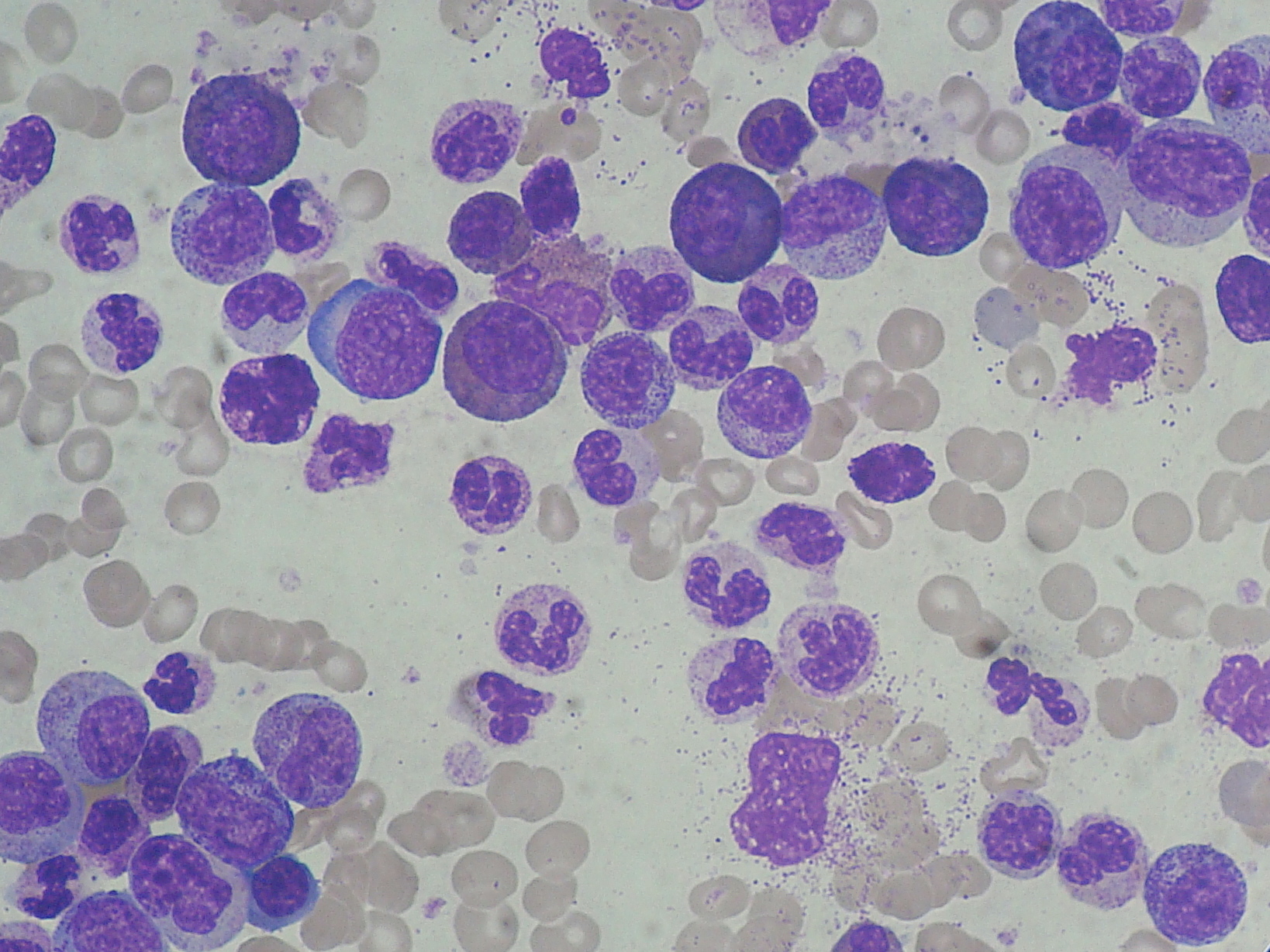
- Smear: marked leukocytosis with a left shift — neutrophils plus myelocytes and metamyelocytes; basophilia is a characteristic clue; often thrombocytosis
- Low leukocyte alkaline phosphatase (LAP) score — distinguishes CML from a leukemoid reaction (reactive, high LAP)
- Massive splenomegaly → early satiety, LUQ fullness; plus fatigue and night sweats
- Phases: chronic (indolent) → accelerated → blast crisis (≈2/3 transform to AML, ≈1/3 to ALL); blast crisis behaves like an acute leukemia
- Management: tyrosine kinase inhibitor — imatinib (and later-generation TKIs) targeting BCR-ABL, which dramatically improves survival
Vignette: A 68-year-old man has a routine CBC showing WBC 32,000/µL with 80% mature-appearing lymphocytes. He feels well; exam reveals small, nontender cervical nodes. The smear shows numerous smudge cells.
- Most likely diagnosis: Chronic lymphocytic leukemia (CLL)
- Best next step (confirm): peripheral blood flow cytometry — expect a clonal CD5+ / CD19+ / CD23+ B-cell population (bone marrow biopsy is usually not required to diagnose)
- If he later develops fatigue + jaundice, falling Hgb, spherocytes, and a positive direct Coombs → superimposed warm autoimmune hemolytic anemia
- If a single node rapidly enlarges with B symptoms and soaring LDH → suspect Richter transformation; next step is excisional lymph node biopsy

Vignette: A 50-year-old woman reports weeks of fatigue, night sweats, and LUQ fullness with early satiety. The spleen is palpable 8 cm below the costal margin. WBC is 180,000/µL with a left shift (myelocytes, metamyelocytes) and basophilia; the LAP score is low.
- Most likely diagnosis: Chronic myeloid leukemia (CML), chronic phase
- Best next step (confirm): test for BCR-ABL1 / Philadelphia chromosome (RT-PCR or FISH; cytogenetics)
- Key contrast — leukemoid reaction: infection-driven neutrophilia with a left shift but HIGH LAP, toxic granulation, no basophilia, and no Ph chromosome
- Treatment once confirmed: imatinib (BCR-ABL tyrosine kinase inhibitor)
- "Philadelphia CreaML cheese" → CML carries the Philadelphia chromosome, t(9;22), BCR-ABL
- Smudge (smear) cells = CLL — fragile mature lymphocytes crushed during slide preparation
- Basophilia → think CML (and other myeloproliferative neoplasms)
- Low LAP = CML; High LAP = leukemoid reaction (infection)
- Leukemia by classic age: ALL (kids) → AML (adults) → CML (middle age ~45–55) → CLL (elderly, >60)
CLL vs CML — Side by Side
| Feature | CLL | CML |
|---|---|---|
| Cell lineage | Mature B lymphocyte | Myeloid (granulocytic) |
| Typical age | >60 yrs (elderly) | ~45–55 yrs (middle age) |
| Smear hallmark | Smudge cells, mature lymphocytosis | Left shift + basophilia, all granulocyte stages |
| Markers / genetics | Flow: CD5+, CD19+, CD23+ | t(9;22) BCR-ABL; low LAP |
| Spleen | Mild–moderate | Often massive |
| Classic complication | Warm AIHA, hypogammaglobulinemia, Richter (DLBCL) | Blast crisis (→ AML > ALL) |
| First-line therapy | Watch & wait; BTK inhibitor (ibrutinib) | Imatinib (TKI) |
- Incidental lymphocytosis in an elderly patient → confirm CLL with peripheral flow cytometry, not a bone marrow biopsy first
- CD5 is shared by CLL and mantle cell lymphoma; CLL is CD23+, while mantle cell is CD23− / cyclin D1+, t(11;14)
- New, rapidly enlarging node in known CLL → biopsy for Richter transformation (DLBCL)
- Neutrophilia + left shift: use LAP — low = CML, high = leukemoid reaction; basophilia favors CML
- CML blast crisis = ≥20% blasts → treat as an acute leukemia; prognosis worsens sharply
- Don't confuse: CLL = clonal mature lymphocytes; CML = clonal mature myeloid cells — both are chronic, so blasts are few (unlike ALL/AML)
Practice Heme/Onc now
Board-style questions, spaced-repetition flashcards, and a Socratic AI tutor — free to start.