Childhood Exanthems & Common Infections
A board-focused tour of the classic childhood exanthems — measles, scarlet fever, rubella, fifth disease, and roseola, plus varicella, hand-foot-mouth, and the must-not-miss Kawasaki mimic — organized by pathognomonic buzzword, feared complication, and next best step.
How the boards test fever-plus-rash
Childhood exanthems are fever-plus-rash syndromes the boards love because each carries a pathognomonic clue and a predictable timeline. The historical "numbered diseases" map to specific pathogens: first = measles, second = scarlet fever, third = rubella, fourth (Dukes disease, obsolete), fifth = erythema infectiosum, sixth = roseola. The examiners rarely ask you to name the number — they hand you a buzzword (Koplik spots, sandpaper rash, slapped cheeks, fever-then-rash) and want the organism, the complication to fear, and the next best step. Anchor each disease to three things: the prodrome, the rash morphology and direction of spread, and the single management or complication decision that changes the outcome (vitamin A, penicillin, IVIG, avoiding aspirin, or exposing a pregnant contact). Keep Kawasaki disease in the differential — it is not an infection, but it mimics measles and scarlet fever and is a can't-miss.
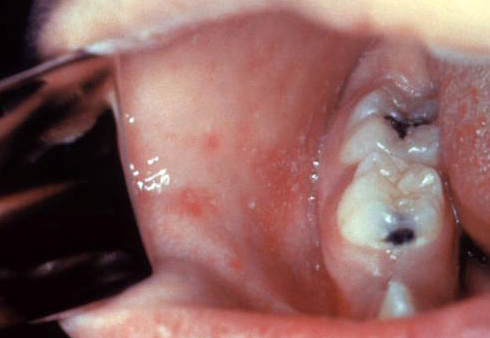
- Measles (rubeola, "1st") — paramyxovirus; 3 C's (cough, coryza, conjunctivitis) + high fever, then Koplik spots (blue-white buccal spots on a red base, pathognomonic), then a cephalocaudal maculopapular rash that becomes confluent
- Scarlet fever ("2nd") — group A Strep pyrogenic exotoxin; sandpaper rash, circumoral pallor, strawberry tongue, Pastia lines; follows pharyngitis, ends in desquamation
- Rubella (German/"3-day" measles, "3rd") — togavirus; mild; tender postauricular and suboccipital nodes, cephalocaudal rash; major teratogen
- Erythema infectiosum ("5th") — parvovirus B19; slapped-cheek then lacy reticular rash; child is no longer contagious once the rash appears
- Roseola (exanthem subitum, "6th") — HHV-6 (or HHV-7); high fever 3–4 days, then rose-pink rash as the fever breaks; febrile seizures
- Varicella — VZV; pruritic vesicles in different stages at once ("dewdrops on a rose petal"), trunk-predominant
- Hand-foot-mouth — coxsackievirus A16; oral ulcers plus vesicles on palms and soles
Comparison: pathogen, hallmark, feared complication
| Disease | Pathogen | Hallmark clue | Feared complication |
|---|---|---|---|
| Measles | Measles virus (paramyxo) | Koplik spots; 3 C's; cephalocaudal rash | Pneumonia (leading cause of death), otitis media (most common), encephalitis, late SSPE |
| Scarlet fever | Group A Strep | Sandpaper rash, strawberry tongue, Pastia lines | Rheumatic fever; PSGN |
| Rubella | Rubella virus (toga) | Postauricular nodes, mild rash | Congenital rubella: PDA, cataracts, deafness |
| Erythema infectiosum | Parvovirus B19 | Slapped cheeks → lacy rash | Aplastic crisis (sickle cell), hydrops fetalis |
| Roseola | HHV-6 | High fever → rash after defervescence | Febrile seizures |
| Varicella | VZV | Vesicles in different stages, pruritic | Bacterial superinfection, pneumonia |
| Hand-foot-mouth | Coxsackie A16 (EV-A71 = severe/CNS) | Oral ulcers + palm/sole vesicles | Usually self-limited |

Vignette: An unvaccinated 4-year-old recent immigrant has 4 days of high fever, dry cough, red watery eyes, and coryza. Exam shows tiny blue-white spots on erythematous buccal mucosa, followed a day later by a blanching maculopapular rash starting at the hairline and behind the ears that spreads downward and becomes confluent.
Diagnosis: Measles (rubeola). The buccal lesions are Koplik spots — pathognomonic, and they precede the rash by 1–2 days.
Next best step: Airborne isolation and notify public health; give vitamin A (reduces morbidity and mortality). Confirm with measles IgM or RT-PCR. Remember: otitis media is the most common complication, pneumonia is the leading cause of death, and SSPE appears years later.
Vignette: A 6-year-old with sickle cell disease has fatigue and pallor. Two classmates recently had a "slapped-cheek" rash. Hemoglobin is 4.5 g/dL with an absent reticulocyte count.
Diagnosis: Transient aplastic crisis from parvovirus B19. The virus infects erythroid progenitors (via the erythrocyte P antigen) and halts red-cell production — devastating when there is chronic hemolysis and no marrow reserve.
Next best step: Transfuse packed RBCs for symptomatic anemia; otherwise supportive. Two more B19 pearls: in a pregnant contact it risks hydrops fetalis (refer for serology and fetal ultrasound), and in healthy children the illness is self-limited and no longer contagious once the rash appears.
Vignette: A 3-year-old has 5 days of fever ≥39°C unresponsive to antibiotics, bilateral non-exudative (bulbar) conjunctivitis, cracked red lips with a strawberry tongue, a polymorphous truncal rash, swollen erythematous hands and feet, and one enlarged cervical node.
Diagnosis: Kawasaki disease — a medium-vessel vasculitis, not an infection: fever ≥5 days plus ≥4 of the 5 principal (CRASH) features. It mimics scarlet fever (but that has pharyngitis and responds to penicillin) and measles (which has Koplik spots).
Next best step: IVIG + high-dose aspirin (transition to low-dose antiplatelet aspirin after defervescence), and get a baseline echocardiogram for coronary artery aneurysms. This is a rare pediatric indication for aspirin. Untreated, roughly 25% develop coronary aneurysms.
- Measles = the 3 C's: Cough, Coryza, Conjunctivitis — then look for Koplik spots
- Kawasaki = "CRASH and burn": Conjunctivitis, Rash, Adenopathy (cervical), Strawberry tongue, Hand/foot changes — plus burn = fever ≥5 days
- Rubella = "3-day measles": short, mild course with tender postauricular nodes (reminds you it is the milder look-alike)
- Measles: airborne isolation + vitamin A; supportive care; watch for pneumonia, otitis media, late SSPE
- Scarlet fever / strep pharyngitis: penicillin or amoxicillin to prevent acute rheumatic fever (does not prevent PSGN); fingertip desquamation follows
- Parvovirus B19: transfuse in aplastic crisis (sickle cell, hereditary spherocytosis); counsel pregnant contacts about hydrops fetalis
- Roseola: reassurance; simple febrile seizures are benign
- Varicella: VZIG for exposed high-risk contacts (immunocompromised, neonates, susceptible pregnant); acyclovir for severe/older patients; never aspirin (Reye syndrome)
- Kawasaki: IVIG + aspirin + echocardiogram
- Pertussis: azithromycin (treat and prophylax contacts); marked lymphocytosis; inspiratory whoop with post-tussive emesis
- Mumps: parotitis, orchitis, aseptic meningitis; supportive care, prevented by MMR
Practice Pediatrics now
Board-style questions, spaced-repetition flashcards, and a Socratic AI tutor — free to start.