Burn Management
A board-focused Step 2 CK lesson on burn management: airway-first triage, depth and TBSA assessment, Parkland fluid resuscitation titrated to urine output, CO/cyanide toxicity, escharotomy, topical antimicrobials, and burn-center transfer criteria — anchored by next-best-step vignettes.
Burns are managed as trauma: airway, breathing, and circulation come before the wound. Every downstream decision hangs on two numbers — burn depth (does it heal on its own or need excision/grafting?) and % total body surface area, TBSA (drives fluid resuscitation and burn-center transfer). On Step 2 CK, a burn stem is usually an airway question in disguise: a patient pulled from a closed-space fire with facial burns, singed nasal hairs, hoarseness, or carbonaceous sputum needs early intubation before progressive edema closes the airway — waiting until they are in respiratory distress is the wrong answer, because by then the airway may be unintubatable. Once the airway is secured, estimate TBSA, start lactated Ringer's by the Parkland formula, titrate to urine output, screen for carbon monoxide and cyanide toxicity, and look for circumferential burns that threaten a limb or ventilation and need escharotomy. Superficial (first-degree) burns do not count toward TBSA or fluids.
- TBSA counts partial- + full-thickness only — never count superficial (1st-degree/sunburn) skin.
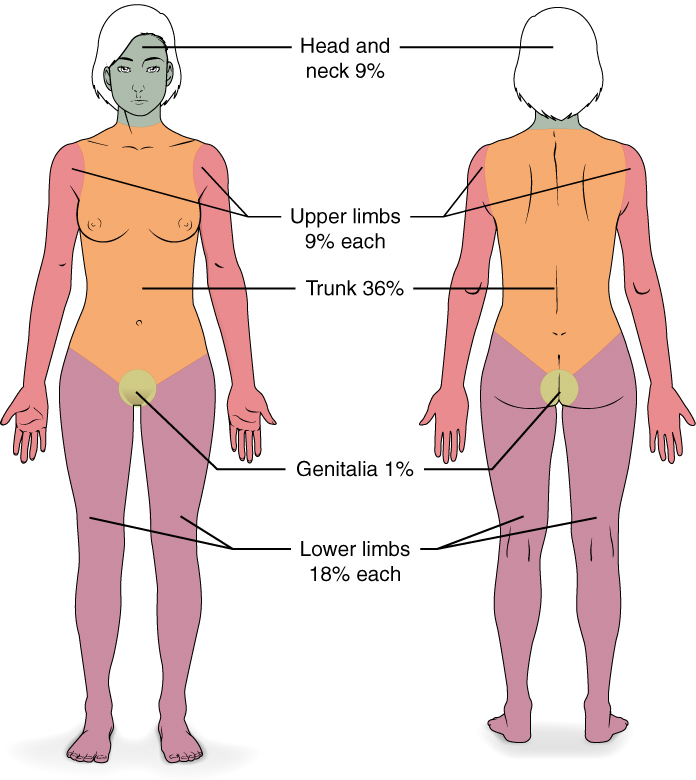
- Rule of Nines (adult): head 9%, each arm 9%, each leg 18%, anterior trunk 18%, posterior trunk 18%, perineum 1%. For scattered burns, the patient's palm + fingers ≈ 1% (palm alone ≈ 0.5%).
- Parkland formula: 4 mL × weight (kg) × %TBSA of lactated Ringer's over 24 h. Give half in the first 8 hours from the time of the burn (not from ED arrival); the remaining half over the next 16 h.
- Titrate to urine output — the single best resuscitation endpoint: 0.5 mL/kg/hr in adults (~30–50 mL/hr), 1 mL/kg/hr in children.
- Parkland is a starting estimate only — adjust the rate to UOP, not to the formula. Over-resuscitation causes "fluid creep" (pulmonary edema, compartment syndrome).
- Children also need maintenance dextrose-containing fluid added.
| Depth | Layers | Appearance | Sensation / blanch | Healing |
|---|---|---|---|---|
| Superficial (1st°) | Epidermis | Red, dry, no blisters | Painful, blanches | 3–7 d, no scar; not in TBSA |
| Superficial partial (2nd°) | + papillary dermis | Red, moist, blisters | Very painful, blanches | 2–3 wk, little scar |
| Deep partial (2nd°) | + reticular dermis | Wet or waxy-dry, blisters | Less painful, sluggish blanch | Often needs graft, scars |
| Full thickness (3rd°) | Entire dermis | White/leathery/charred, dry | Insensate, no blanch | Excision + grafting |
| 4th degree | Into fat/muscle/bone | Charred, mummified | Insensate | Debridement/reconstruction |

Vignette: A 34-year-old man is pulled from a burning house. He has burns over the face and neck, singed nasal hairs and eyebrows, soot in the oropharynx with black (carbonaceous) sputum, and a hoarse voice; mild inspiratory stridor is developing. SpO₂ is 96% and he is speaking in short sentences.
Diagnosis: Inhalation injury with impending upper-airway obstruction from thermal edema.
Next best step: Early endotracheal intubation now, while the airway is still patent. Edema worsens over the first hours and is accelerated by fluid resuscitation; delay converts an easy intubation into a surgical airway. Do not wait for an ABG, chest x-ray, or overt respiratory failure. A near-normal SpO₂ is falsely reassuring — it does not exclude airway compromise or carbon monoxide poisoning.
- Carbon monoxide: house fire + headache/confusion; pulse oximetry is falsely normal (can't distinguish carboxyhemoglobin from oxyhemoglobin). Diagnose with co-oximetry / carboxyhemoglobin level. Treat with 100% O₂ via non-rebreather (cuts COHb half-life from ~4 h to ~1 h); hyperbaric O₂ for severe cases (coma/LOC, cardiac or neuro ischemia, pregnancy).
- Cyanide (burning plastics/synthetics): persistent high anion-gap lactic acidosis despite adequate O₂, with a narrowed arterial–venous O₂ difference. Antidote = hydroxocobalamin (preferred over nitrites in smoke inhalation — nitrites cause methemoglobinemia and worsen O₂ delivery when CO coexists).
- Circumferential full-thickness burn → escharotomy for a cold/pulseless limb, or on the chest/abdomen when rising airway pressures impair ventilation.
- Tetanus prophylaxis per status; start early enteral nutrition (severe hypermetabolic state).
- Curling ulcer = burn-related stress ulcer (classically duodenal) → PPI prophylaxis.
- No prophylactic systemic antibiotics — use topical agents and treat infection when it develops.
Vignette: An 80-kg man has 36% TBSA partial- and full-thickness burns sustained at 08:00. He arrives in the ED at 10:00. What fluid do you order?
Calculation (Parkland): 4 mL × 80 kg × 36 = 11,520 mL lactated Ringer's over 24 h.
- First half (5,760 mL) goes in the first 8 hours from the burn (08:00). Because 2 h already elapsed, deliver it over the remaining 6 h ≈ 960 mL/hr.
- Second half (5,760 mL) over the next 16 h ≈ 360 mL/hr.
Next best step / pearl: Start LR and titrate to urine output 0.5 mL/kg/hr (~40 mL/hr). The classic trap is timing the first 8 hours from arrival instead of from the injury — always subtract the elapsed time.
| Topical agent | Eschar penetration | Key adverse effect | Use / avoid |
|---|---|---|---|
| Silver sulfadiazine | Poor (no eschar penetration) | Transient leukopenia/neutropenia; avoid in sulfa allergy, G6PD deficiency, near-term/neonates | Broad first-line; avoid on the face |
| Mafenide acetate | Excellent — penetrates eschar & cartilage | Painful; metabolic acidosis (carbonic anhydrase inhibition) | Preferred for ears/nose and deep, thick eschar |
| Bacitracin | Superficial only | Minimal | Face and small superficial burns |
- ABA burn-center transfer criteria: partial thickness >10% TBSA; any full-thickness burn; burns to face, hands, feet, genitalia/perineum, or major joints; electrical (including lightning), chemical, or inhalation injury; burns with concomitant trauma or major comorbidity; and children at facilities without pediatric capability.
- Electrical burns: skin can look deceptively minor while deep muscle necrosis is severe → rhabdomyolysis with myoglobinuria (dark urine). Give aggressive LR to UOP 1–1.5 mL/kg/hr, obtain an ECG (arrhythmia), and watch for compartment syndrome — deep swelling may need fasciotomy, not just escharotomy.
- Chemical burns: copious water irrigation; brush off dry lime and elemental sodium first (they react with water). Alkali burns cause liquefactive necrosis and penetrate deeper than acids (coagulative necrosis).
- Circumferential limb burns: serial neurovascular checks — falling pulses/worsening pain signal need for escharotomy.
Practice Surgery now
Board-style questions, spaced-repetition flashcards, and a Socratic AI tutor — free to start.