Autonomic Pharmacology: Adrenergic & Cholinergic
A board-focused tour of autonomic pharmacology: the ACh/NE wiring diagram, adrenergic and cholinergic receptor subtypes with their G-proteins and effects, the key agonist/antagonist drug classes, and the classic tested toxidromes (organophosphate crisis, antimuscarinic toxicity, and unopposed-alpha traps).
The autonomic wiring diagram
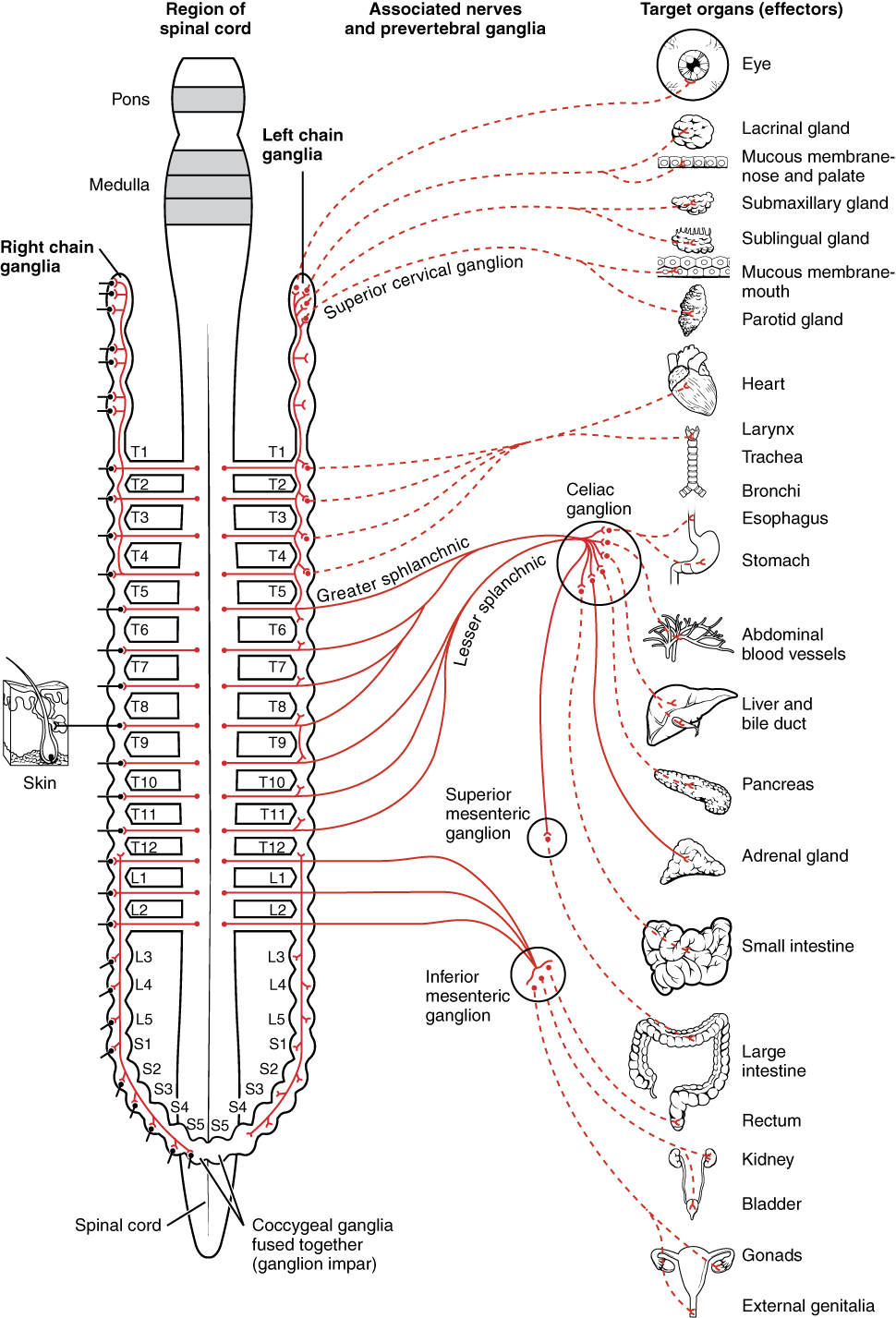
The autonomic nervous system (ANS) controls involuntary function through two branches — parasympathetic ("rest-and-digest") and sympathetic ("fight-or-flight") — using two primary transmitters: acetylcholine (ACh) and norepinephrine (NE). Almost every drug in this unit works by agonizing or antagonizing the receptors these transmitters hit, so the whole topic collapses into three questions: which receptor does the tissue express, what G-protein/second messenger does it couple to, and what happens when you turn it up or down?
Learn the wiring first:
- All preganglionic neurons (sympathetic and parasympathetic) release ACh onto nicotinic (Nn) receptors in the ganglia.
- Parasympathetic postganglionic neurons release ACh onto muscarinic receptors.
- Sympathetic postganglionic neurons release NE onto adrenergic receptors — except sweat glands (ACh onto muscarinic; the classic sympathetic-cholinergic exception). The adrenal medulla is a special case: it has no postganglionic neuron — preganglionic sympathetic fibers synapse directly on chromaffin cells via ACh (Nn), which then dump epinephrine straight into the blood.
- Second messengers: Gs raises adenylyl cyclase, raising cAMP; Gi lowers cAMP; Gq drives phospholipase C, raising IP3 (increases intracellular Ca2+) + DAG
- "MAD 2's are inhibitory" (Gi): M2, alpha-2, D2
- All beta receptors are Gs; alpha-1, M1, M3 are Gq
- Sympathetic sweat glands are cholinergic (the classic exception that gets tested)
- The adrenal medulla is a modified sympathetic ganglion, releasing epinephrine (~80%) + NE into the circulation
- Nicotinic receptors are ligand-gated ion channels (fast); muscarinic and all adrenergic receptors are GPCRs (slower)
In receptor order alpha-1, alpha-2, beta-1, beta-2 / M1, M2, M3 / D1, D2, H1 / H2, V1, V2:
- QISS → alpha-1 = Q, alpha-2 = I, beta-1 = S, beta-2 = S
- QIQ → M1 = Q, M2 = I, M3 = Q
- SIQ → D1 = S, D2 = I, H1 = Q
- SQS → H2 = S, V1 = Q, V2 = S
Fast shortcut: all beta = Gs, alpha-1 / M1 / M3 = Gq, and the "MAD 2's" (M2, alpha-2, D2) = Gi.
Adrenergic receptors
| Receptor | G-protein | Key effects (boards) |
|---|---|---|
| alpha-1 | Gq | Vasoconstriction (raises BP and TPR), mydriasis (dilator pupillae), internal urethral sphincter + prostate contraction (urinary retention) |
| alpha-2 | Gi | Presynaptic decreased NE release, lowers central sympathetic outflow (clonidine lowers BP), lowers insulin, raises platelet aggregation |
| beta-1 | Gs | Raises heart rate, contractility, AV conduction, and renin release |
| beta-2 | Gs | Bronchodilation, vasodilation, uterine relaxation (tocolysis), glycogenolysis, raises insulin, drives K+ into cells |
| beta-3 | Gs | Bladder detrusor relaxation (mirabegron), lipolysis |
| D1 | Gs | Renal and mesenteric vasodilation |
Cholinergic receptors
| Receptor | Signal | Location → effect |
|---|---|---|
| M1 | Gq (GPCR) | CNS, enteric nervous system, gastric parietal cells (raises acid) |
| M2 | Gi (GPCR) | Heart (SA/AV node): lowers HR, lowers AV conduction |
| M3 | Gq (GPCR) | Smooth muscle and glands: miosis (sphincter pupillae), accommodation (ciliary muscle), bronchoconstriction, raises secretions, detrusor contraction; endothelial NO → vasodilation |
| Nn | Ligand-gated Na+/K+ channel | Autonomic ganglia, adrenal medulla, CNS |
| Nm | Ligand-gated Na+/K+ channel | Skeletal muscle NMJ |

- Cholinomimetics (direct): bethanechol (post-op ileus / urinary retention — activates Bowel & Bladder, resistant to AChE), pilocarpine (glaucoma — both open- and closed-angle; xerostomia in Sjogren — potent stimulator of sweat/tears/saliva, crosses membranes), carbachol (glaucoma), methacholine (bronchoprovocation challenge for asthma)
- AChE inhibitors (indirect): neostigmine (post-op ileus, myasthenia gravis, reversal of non-depolarizing NM blockade — no CNS entry), pyridostigmine (chronic MG — no CNS), physostigmine (antimuscarinic overdose — crosses BBB), donepezil / rivastigmine / galantamine (Alzheimer), edrophonium (historical MG diagnosis)
- Antimuscarinics: atropine / tropicamide (mydriasis, cycloplegia), ipratropium / tiotropium (COPD, asthma), oxybutynin / solifenacin (overactive bladder), scopolamine (motion sickness), glycopyrrolate (dries secretions), benztropine / trihexyphenidyl (Parkinson, acute dystonia)
- Sympathomimetics: epinephrine (anaphylaxis; alpha + beta), norepinephrine (alpha-1 > beta-1; septic shock), dopamine / dobutamine (inotropes), phenylephrine (alpha-1 decongestant / mydriatic / pressor), albuterol / salmeterol (beta-2, asthma), terbutaline (tocolysis)
- Sympatholytics: clonidine / alpha-methyldopa (central alpha-2, lowers BP; methyldopa in pregnancy; clonidine → rebound HTN if stopped abruptly), prazosin and the "-osins" (alpha-1 block — BPH, HTN, PTSD nightmares; first-dose orthostasis), phenoxybenzamine (irreversible alpha — pheochromocytoma pre-op), beta-blockers ("-olol")
Classic vignette: an agricultural worker (or a nerve-gas / sarin exposure) presents with pinpoint pupils (miosis), profuse salivation, lacrimation, sweating, wheezing / bronchorrhea, bradycardia, vomiting, diarrhea, and muscle fasciculations progressing to weakness. Cause = an organophosphate (irreversible AChE inhibitor), so ACh accumulates and overstimulates both muscarinic and nicotinic receptors.
- The "Killer B's" — bronchorrhea and bronchospasm — are the usual cause of death.
Next best step / treatment:
- Atropine — competitive muscarinic antagonist; reverses the muscarinic signs (titrate to drying of pulmonary secretions). It does NOT reverse the nicotinic effects (fasciculations, weakness).
- Pralidoxime (2-PAM) — regenerates AChE and addresses the nicotinic (NMJ) signs; give early, before enzyme "aging" makes the inhibition permanent.
- Benzodiazepine (e.g., diazepam) — seizure control/prophylaxis; the standard third agent in nerve-agent exposure.
Cholinergic (muscarinic) excess — "DUMBBELSS": Diarrhea, Urination, Miosis, Bronchospasm, Bradycardia, Excitation (skeletal-muscle fasciculations and CNS), Lacrimation, Salivation, Sweating. (Also taught as SLUDGE-M: Salivation, Lacrimation, Urination, Defecation, GI upset, Emesis + Miosis.)
Antimuscarinic (anticholinergic) toxicity — the "mad hatter":
- Hot as a hare (hyperthermia — sweating blocked)
- Dry as a bone (no secretions)
- Red as a beet (cutaneous flushing)
- Blind as a bat (mydriasis + cycloplegia)
- Mad as a hatter (delirium / hallucinations)
- Full as a flask (urinary retention)
- ...and the heart races (tachycardia). Antidote: physostigmine (crosses the BBB to reverse central and peripheral signs; reserve for severe cases and avoid in TCA / wide-QRS overdose — risk of seizures and asystole).
High-yield questions that hinge on unopposed alpha activity:
- Cocaine / sympathomimetic toxicity: do not give a beta-blocker alone — unopposed alpha-1 vasoconstriction worsens hypertension and causes coronary vasospasm. Manage with benzodiazepines plus, if needed, an alpha-blocker (phentolamine).
- Pheochromocytoma: alpha-block first (phenoxybenzamine), then beta-block. A beta-blocker given before alpha-blockade leaves alpha unopposed and precipitates a hypertensive crisis.
- Epinephrine reversal: after alpha-blockade, epinephrine's alpha-1 pressor effect is lost and beta-2 vasodilation dominates, so BP falls.
- Reflex bradycardia: a pure alpha-1 agonist (phenylephrine) raises BP, triggering a baroreceptor reflex and bradycardia.
Practice Pharmacology now
Board-style questions, spaced-repetition flashcards, and a Socratic AI tutor — free to start.