Approach to Hyponatremia
A boards-focused, stepwise approach to hyponatremia — serum osmolality → volume status → urine osm/Na⁺ — anchored on SIADH, the euvolemic mimics, and the safe rate of correction. Emphasizes the exact \"next best step\" (workup vs. management) and the osmotic demyelination guardrails STEP 2 CK loves to test.
The core concept: hyponatremia is a water problem
Hyponatremia (serum Na⁺ < 135 mEq/L) is almost always a disorder of water balance, not sodium balance — too much free water relative to solute. The usual culprit is antidiuretic hormone (ADH/vasopressin) acting when it shouldn't, so the kidney can't excrete free water. Serum Na⁺ reflects the ratio of total body (Na⁺ + K⁺) to total body water, which is why a patient can be volume-depleted, euvolemic, or fluid-overloaded and still be hyponatremic.
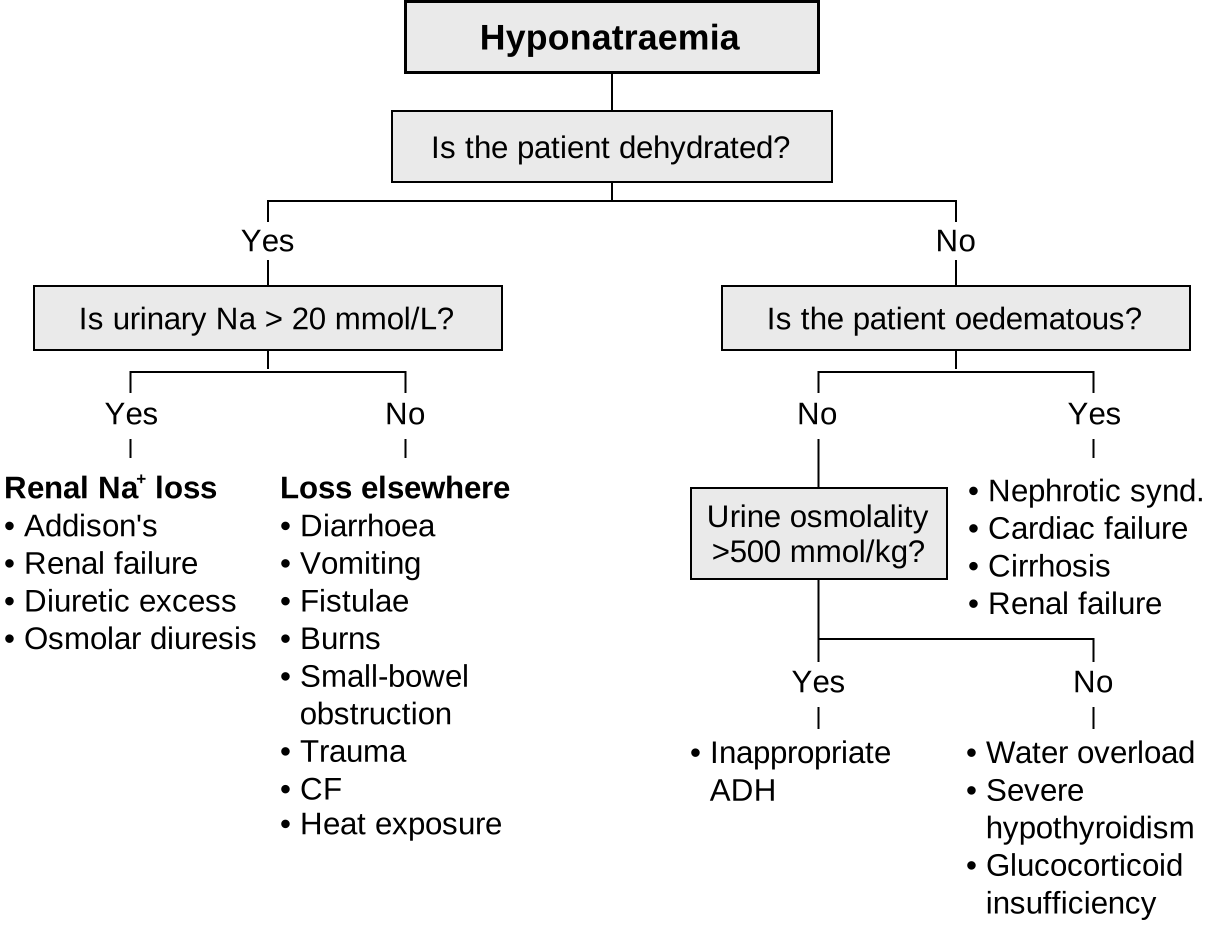
Symptoms track with the severity and rate of the fall. Chronic, mild hyponatremia is often asymptomatic; a rapid drop causes cerebral edema — nausea, headache, lethargy, confusion, seizures, coma. The boards want a fixed, stepwise workup before you treat: (1) serum osmolality, (2) volume status, (3) urine osmolality and urine sodium.
- Definition: Na⁺ < 135; severe usually < 120 or symptomatic.
- Step 1 — Serum osmolality. Isotonic/normal (275–295) = pseudohyponatremia (severe hyperlipidemia, hyperproteinemia/paraproteins). Hypertonic (> 295) = hyperglycemia or mannitol pulling water out — correct Na⁺ up ~1.6–2.4 mEq/L per 100 mg/dL glucose above 100. Hypotonic (< 275) = true hyponatremia → keep going.
- Step 2 — Volume status (exam!): hypovolemic, euvolemic, or hypervolemic.
- Step 3 — Urine osm + urine Na⁺. Urine osm < 100 = ADH appropriately off → primary polydipsia, beer potomania/low-solute intake. Urine osm > 100 = ADH on. Urine Na⁺ < 25 = renal Na⁺ avidity (true hypovolemia, CHF, cirrhosis). Urine Na⁺ > 30–40 = SIADH, diuretics, adrenal insufficiency, salt wasting.
- SIADH lab signature: euvolemic + urine osm > 100 + urine Na⁺ > 30 + low uric acid (< 4) + low BUN.
- Golden rule: don't raise Na⁺ faster than ~6–8 mEq/L in 24 h → osmotic demyelination risk.
Hypotonic hyponatremia by volume status
| Volume status | Urine Na⁺ | Classic causes | First-line management |
|---|---|---|---|
| Hypovolemic | < 25 (renal losses > 25) | GI/skin losses, thiazides, adrenal insufficiency, cerebral salt wasting | Isotonic 0.9% saline (restores volume → ADH shuts off) |
| Euvolemic | > 30 | SIADH, hypothyroidism, glucocorticoid deficiency, primary polydipsia (urine osm < 100) | Treat cause; fluid restriction (SIADH) |
| Hypervolemic | < 25 (CHF, cirrhosis); > 25 in renal failure | CHF, cirrhosis, nephrotic syndrome, renal failure | Water + Na⁺ restriction, loop diuretic, treat underlying disease |
Buzzwords: small cell lung cancer, subarachnoid hemorrhage / head trauma, pneumonia or TB, recent SSRI or carbamazepine, post-op pain/nausea. Labs: euvolemic patient, Na⁺ 122, serum osm 258, urine osm 480, urine Na⁺ 55, low uric acid.
Next best step:
- Confirm euvolemia and exclude mimics — check TSH and AM cortisol (SIADH is a diagnosis of exclusion; can't have hypothyroidism, adrenal insufficiency, or diuretic use).
- Asymptomatic / chronic SIADH → fluid restriction first-line (add oral salt tablets ± loop diuretic; vaptans or urea if refractory).
- Severe symptoms (seizure, coma) → 3% hypertonic saline immediately, regardless of chronicity.
Trap: giving normal saline to a true SIADH patient (especially with high urine osm) can worsen Na⁺ — the kidney keeps the water and excretes the salt.
Four cause buckets:
- CNS: stroke, hemorrhage, tumor, meningitis/encephalitis, trauma.
- Pulmonary: small cell lung carcinoma (ectopic ADH), pneumonia, TB.
- Drugs: SSRIs, carbamazepine/oxcarbazepine, cyclophosphamide, NSAIDs, MDMA ("ecstasy"), desmopressin.
- Pain, nausea, and the post-operative state (potent ADH stimuli).
Diagnostic criteria: hypotonic plasma (osm < 275) with inappropriately concentrated urine (osm > 100), euvolemia, urine Na⁺ > 30, and normal thyroid & adrenal function, no diuretics. Supportive: low serum uric acid and low BUN.
Match the vignette to the next best step:
- Elderly woman started on HCTZ 1–2 weeks ago, Na⁺ 124 → thiazide-induced hyponatremia (impairs urinary dilution). Next: stop the thiazide.
- Heavy beer drinker or "tea-and-toast" elder, urine osm < 100 → beer potomania / low-solute intake (too few osmoles to excrete free water). Next: resume normal protein/solute diet — but expect rapid autocorrection → overcorrection risk.
- Psychiatric patient drinking liters of water, dilute urine (osm < 100) → primary (psychogenic) polydipsia. Next: water restriction.
- Marathon runner collapses after over-drinking water → exercise-associated hyponatremia; if seizing → 3% hypertonic saline, never hypotonic fluids.
Management: rate is everything
Split every patient into acute-symptomatic vs chronic-asymptomatic.
Severe symptoms (seizures, obtundation, coma) are an emergency regardless of chronicity: give 3% hypertonic saline as a 100–150 mL bolus (may repeat), aiming to raise Na⁺ by only 4–6 mEq/L to reverse cerebral edema — you are treating the brain, not chasing a normal number.
Chronic/asymptomatic: correct the underlying cause and go slow. Ceiling is ~6–8 mEq/L per 24 h (use the stricter ≤ 6 mEq/L in high-risk patients: alcoholism, malnutrition, hypokalemia, advanced liver disease, or Na⁺ < 105). If you overcorrect, the rescue is DDAVP + free water (D5W) to re-lower Na⁺ back into the safe range.
"From low to high, the pons will die; from high to low, the brains will blow."
- Low → high too fast (over-correcting hyponatremia) → osmotic demyelination syndrome / central pontine myelinolysis.
- High → low too fast (over-correcting hypernatremia) → cerebral edema.
ODS clinical picture: neurologic symptoms appear 2–6 days later (deceptive delay) — dysarthria, dysphagia, spastic quadriparesis, "locked-in" syndrome — and are often irreversible. This is why the correction limit exists.

- Hyperglycemia first: always correct measured Na⁺ for glucose before calling it "true" hyponatremia — it may be normal.
- SIADH vs cerebral salt wasting (both after CNS injury): near-identical urine chemistries — volume status is the tiebreaker. SIADH = euvolemic → fluid restrict; CSW = hypovolemic → give salt + volume. Getting this backwards harms the patient.
- Anticipate overcorrection in hypovolemic hyponatremia, beer potomania, and psychogenic polydipsia: once you give saline/solute or remove the water stimulus, ADH switches off and the kidney dumps free water → Na⁺ can shoot up fast. Watch urine output; pre-empt with a DDAVP clamp when risk is high.
- Don't give hypotonic fluids to a hyponatremic patient.
Practice Internal Medicine now
Board-style questions, spaced-repetition flashcards, and a Socratic AI tutor — free to start.