Approach to Chest Pain
A board-style approach to chest pain that rules out the six immediate killers first — anchored on the 10-minute ECG — then drills the buzzword-to-next-step decisions for ACS, aortic dissection, PE, cardiac tamponade, and their common mimics.
Rule Out the Killers First
Chest pain is a rule-out-the-killers-first presentation. Before settling on a benign cause, exclude the immediately life-threatening diagnoses: acute coronary syndrome (ACS), aortic dissection, pulmonary embolism (PE), tension pneumothorax, cardiac tamponade, and esophageal rupture (Boerhaave). The single most important first action in any undifferentiated adult with chest pain is a 12-lead ECG within 10 minutes of arrival, along with vital signs (including bilateral arm BP) and IV access; troponin is drawn but never delays the ECG. On the boards, the vignette hands you one discriminating clue — tearing pain radiating to the back, pleuritic pain after a long flight, pain relieved by leaning forward — and the tested skill is matching that clue to the next best step in diagnosis or management, not reciting pathophysiology.
- ECG in ≤10 min for every adult with nontraumatic chest pain — it triages the six killers
- ACS/STEMI: pressure pain + diaphoresis ± arm/jaw radiation; ST elevation in ≥2 contiguous leads → emergent reperfusion; aspirin carries the mortality benefit
- Aortic dissection: tearing pain to the back, inter-arm BP differential, widened mediastinum on CXR → CT angiography if stable
- PE: pleuritic pain + dyspnea + tachycardia with risk factors (immobility, malignancy, estrogen) → Wells score, then CTPA
- Tension pneumothorax: hypotension, tracheal deviation, absent breath sounds → needle decompression BEFORE imaging (clinical diagnosis)
- Cardiac tamponade: Beck's triad (hypotension, JVD, muffled heart sounds) + pulsus paradoxus; low-voltage/electrical alternans → echo → pericardiocentesis
- Boerhaave: severe pain after forceful vomiting + subcutaneous emphysema → CT or water-soluble contrast esophagram
- Mimics — pericarditis (positional pain, friction rub, diffuse ST elevation + PR depression) and GERD/costochondritis: never assign before the cardiovascular killers are cleared
Major Causes at a Glance
| Cause | Buzzword clue | Best test | Key management |
|---|---|---|---|
| STEMI | Crushing substernal pain, diaphoresis, ST elevation | ECG + troponin | Aspirin + PCI ≤90 min (fibrinolysis if unavailable) |
| NSTEMI / UA | ST depression or T-wave inversion, ± troponin | ECG + serial troponin | Antiplatelet + anticoagulation; early invasive if high risk |
| Aortic dissection | Tearing pain to back, unequal arm BP | CT angiography (TEE if unstable) | Type A → surgery; Type B → IV beta-blocker |
| PE | Pleuritic pain, dyspnea, DVT risk | CTPA (D-dimer if low probability) | Anticoagulation; thrombolysis if unstable |
| Pericarditis | Positional pleuritic pain, friction rub | ECG: diffuse ST elev + PR depression | NSAIDs + colchicine |
| Tension pneumothorax | Hypotension, tracheal shift, absent sounds | Clinical (do not delay) | Needle decompression → chest tube |
| Cardiac tamponade | Beck's triad, pulsus paradoxus, electrical alternans | Echocardiography | Pericardiocentesis (IV fluids to temporize) |
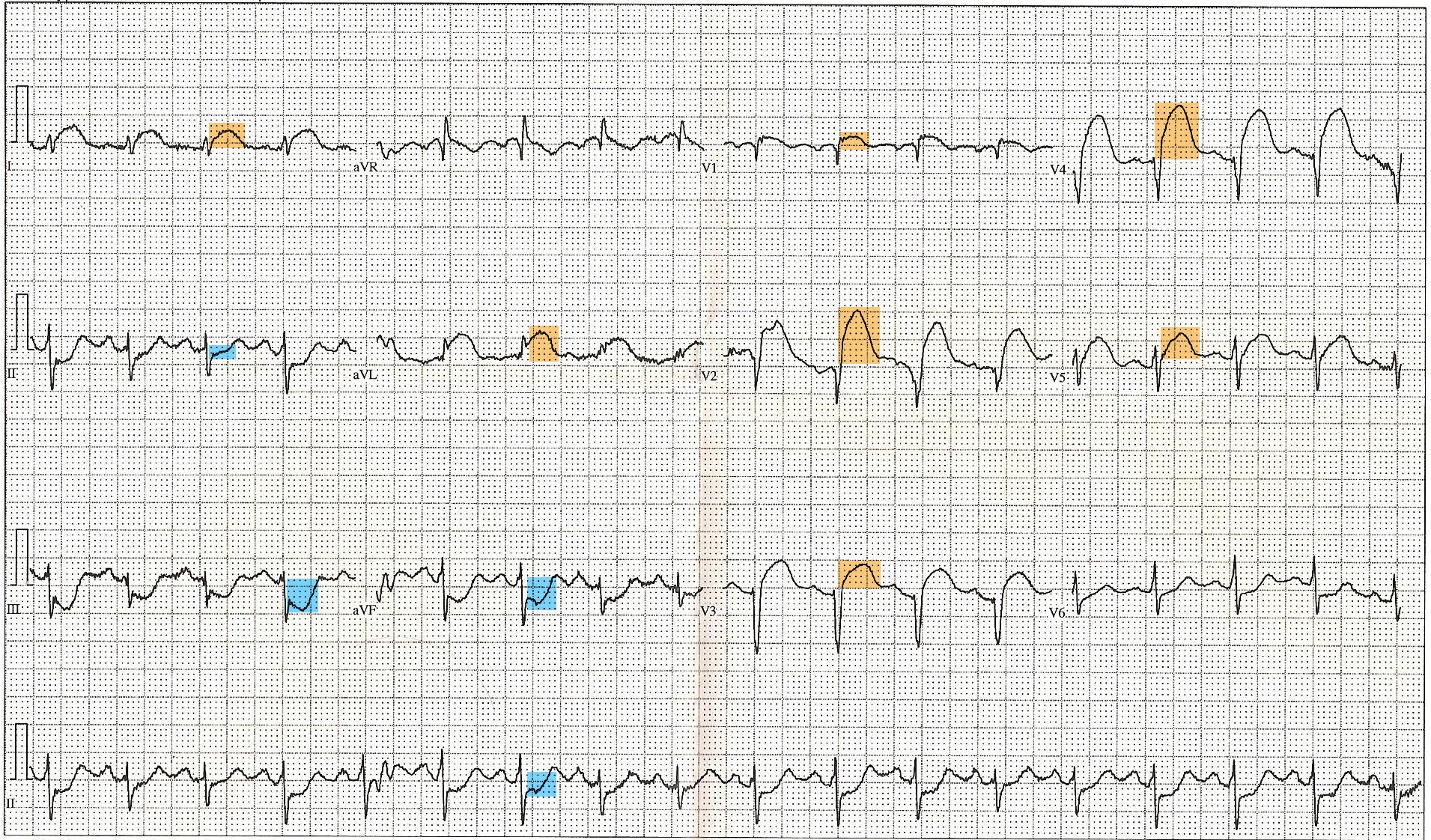
Vignette: A 58-year-old man with hypertension and a 30-pack-year smoking history has 45 minutes of crushing substernal pressure radiating to the left arm, with diaphoresis and nausea. BP 150/90, HR 98. ECG shows 2-mm ST elevation in II, III, and aVF.
Diagnosis: Acute inferior-wall STEMI (right coronary artery territory).
Next best step: Chewed aspirin 162–325 mg and activate emergent PCI (door-to-balloon ≤90 min); fibrinolysis if PCI is not available within 120 min. High-yield trap: inferior STEMI may involve the right ventricle — get right-sided leads (V4R). If RV infarct is present, the patient is preload-dependent, so avoid nitroglycerin (risk of profound hypotension) and give IV fluids instead.
Vignette: A 65-year-old man with poorly controlled hypertension develops sudden tearing chest pain radiating to the back. BP is 178/96 in the right arm and 150/84 in the left; CXR shows a widened mediastinum.
Diagnosis: Acute aortic dissection.
Next best step: If hemodynamically stable, confirm with CT angiography of the chest (TEE if unstable or cannot leave the bedside). Start IV beta-blockade first — esmolol or labetalol — targeting HR <60 and SBP 100–120, then add a vasodilator (nitroprusside) if BP is still high. Rate control before vasodilator prevents reflex tachycardia and rising aortic shear stress. Type A (ascending) → emergent surgery; Type B (descending) → medical management.

Vignette: A 44-year-old woman returns from a 10-hour flight with acute pleuritic chest pain and dyspnea. She takes combined oral contraceptives. HR 112, RR 24, SpO2 91%. Lungs are clear; the right calf is swollen and tender. ECG shows sinus tachycardia.
Diagnosis: Pulmonary embolism (provoked by immobility + estrogen).
Next best step: She is high probability by Wells criteria, so skip the D-dimer and go directly to CT pulmonary angiography; begin empiric anticoagulation (e.g., LMWH) while awaiting imaging if there is no bleeding contraindication. If she becomes hemodynamically unstable (massive PE) → systemic thrombolysis. Remember S1Q3T3 is the classic but uncommon finding; sinus tachycardia is the most frequent ECG abnormality.
MONA-B — the classic recall for initial ACS therapy. Know the modern caveats the boards now test:
- Morphine — for refractory pain only; can mask symptoms and slow oral antiplatelet absorption
- Oxygen — only if SpO2 <90%; routine oxygen in non-hypoxic patients gives no benefit
- Nitrates — for ongoing pain/hypertension; contraindicated with RV infarct, hypotension, or recent PDE-5 inhibitor (sildenafil) use
- Aspirin — 162–325 mg chewed; the step with proven mortality benefit — give to everyone without a true contraindication
- Beta-blocker — oral, within 24 h, if no heart failure, low-output state, or cardiogenic-shock risk
Order ≠ priority: aspirin plus timely reperfusion save lives; the rest are adjuncts.
Practice Internal Medicine now
Board-style questions, spaced-repetition flashcards, and a Socratic AI tutor — free to start.