Anticoagulation: Agents, Reversal & Bridging
A management-focused Step 2 CK review of anticoagulation: choosing the agent by indication (DOAC vs warfarin vs heparin), reversing life-threatening bleeds, managing suspected HIT, and deciding when peri-procedural and initiation bridging are — and are not — needed.
Overview: Match the Agent to the Situation
Anticoagulation questions on Step 2 CK are almost always management questions: which agent, how to reverse it, and whether to bridge. The choice is driven by the indication, the kidneys, and how fast you may need the drug on or off.
- Parenteral, fast on/off: unfractionated heparin (UFH, IV) and LMWH (enoxaparin, SC). Use when you need rapid onset or the ability to reverse quickly (peri-procedural, acute inpatient VTE).
- Oral, slow onset: warfarin takes ~5 days for full effect and is transiently procoagulant early (protein C falls first) — so an acute clot started on warfarin must be bridged with heparin.
- Oral, fast onset: DOACs (dabigatran, apixaban, rivaroxaban, edoxaban) act within hours, need no routine monitoring, and require no bridging.
Two hard rules anchor most vignettes: mechanical heart valves and moderate–severe (rheumatic) mitral stenosis = warfarin only (DOACs are contraindicated), and most other AF/VTE = DOAC first-line.
- Non-valvular AF or VTE: a DOAC is first-line over warfarin (less intracranial bleeding, no INR monitoring, no bridging).
- Mechanical heart valve or moderate–severe (rheumatic) mitral stenosis: warfarin only — DOACs are contraindicated (dabigatran caused more clots and bleeds in RE-ALIGN).
- Pregnancy: use LMWH — warfarin is teratogenic and DOACs are not recommended.
- Antiphospholipid syndrome (esp. triple-positive): warfarin, not a DOAC (rivaroxaban performed worse in TRAPS).
- Cancer-associated VTE: LMWH or an oral Xa inhibitor (apixaban/edoxaban/rivaroxaban) — use caution with luminal GI/GU tumors, where apixaban or LMWH is preferred over rivaroxaban/edoxaban for bleeding.
- Severe renal impairment (CrCl <30) or need for rapid reversibility: favor UFH (short-acting, protamine-reversible); warfarin and apixaban are the more renally-forgiving oral options.
- Starting warfarin for an acute clot: overlap with heparin for ≥5 days AND until INR ≥2 for 24 h before stopping the heparin.
- Suspected HIT: stop ALL heparin and start a non-heparin agent (argatroban/bivalirudin/fondaparinux); never warfarin alone and never prophylactic platelets.
- Life-threatening warfarin bleed: 4-factor PCC + IV vitamin K 10 mg (FFP only if PCC unavailable).
Agent Comparison
| Agent | Target | Route | Monitor | Reversal | Key point |
|---|---|---|---|---|---|
| UFH | IIa + Xa (via antithrombin) | IV | aPTT / anti-Xa | Protamine (full) | Fast on/off; use if CrCl <30 or reversal likely; HIT risk |
| LMWH (enoxaparin) | Xa > IIa | SC | Usually none (anti-Xa if pregnant/renal/obese) | Protamine (~partial) | Renally cleared; treatment dose 1 mg/kg SC q12h |
| Fondaparinux | Xa only | SC | None | No specific antidote | Option in HIT; avoid if CrCl <30 |
| Warfarin | II, VII, IX, X (+ protein C, S) | PO | INR (goal 2–3) | Vitamin K + 4F-PCC | Slow onset → needs bridge; teratogen; many drug/diet interactions |
| Dabigatran | IIa (direct thrombin) | PO | None | Idarucizumab | Renally cleared |
| Xa DOACs (apixaban / rivaroxaban / edoxaban) | Xa (direct) | PO | None | Andexanet alfa (or 4F-PCC) | Apixaban safest in renal disease; no bridging needed |
A 72-year-old man on warfarin for atrial fibrillation presents with melena, HR 118, BP 84/50. INR is 6.8.
Next best step: resuscitate, hold warfarin, and give 4-factor prothrombin complex concentrate (PCC) PLUS IV vitamin K 10 mg.
- 4F-PCC replaces factors II, VII, IX, X immediately and in a small volume — faster and more reliable than FFP, and it avoids volume overload.
- IV vitamin K is co-administered because PCC's effect is transient; vitamin K provides durable correction.
- Vitamin K alone is too slow for a hemorrhaging patient. FFP is second-line (only if PCC is unavailable).
- Contrast: INR elevated with no/minor bleeding → just hold warfarin ± oral vitamin K (give oral vitamin K when INR >10 without bleeding; for INR 4.5–10 without bleeding, simply hold). Do not reflexively give PCC or FFP.
Reversal Quick Reference
| Anticoagulant | First-line reversal |
|---|---|
| UFH | Protamine sulfate |
| LMWH | Protamine (partial neutralization) |
| Warfarin — major/life-threatening bleed | 4-factor PCC + IV vitamin K 10 mg |
| Warfarin — high INR, no/minor bleed | Hold ± oral vitamin K (FFP not indicated) |
| Dabigatran | Idarucizumab 5 g IV |
| Apixaban / rivaroxaban / edoxaban | Andexanet alfa (4F-PCC if andexanet unavailable) |
| Fondaparinux | No specific antidote (consider 4F-PCC) |
A patient on prophylactic UFH since surgery has a platelet drop from 250 → 85 (>50% fall) on post-op day 6, plus a new DVT.
Next best step: STOP all heparin (including LMWH and line flushes) and start a non-heparin anticoagulant — argatroban (a direct thrombin inhibitor; hepatically cleared, so favored in renal failure). Bivalirudin or fondaparinux are alternatives. Send a HIT antibody (anti-PF4/heparin) assay, confirmed by serotonin release assay.
- Do NOT start warfarin during acute HIT — depleting protein C while patients are prothrombotic risks venous limb gangrene / skin necrosis. Only transition to warfarin once platelets recover (>150k), with ≥5-day overlap on the non-heparin agent.
- Do NOT transfuse platelets prophylactically (adds fuel to thrombosis).
- Score clinical probability with the 4 T's (Thrombocytopenia, Timing 5–10 days, Thrombosis, no oTher cause).
Bridging: Two Different Questions
"Bridging" means two distinct things — don't conflate them.
1. Initiation bridging. When starting warfarin for an acute clot (VTE, or high-risk AF), overlap with heparin/LMWH because warfarin is slow and transiently procoagulant. Continue the heparin for at least 5 days AND until the INR has been ≥2 for 24 hours, then stop it. DOACs need no initiation bridge (some, like apixaban/rivaroxaban, are simply started at a higher lead-in dose).
2. Peri-procedural bridging. For a patient already on warfarin who must stop it for surgery. The BRIDGE trial showed that for atrial fibrillation, LMWH bridging did not reduce arterial thromboembolism and more than doubled major bleeding (3.2% vs 1.3%) — so most AF patients do NOT need bridging. Reserve bridging for high thrombotic risk: mechanical mitral valve, mechanical valve with additional risk factors, recent (<3 months) VTE or stroke/TIA, or prior clot during a previous interruption. DOACs are not bridged — their short half-life means you simply hold them 1–2 days pre-op (longer if renal impairment or a high bleeding-risk procedure).
A 68-year-old woman on warfarin for AF (CHA₂DS₂-VASc 3) needs an elective colonoscopy with anticipated polypectomy.
Next best step: Stop warfarin ~5 days before the procedure, confirm the INR has normalized on the day of surgery, and resume warfarin afterward — do NOT bridge with LMWH. For non-valvular AF, bridging only increases bleeding without preventing stroke.
Contrast — when you WOULD bridge: the same patient with a mechanical mitral valve (or a recent VTE <3 months). Stop warfarin ~5 days out; start therapeutic LMWH once the INR falls below target; give the last LMWH dose ~24 h before surgery; resume post-op once hemostasis is secure.
If she were on a DOAC instead: no bridge — just hold it for the appropriate interval (per renal function and procedural bleeding risk) and restart when hemostasis allows.
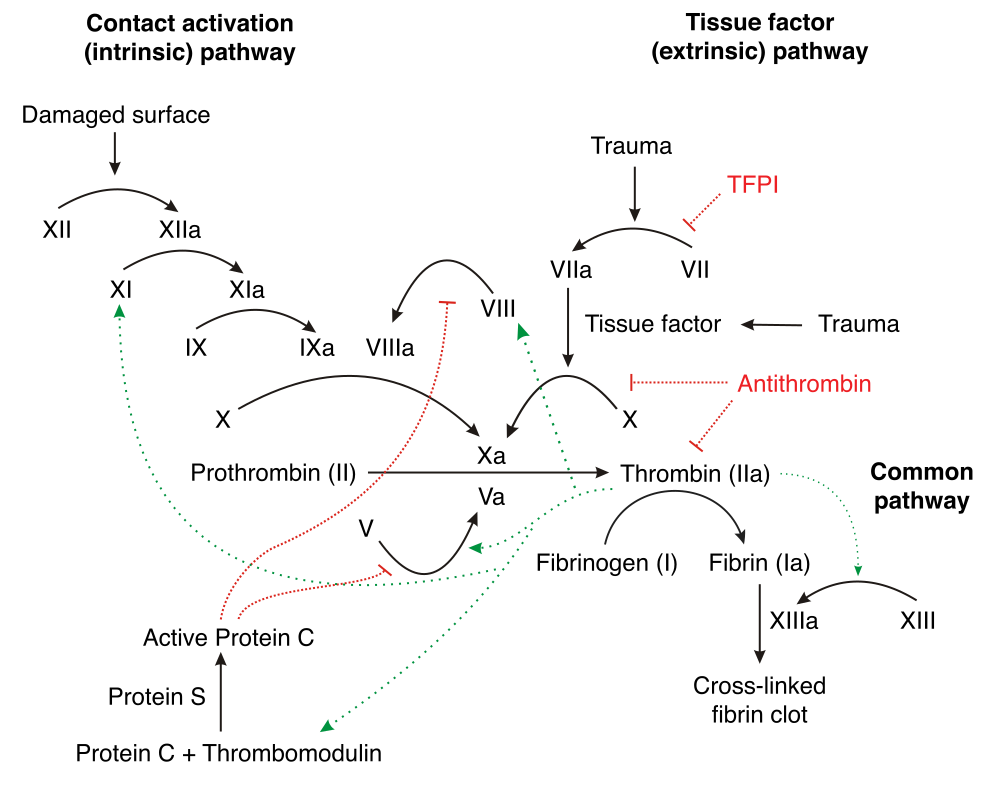
- Vitamin K–dependent factors warfarin depletes → II, VII, IX, X (i.e., factors 2, 7, 9, 10), plus the anticoagulant proteins C & S. Protein C's short half-life means it falls first, so warfarin is transiently procoagulant early — the rationale for heparin bridging and the cause of rare warfarin skin necrosis.
- HIT "4 T's" → Thrombocytopenia, Timing (5–10 days), Thrombosis, no oTher cause.
- Which lab, which drug: "Play Table-Tennis inside" = aPTT → Heparin (intrinsic pathway); "Play Tennis outside" = PT/INR → Warfarin (extrinsic pathway).
Practice Clinical Management now
Board-style questions, spaced-repetition flashcards, and a Socratic AI tutor — free to start.