Acid–Base Disorders: A Systematic Approach
A five-step algorithm for reading any ABG — pH, primary driver, anion gap, compensation (Winter's), then the delta gap — packaged with the formulas, MUDPILES/HARDASS mnemonics, and the mixed-disorder vignettes (DKA, salicylates, vomiting) that Step 1 and CK reward.
Read every gas the same way
Acid–base interpretation is a fixed algorithm, not pattern-matching. By Henderson–Hasselbalch (pH tracks HCO3⁻ / PaCO2), every derangement is either metabolic (the HCO3⁻ numerator, kidney-controlled) or respiratory (the PaCO2 denominator, lung-controlled). Lungs compensate in minutes; kidneys take 3–5 days to fully compensate. Run the same five steps every time so you never miss the mixed disorders boards bury in the numbers:
- pH — acidemia (<7.35) or alkalemia (>7.45)? This names the primary process, even when partly compensated.
- Driver — compare pH and PaCO2: moving in opposite directions = primary respiratory (pH↓/PaCO2↑ = respiratory acidosis; pH↑/PaCO2↓ = respiratory alkalosis); moving the same direction = primary metabolic, with HCO3⁻ tracking the pH (both ↓ = metabolic acidosis).
- Anion gap — always compute it: AG = Na⁺ − (Cl⁻ + HCO3⁻).
- Compensation — is it appropriate (Winter's, etc.)? Too much or too little means a second disorder.
- Delta gap — in a high-AG acidosis, this unmasks a coexisting normal-AG acidosis or metabolic alkalosis.
- Normal: pH 7.35–7.45 · PaCO2 35–45 mmHg · HCO3⁻ 22–26 mEq/L · anion gap 8–12 mEq/L
- Winter's formula (metabolic acidosis): expected PaCO2 = 1.5 × HCO3⁻ + 8 ± 2. Measured > expected → added respiratory acidosis; < expected → added respiratory alkalosis.
- Compensation rarely normalizes pH — the lone exception is chronic respiratory alkalosis. A normal pH with abnormal PaCO2 and HCO3⁻ = a mixed disorder.
- Correct the AG for albumin: add ~2.5 mEq/L to the gap per 1 g/dL of albumin below 4 — hypoalbuminemia hides a real gap.
- Compensation is a reflex, never an overshoot: the lung/kidney never push pH across normal to the opposite side.
The four primary disorders
| Disorder | pH | Primary change | Compensatory response |
|---|---|---|---|
| Metabolic acidosis | ↓ | ↓ HCO3⁻ | ↓ PaCO2 (hyperventilate) |
| Metabolic alkalosis | ↑ | ↑ HCO3⁻ | ↑ PaCO2 (hypoventilate) |
| Respiratory acidosis | ↓ | ↑ PaCO2 | ↑ HCO3⁻ (renal, slow) |
| Respiratory alkalosis | ↑ | ↓ PaCO2 | ↓ HCO3⁻ (renal, slow) |

Is the compensation appropriate?
| Primary disorder | Expected compensation |
|---|---|
| Metabolic acidosis | PaCO2 = 1.5 × HCO3⁻ + 8 ± 2 (Winter's) |
| Metabolic alkalosis | PaCO2 ↑ ~0.7 mmHg per 1 mEq/L ↑ HCO3⁻ |
| Acute respiratory acidosis | HCO3⁻ ↑ 1 per 10 mmHg ↑ PaCO2 |
| Chronic respiratory acidosis | HCO3⁻ ↑ 3.5–4 per 10 mmHg ↑ PaCO2 |
| Acute respiratory alkalosis | HCO3⁻ ↓ 2 per 10 mmHg ↓ PaCO2 |
| Chronic respiratory alkalosis | HCO3⁻ ↓ 4–5 per 10 mmHg ↓ PaCO2 |
Anion gap, delta gap, urine gap
A high-AG acidosis means unmeasured acid anions have accumulated; a normal-AG (hyperchloremic) acidosis means HCO3⁻ was lost and Cl⁻ rose to fill the space.
Delta ratio = (measured AG − 12) / (24 − measured HCO3⁻) — run it on every high-AG acidosis:
- < 1 → also a coexisting normal-AG metabolic acidosis
- 1–2 → pure high-AG metabolic acidosis
- > 2 → also a metabolic alkalosis (or a chronic respiratory acidosis raising baseline HCO3⁻)
For a normal-AG acidosis, the urine anion gap (Na⁺ + K⁺ − Cl⁻) localizes the cause:
- Negative ('neGUTive') → GI HCO3⁻ loss (diarrhea); the kidney is appropriately excreting NH4Cl (unmeasured NH4⁺ drives Cl⁻ up).
- Positive → a renal defect (renal tubular acidosis) — impaired NH4⁺ excretion.
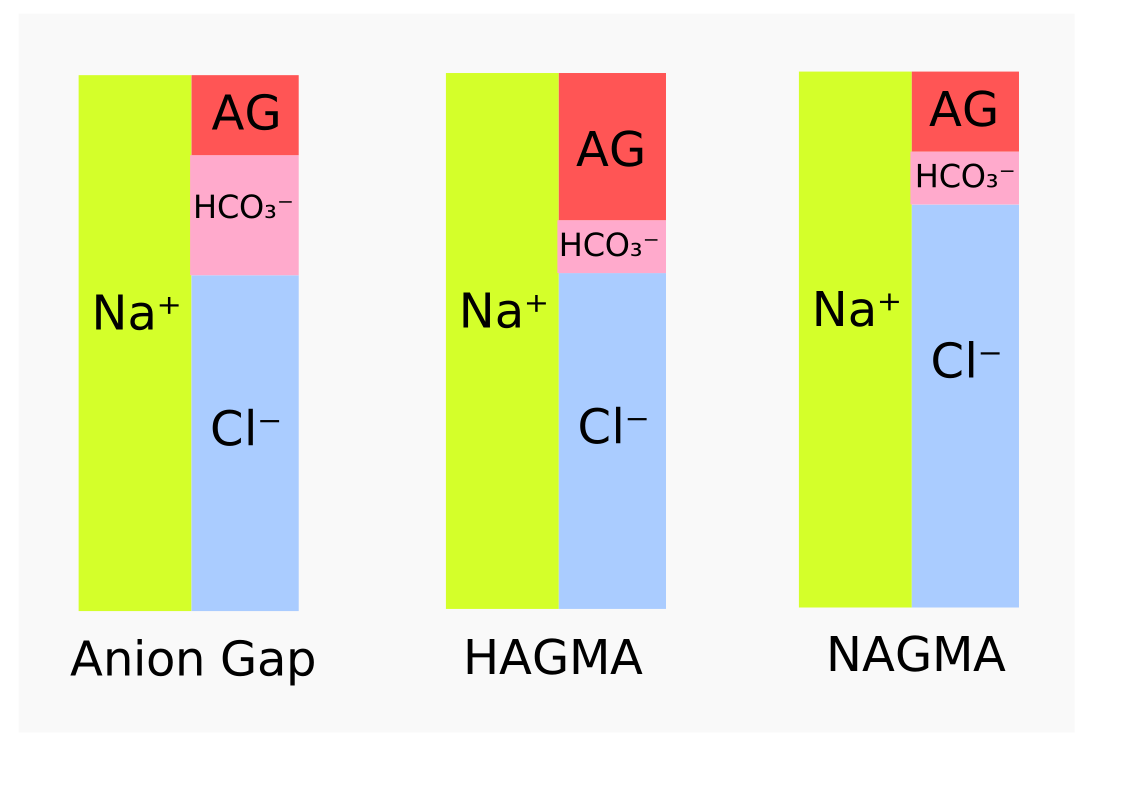
High anion gap — MUDPILES
- Methanol (and Metformin — via lactate)
- Uremia
- DKA (also alcoholic/starvation ketoacidosis)
- Propylene glycol / Paraldehyde
- Isoniazid / Iron
- Lactic acidosis
- Ethylene glycol
- Salicylates
*(Modern equivalent — GOLD MARK: Glycols, Oxoproline, L-lactate, D-lactate, Methanol, Aspirin, Renal failure, Ketoacidosis.)*
Normal anion gap — HARDASS
- Hyperalimentation (TPN)
- Addison disease
- Renal tubular acidosis
- Diarrhea
- Acetazolamide
- Spironolactone
- Saline (large-volume NS)
- DKA: young type 1 diabetic, fruity breath, Kussmaul (deep, rapid) respirations → high-AG acidosis with Winter's-appropriate respiratory compensation. Serum K⁺ reads normal/high but total-body K⁺ is depleted and falls once insulin starts — replete K⁺ before/with insulin if it is low.
- Salicylate toxicity: adult with tinnitus, hyperventilation, and fever → the classic mixed primary respiratory alkalosis + high-AG metabolic acidosis (pH is often near-normal). Next step: alkalinize the urine with sodium bicarbonate (ion trapping); dialysis if severe.
- Vomiting / NG suction: hypochloremic, hypokalemic metabolic alkalosis; urine Cl⁻ < 20 = saline-responsive → treat with normal saline + KCl.
- COPD retainer: chronic respiratory acidosis with a compensatory high HCO3⁻ (pH often near-normal). Over-oxygenating can raise PaCO2 — mostly via worsened V/Q matching (release of hypoxic pulmonary vasoconstriction) and the Haldane effect, with blunted respiratory drive a lesser factor — so titrate O2 to an SpO2 of ~88–92% rather than withholding it.
- Diarrhea: normal-AG acidosis with a negative urine anion gap.
- Respiratory alkalosis: anxiety/panic, PE, high altitude, pregnancy, early salicylates, sepsis → perioral/digital paresthesias, carpopedal spasm (from a fall in ionized calcium).
- A near-normal pH with both PaCO2 and HCO3⁻ deranged = a mixed disorder until proven otherwise.
- If PaCO2 and HCO3⁻ move in opposite directions (one up, one down), there are two primary disorders — in any simple disorder, primary and compensation move them the same way.
- Salicylates are the boards' signature mix: respiratory alkalosis + high-AG metabolic acidosis.
- Triple disorder classic — the vomiting alcoholic with pancreatitis: high-AG acidosis (lactate/ketones) + metabolic alkalosis (vomiting) + respiratory alkalosis (pain/sepsis); the delta gap is what exposes the hidden alkalosis.
- Metabolic alkalosis workup = urine chloride: < 20 saline-responsive (vomiting, prior diuretics, post-hypercapnia); > 20 saline-resistant (hyperaldosteronism, Cushing, Bartter/Gitelman).
Practice Renal now
Board-style questions, spaced-repetition flashcards, and a Socratic AI tutor — free to start.